
-
Welcome to Photrio!Registration is fast and free. Join today to unlock search, see fewer ads, and access all forum features.Click here to sign up
You are using an out of date browser. It may not display this or other websites correctly.
You should upgrade or use an alternative browser.
You should upgrade or use an alternative browser.
What enlarger(s) do you own/use?
-
A
- Thread starter henryyjjames
- Start date
Recent Classifieds
-
Want to Buy Widelux
- Started by Jeff Bennett
-
Sold ULF Camera 7X11, 8X10 Eastman Improved #2
- Started by jimgalli
-
Want to Buy Workhorse Canon F-1
- Started by BHuij
-
Want to Buy Gossen Multibeam Spot Attachment
- Started by Srahimian24
-
For Sale Canon Strap and Canon battery magazine BGM-E2(unused)
- Started by absalom1951
Forum statistics
- Threads
- 203,541
- Messages
- 2,856,305
- Members
- 101,895
- Latest member
- SryImBadAtNaming
- Recent bookmarks
- 0

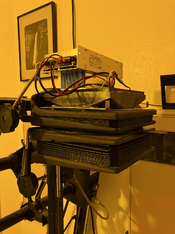
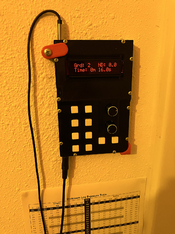
Forgive the yellowness, I use a bug light as my "main" light in the darkroom and leave only the red lights on when I'm not doing alt processes that can handle the yellow. There's no "proper" light source in the room anywhere haha.
First shot is the head. It leans hard into the "Borg" aesthetic. From bottom to top you can see the bellows, the head itself (black 3D printed bit sitting on top of the top bellows), then a big ol' heatsink, and finally the power supply unit on top of that. It uses 256 neopixel LEDs and a diffuser plate cannibalized from a Zone VI cold light head.
Second picture is the custom control panel. It runs on a Pico RP2040 microcontroller that I programmed in CircuitPython. The cord coming into the top is power from the power supply as well as data out for actually controlling the lights. The cord on the bottom goes to my foot pedal. Buttons are for controlling exposure time (in minutes, seconds, stops, or 1/12 stops), the two on the right are for activating compose/focus mode (all LEDs at 100% brightness on R, G, and B channels), and the far right button is the same as the foot pedal, just a "start exposure" button. Top knob controls contrast grade in 1/2 grade increments from 00 to 5. Bottom knob control "neutral density" (really just selective dimming of LEDs) in 1/3 stops from 0 to 5 stops.
It was a really fun project to put together, and it's a real joy to use. So much easier than messing around with that heavy condenser head and giant filters in and out of the tray.
View attachment 326210View attachment 326211
Forgive the yellowness, I use a bug light as my "main" light in the darkroom and leave only the red lights on when I'm not doing alt processes that can handle the yellow. There's no "proper" light source in the room anywhere haha.
First shot is the head. It leans hard into the "Borg" aesthetic. From bottom to top you can see the bellows, the head itself (black 3D printed bit sitting on top of the top bellows), then a big ol' heatsink, and finally the power supply unit on top of that. It uses 256 neopixel LEDs and a diffuser plate cannibalized from a Zone VI cold light head.
Second picture is the custom control panel. It runs on a Pico RP2040 microcontroller that I programmed in CircuitPython. The cord coming into the top is power from the power supply as well as data out for actually controlling the lights. The cord on the bottom goes to my foot pedal. Buttons are for controlling exposure time (in minutes, seconds, stops, or 1/12 stops), the two on the right are for activating compose/focus mode (all LEDs at 100% brightness on R, G, and B channels), and the far right button is the same as the foot pedal, just a "start exposure" button. Top knob controls contrast grade in 1/2 grade increments from 00 to 5. Bottom knob control "neutral density" (really just selective dimming of LEDs) in 1/3 stops from 0 to 5 stops.
It was a really fun project to put together, and it's a real joy to use. So much easier than messing around with that heavy condenser head and giant filters in and out of the tray.
Nice. I admire your electronics and programming skills. It does look a bit sci-fi.


Durst 138G and Omega D3


Durst 138G and Omega D3
View attachment 326214
When I lived in France I had the 138 and 184 both with condensers.
Fantastic beasts. Only the 138 followed me to LA and I got away with it at some point.
These bulbs were so hard to find.
I like the howitzer feel of it
albada
Member
View attachment 326210View attachment 326211
Forgive the yellowness, I use a bug light as my "main" light in the darkroom and leave only the red lights on when I'm not doing alt processes that can handle the yellow. There's no "proper" light source in the room anywhere haha.
First shot is the head. It leans hard into the "Borg" aesthetic. From bottom to top you can see the bellows, the head itself (black 3D printed bit sitting on top of the top bellows), then a big ol' heatsink, and finally the power supply unit on top of that. It uses 256 neopixel LEDs and a diffuser plate cannibalized from a Zone VI cold light head.
Second picture is the custom control panel. It runs on a Pico RP2040 microcontroller that I programmed in CircuitPython. The cord coming into the top is power from the power supply as well as data out for actually controlling the lights. The cord on the bottom goes to my foot pedal. Buttons are for controlling exposure time (in minutes, seconds, stops, or 1/12 stops), the two on the right are for activating compose/focus mode (all LEDs at 100% brightness on R, G, and B channels), and the far right button is the same as the foot pedal, just a "start exposure" button. Top knob controls contrast grade in 1/2 grade increments from 00 to 5. Bottom knob control "neutral density" (really just selective dimming of LEDs) in 1/3 stops from 0 to 5 stops.
It was a really fun project to put together, and it's a real joy to use. So much easier than messing around with that heavy condenser head and giant filters in and out of the tray.
Nice work.
This is the kind of electronics that manufacturers of enlargers would have offered had digital not halted their engineering. For example, you have a knob that sets grade -- that's a big step forward from the dinosaur technology of a tungsten bulb plus contrast-filters.
Mark
Nice work.
This is the kind of electronics that manufacturers of enlargers would have offered had digital not halted their engineering. For example, you have a knob that sets grade -- that's a big step forward from the dinosaur technology of a tungsten bulb plus contrast-filters.
Mark
There's a fellow from Denmark that sells 8x10 conversion kits. I put one on my Durst Laborator 138. Not only does it give me the ability to enlarge 8x10 but converts the enlarger to LED. I am probably going to buy an Intrepid 4x5 enlarger and use it to replace the dichro head on my Laborator 1000. A Heiland LED head is $1500 for the L1000. I guess what I am saying is I am not sure you have to build your own anymore. The 8x10 Conversion kit cost $800. The Intrepid light source is under $500. I am impressed by anyone who can build their own! Some of these bulbs (like those for the L138) are rare as hen's teeth and cost more than the whole shebang from Intrepid. We need to support these boutique businesses; they have been wonderful supporting our hobby.
There's a fellow from Denmark that sells 8x10 conversion kits. I put one on my Durst Laborator 138. Not only does it give me the ability to enlarge 8x10 but converts the enlarger to LED. I am probably going to buy an Intrepid 4x5 enlarger and use it to replace the dichro head on my Laborator 1000. A Heiland LED head is $1500 for the L1000. I guess what I am saying is I am not sure you have to build your own anymore. The 8x10 Conversion kit cost $800. The Intrepid light source is under $500. I am impressed by anyone who can build their own! Some of these bulbs (like those for the L138) are rare as hen's teeth and cost more than the whole shebang from Intrepid. We need to support these boutique businesses; they have been wonderful supporting our hobby.
Fully agree !

Beseler 45V-XL with an Oriental VC-CLS variable contrast cold light head.
Like a lot of impoverished Europeans, I own a Meopta Opemus. It's good for up to 6x6 and is fitted with the corresponding colour head. Wish my daughter would clear enough rubbish out of my "darkroom" to enable me to use it. It uses a pair of Minolta CE's - a 50mm f2.8 and an 80 mm f5.6

Another thing common to a lot of impoverished Europeans. At least, I have daughter rubbish, but not in my darkroom. That's sacred.Wish my daughter would clear enough rubbish out of my "darkroom" to enable me to use it.

Guivd
Subscriber
Good old Durst Laborator 1000 for 4x5 and 6x7 (bw)
A Focomat 2c and a Meopta Opemus 6 with diffuser head.
View attachment 326132
I love your space! I would like to learn more about your Focomat!
I love your space! I would like to learn more about your Focomat!
Well, the 2c version can print from 35mm up to 6x9 negs. It has a double lens turret, with a 60mm lens for 35mm negs and a 100mm lens (Focotar II) for medium format negs. Mine has the standard condenser head and filter drawer (some printers install multigrade heads, like an Ilford 500H). Thanks to its massive construction there is plenty of space to move around your easel on the baseboard (this can be a problem with enlargers that have a straight column; there are workarounds though). I can't find much else to say really, apart from the fact that it is wonderfully engineered, rock solid and a joy to use.

I have two, the LPL 4x5 with the black and white head, and the Leitz V35, which is the white one that looks like a robotic arm... and seemed so modern when it came out forty years ago.

Saunders LPL 4550 XLG
I've got the LPL as well. Great enlarger.
For large format I have two Omega D5500 and a Durst. For smaller format I have a Philips PCS150 and Minolta Mod III.
View attachment 325486View attachment 325485
I'ts been a long time since I've seen one of these Dursts. Incredible enlarger.
Omega D5-XL, with Ilford Multigrade 400 setup..
Turret with Rodenstock 80mm & Rodenstock 105mm, EL-Nikkor 150mm. Also an EL-Nikkor 50mm f2.8
Turret with Rodenstock 80mm & Rodenstock 105mm, EL-Nikkor 150mm. Also an EL-Nikkor 50mm f2.8
- Omega ProLab rigged for 20x24in from 120neg
- Omega D6 rigged for 20x24in from 4x5neg
- Omega D2 rigged for 11x14in
- Focomat 1c for small prints.
- UV burner on the right which needs to find a new home.
I think this confirms I’ll be able to go from 6x6cm negative to 20x20” print without wall mounting? Picking up a D6 this weekend, pretty relieved to see this setup!
Focomat 1C & LPL 4x5.
De Vere 108s
De Vere 504
Focomat 2c
De Vere 504
Focomat 2c

Mick Fagan
Subscriber
De Vere 108s
De Vere 504
Focomat 2c
Welcome to the forum.
Interesting that you have the 108s and the 504 DeVere enlargers, commercial enterprise?
I have a DeVere freestanding 504.
Sure beats the S**t out of the old Paterson I had!
Welcome to the forum.
Interesting that you have the 108s and the 504 DeVere enlargers, commercial enterprise?
I have a DeVere freestanding 504.
Semi commercial.
I got the 504 years ago.
I found the 108s at the end of last year.

Sirius Glass
Subscriber
Still only one: 4"x5" Chromega Dichroic II 5D-XL
| Photrio.com contains affiliate links to products. We may receive a commission for purchases made through these links. To read our full affiliate disclosure statement please click Here. |
PHOTRIO PARTNERS EQUALLY FUNDING OUR COMMUNITY:  |