• Welcome to Photrio!
    Registration is fast and free. Join today to unlock search, see fewer ads, and access all forum features.
    Click here to sign up

What do you recommend to develop Tmax 100

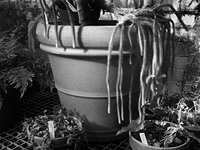
Ferns

H
Ferns

  • 0
  • 0
  • 24
between takes

H
between takes

  • Tel
  • Mar 21, 2026
  • 3
  • 0
  • 43

Recent Classifieds

Forum statistics

Threads
202,868
Messages
2,846,776
Members
101,578
Latest member
Reaton
Recent bookmarks
1
Maybe Dektol cures Covid. It seems to be the universal elixir. Anyone try it yet? Maybe Fred Picker sold it as "Zone VI Geritol".
 
Dektol is just strong D76. Go ahead, give it a try....
 
I still have a few ancient packs of Zone VI modified Dektol powder - pretty much the same thing as Dektol but with double the hydroquinone. Maybe it cures the common cold too.
 
I feel sorry for anyone who takes this advice literally! But then injecting bleach will cure a person of COVID, I hear....

For the sake of argument, let's mention that Dektol/D-72 was a "universal" developer that was meant to be used with both films and papers. Of course, it was mostly recommended for sheet film because of graininess, but it worked and Kodak gave times for it.

Not sure if it's still a good choice on modern films and smaller sizes, though.

Here's an excerpt from the 1946 Reference Handbook.


Capture d’écran, le 2024-09-30 à 18.33.59.png
 
I do use paper developer (not Dektol or D72, which I almost never have) to develop various old 4x5 ortho films. Good luck finding grain in those, by the way. I use it because I generally have it in a bottle and can just watch the film develop under safelight.

But it would probably be less than idea for Tmax.
 
For the sake of argument, let's mention that Dektol/D-72 was a "universal" developer that was meant to be used with both films and papers. Of course, it was mostly recommended for sheet film because of graininess, but it worked and Kodak gave times for it.

Not sure if it's still a good choice on modern films and smaller sizes, though.

Here's an excerpt from the 1946 Reference Handbook.


View attachment 379802

I think you can do much better nowadays
 
The bigger problem is finding usable1946 films and glass plates. Heck, that's less than 80 years ago, but older than me, so I don't know what did or didn't work well back then.
 
it's safe to assume he was asking for results people had in their real world experience.

It's also safe to assume that he got all possible meaningful responses within 12 comments.
 
The Jobo Alpha was designed for rotary processing. Can it be used for inversion developing?

Keith, yes, it can be used also for classic inversion developing. Technically no problem at all. You will also get excellent results with better detail rendition compared to HC-110, D-76, XTOL etc.
But it is not so economical, as you need much less developer in rotary processing. And the market price is based on the rotary application for which is was designed for.

Best regards,
Henning
 
It's also safe to assume that he got all possible meaningful responses within 12 comments.

...which can be summed up by: "Any currently available developer will be just fine." 🙂
 
I used to shoot a lot of this film, but over time I became unhappy with the tones and contrast I got with it. However, the best negs I got were with well-diluted Rodinal, 1+50 or more. The film has fine grain and isn't much of an issue with any developer, but Rodinal strips away the purple color (won't hurt anything, but I find it unappealing) and gives better contrast with this film than others I've tried.

What don't you like about the tones and contrast?
 
I resort to Perceptol 1:3 to increase the edge acutance of TMX100 by giving it just enough extra grain growth time. At 1:3, Perceptol behaves much differently than at the normal 1:1. Conventional development, whether in a common developer like 76 or a specialized pyro developer, will not do this. That's fine is you want a less crisp look, like for smooth complexion portraiture. TMX still holds tremendous detail. But for landscape and architectural subjects, I prefer a crisper edge rendition.

I use TMX for both general photography (in formats all the way from 4X5 to 8x10) and technical lab applications (like masking, color separations, and internegs etc). It's comfortable with many different developers; but I still need to select from among those in terms of specific application. I do have special low contrast dev tweaks for masking. But I avoid as much as possible any kind of heavy compensating or minus development in shooting situations; I'd rather add a supplemental contrast control mask than scrunch the microtonal life and sparkle out of an image via heavy-handed minus development.

Why not use Tmax 400 instead since it already has more acutance?
 
Hi Alan - I keep both TMY and TMX on hand. In sheet film version (4x5 and 8x10), TMY 400 is itself so fine-grained that it makes little difference. But in smaller roll formats TMX has a visible advantage. I often intermix 16X20 prints from 6X7 and 6X9 negs into the same portfolios as 4X5 and 8X10 shots, and the difference is less apparent when TMax100 has been used. That's not a hard rule, but does predominate. I also made a bigger buy of 4X5 and 8X10 TMX100 because I also use that for secondary purposes like unsharp masking etc, in which case it's a much better choice than TMY, because TMX was designed for those kinds of purposes to begin with.
 
Next question I have the Jobo 1520 tank with 1 reel. How much chemical should I use?
 
How much chemical should I use?

It's printed on the label on the tank; I always just read that before starting. If memory serves, I always round up to 250ml for rotation or 500ml for manual agitation. If you use a developer that has a high minimum volume requirement, you may have to take that into account as well.
 
No one else has plunked for Tmax 100 in Caffenol so I will: 15min in Caffenol CM at 20C works great. One other thing: Tmax films take A LOT out of fixer; use fresh fixer on them if possible. But if you don't develop much b+w you probably will be doing that anyway...
 
Keith, yes, it can be used also for classic inversion developing. Technically no problem at all. You will also get excellent results with better detail rendition compared to HC-110, D-76, XTOL etc.
But it is not so economical, as you need much less developer in rotary processing. And the market price is based on the rotary application for which is was designed for.

Best regards,
Henning

Thank you Henning.
The Spur Omega X developer that you mentioned is also of interest. Perhaps that would be more economical than the Jobo Alpha developer for inversion agitation.
 
Thank you Henning.
The Spur Omega X developer that you mentioned is also of interest. Perhaps that would be more economical than the Jobo Alpha developer for inversion agitation.

Price wise, Jobo Alpha still comes out on top, even on inversion tanks:
Here in Germany it's about 19EUR for 6 litres of working solution, which is about 12-20 120/135 films in my paterson tanks. So roughly speaking 1.5 to 2 EUR per roll.

Spur Omega X is 35 EUR, total working solution depends on the film, but TMX will give 4 litres (which is about in the middle of the range). So that's 8-13 films, or roughly 2.70 to 4.40 EUR per roll.
[edit: I miss calculated the Omega X mix and it actually gives ( liter total solution, which is around 1.30 to 2.20 in my tanks]

I just ordered some Spur Omega X and will try to test it with Jobo Alpha, and of course with trusty XTOL as a reference.
 
Last edited:
As far as results. I think TMax100 is a superb film. I'm sure excellent results can be had in many developers. Here's my latest in Pyrocat HD...the camera, a Perkeo ii w Color Skopar. Works for me.
IMG_8644 2.jpg
 
Price wise, Jobo Alpha still comes out on top, even on inversion tanks:
Here in Germany it's about 19EUR for 6 litres of working solution, which is about 12-20 120/135 films in my paterson tanks. So roughly speaking 1.5 to 2 EUR per roll.
Spur Omega X is 35 EUR, total working solution depends on the film, but TMX will give 4 litres (which is about in the middle of the range). So that's 8-13 films, or roughly 2.70 to 4.40 EUR per roll.

I just ordered some Spur Omega X and will try to test it with Jobo Alpha, and of course with trusty XTOL as a reference.
Thanks. I will look forward to reading your results. I have heard good things about the Jobo Alpha developer.
 
Price wise, Jobo Alpha still comes out on top, even on inversion tanks:
Here in Germany it's about 19EUR for 6 litres of working solution, which is about 12-20 120/135 films in my paterson tanks. So roughly speaking 1.5 to 2 EUR per roll.

It is priced 29,90€ in the JOBO webshop.
If you want to use it for inversion development (that was the question of Keith Tepscott), then you can develop 24 rolls of TMX with it (calculation based on usage with a JOBO 1510 tank).
That makes 1.25€ per roll.

In rotation then of course a lot less (about half), because you need only about half of the chemistry volume for rotation.

Spur Omega X is 35 EUR, total working solution depends on the film, but TMX will give 4 litres (which is about in the middle of the range). So that's 8-13 films, or roughly 2.70 to 4.40 EUR per roll.

The same calculation as above leads to a price per roll TMX for inversion development of 1.14€ per roll.

So for classic inversion development the costs for Omega X are lower.
JOBO Alpha has a clear cost advantage when used in rotary processors, for which is was designed. And the pricing is adapted to that.
 
Photrio.com contains affiliate links to products. We may receive a commission for purchases made through these links.
To read our full affiliate disclosure statement please click Here.

PHOTRIO PARTNERS EQUALLY FUNDING OUR COMMUNITY:



Ilford ADOX Freestyle Photographic Stearman Press Weldon Color Lab Blue Moon Camera & Machine
Top Bottom