• Welcome to Photrio!
    Registration is fast and free. Join today to unlock search, see fewer ads, and access all forum features.
    Click here to sign up

What Compressed Air Gun Do You Use For Lenses And Film?

Recent Classifieds

Forum statistics

Threads
202,690
Messages
2,844,292
Members
101,470
Latest member
pennyboy
Recent bookmarks
0
Doesnt anyone use a 'puffer' or sable lens brush anymore?🤔
(Just asking)
 
Last edited:
The question is, where are you blowing the dust?
 
Could draft soda beer CO2 tanks be used. They're available at Walmart pretty cheap. OF course, you have to fill them at a local gas supply company.
 
One word of advise if you go an air compressor route: Be aware of the air you are pulling in. Worked with compressors for spray painting. One compressor was near an area used for occassional mold castings. Turned out the release used for the molds would get pulled into the compressor and through the assorted filters and create a day of fisheyes in paints. Have to turn off the compressor and empty it to get rid of the contamination.

Anyway, don't pull crud air into your compressor. Garbage in, garbage out is not just in computers.
 
Could draft soda beer CO2 tanks be used. They're available at Walmart pretty cheap. OF course, you have to fill them at a local gas supply company.
I don't know what kind of fittings they have, but you ideally would want to add a regulator and an air gun/nozzle.
 
Gosh. Just get a decent small air compressor and make life easy. The cost of all those pressurized canisters can start to add up fast.

What Dan referred to as "fisheyes" in probably either lacquer or water-based finishes is due to some kind of contamination coming through the air lines - either oil or water or something else. Proper line filtration is important. And note that many junk compressors don't even have regulators. But a good compressor is a multi-purpose device that you can use for lots of things in a darkroom or shop. The compressor itself can be in a different room, which just an air line coming into the clean area of the darkroom itself.

There should be filters at both the start and end of the air hose, since contaminants can arise within the hose itself, especially if it's a junk cheapo hose.
 
Hello,

I would like to stop spending money on cans of compressed air and worrying about the occasional spritz of condensation. I do not find the hand pump rubber air blowers with the red tips useful.

Are any electronic compressed air guns safe for use on lenses, camera parts, scanner glass surfaces, and film? If so, which one do you recommend based on your experience? I am looking at a few options.

Thank you.

I use Rocket blower for lenses. Don't want to blow dust in lenses with high pressure air.

For most everything else it is a Makita compressor.

Temp%20air%20hose%20hanger%20D.D.Teoli%20Jr.%20A.C..JPG


71Y92S-3uQL._AC_SL1500_.jpg
 
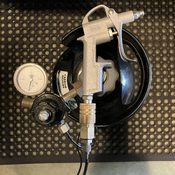
Portable air compressor for your larger negatives. 🙂
Screen Shot 2025-12-19 at 8.51.39 AM.png
 
I had something similar to this and it was very nice for blowing off negatives and blowing out small spaces. As the description says, a plastic noozle is lighter and easier to handle. Not recommended for heavier uses, but if you don't plan to be dropping it on the table regularly, it should hold up fine.


Anything pressurized from Harbor Freight should be classified in the same category as a hand grenade or land mine. (Yeah, I have seen their stuff outright blow up when dropped). Oh well, maybe they sell cheap flack jackets and combat helmets too.
 
The Kinetronics brushes lose their charge over time. I don't know if there's any convenient way to recharge them. You could try rubbing a rubber balloon across cat fur a few thousand times, or a wool glove on a piece of Plexiglas, or perhaps flying a kite in a lightning storm using a copper line. Did you lose your hair trying that, Alan?

I sometimes used the wool glove method to add a static charge to acrylic sheeting used as a mounting substrate behind Cibachrome prints, which caused them to tightly cling to the plastic behind them for up to a decade - what was called "static mounting" - smoothest method there was, yet redoable and easily reversible if needed.
 
The Kinetronics brushes lose their charge over time. I don't know if there's any convenient way to recharge them. You could try rubbing a rubber balloon across cat fur a few thousand times, or a wool glove on a piece of Plexiglas, or perhaps flying a kite in a lightning storm using a copper line. Did you lose your hair trying that, Alan?

I sometimes used the wool glove method to add a static charge to acrylic sheeting used as a mounting substrate behind Cibachrome prints, which caused them to tightly cling to the plastic behind them for up to a decade - what was called "static mounting" - smoothest method there was, yet redoable and easily reversible if needed.

Apparantly Kinteronic brushes donlt need recharging. They have a whole series of cloths, ionizers, brushes etc that are anti static dust removers. I do have less hair since I started using them, however. :wink:
 
The sheer quantity of ambient humidity cycles one of those little antistatic brushes goes through has an impact on its ability to hold a static charge. The brushes use Polonium; so never eat one. These simply weren't efficient enough at removing dust for me in the darkroom, although they might be useful in a compact field kit. I just never saw much difference between one of these and what an ordinary camel-hair "lipstick" lens brush could do.
 
I first heard of the oil problem from a friend who used to go diving using an air tank.
He told me that he'd had his tanks filled with compressed air from a local garage.
Soon realised his mistake when when he started breathing in the the smell of compressor oil, and ruined his day out diving.

It was a costly do to have the tanks thoroughly cleaned and filled by a shop that specialised in diving equipment and bottle refilling.

I admit I do not know much more than the above story, and have no technical knowledge about such things, but I would be worried about any oil deposits on my lenses or negatives.
 
Everything needs to be cleaned and purged in advance - blowguns, air fittings, hoses outside and inside. Oilless compressors aren't essential, since there are filters for that issue, but they do help.
 
Everything needs to be cleaned and purged in advance - blowguns, air fittings, hoses outside and inside. Oilless compressors aren't essential, since there are filters for that issue, but they do help.

It cannot be emphasized enough that the quality of the air delivered by the compressor is directly related the air it is pulling in plus whatever crud the compressor and hoses introduce. As you say, if you're going to use a compressor at all, filtration is a must.
 
In general other than a few little final clean puffs when loading negative carriers etc. when it comes to cleaning I prefer to remove dust rather than push or blow it around and into stuff.

So my question to you is - would you have any recommendations for a small (handheld?) “anti-static” vacuum? I’ve always been curious about them because assuming they actually work, I could potentially make a lot of use of one not only for darkroom gear but also for electronic equipment. Of course the ambient environment is important even if you’re using an ESD-safe vacuum but I’m just wondering whether it’s a reasonable idea or mostly baloney (like polonium strips on brushes…) - or if it can be worthwhile does it mean big money otherwise it’s garbage. Don’t worry,
I wouldn’t buy one from Harbor Freight, but I mean is there any middle ground for light, hobbyist use or not.

Perhaps this is one of those overdoing it things (none of the photographers I know of - no matter how fastidious - uses anything like this) but I’m still curious because of the variety of uses I might have.

EDIT: I forgot the other question - probably most important - what’s the best way to keep enlargers etc. covered when not in use? Unfortunately there was never a dedicated /properly shaped/sized cover made for my enlarger so I’ve just done with makeshift coverings but I could probably do better.


Everything needs to be cleaned and purged in advance - blowguns, air fittings, hoses outside and inside. Oilless compressors aren't essential, since there are filters for that issue, but they do help.
 
Last edited:
It cannot be emphasized enough that the quality of the air delivered by the compressor is directly related the air it is pulling in plus whatever crud the compressor and hoses introduce. As you say, if you're going to use a compressor at all, filtration is a must.

Relying on oil, water and dust filters in a compressor is playing with fire. Filters aren;t perfect even when you regularly maintain and replace them.
 
Photrio.com contains affiliate links to products. We may receive a commission for purchases made through these links.
To read our full affiliate disclosure statement please click Here.

PHOTRIO PARTNERS EQUALLY FUNDING OUR COMMUNITY:



Ilford ADOX Freestyle Photographic Stearman Press Weldon Color Lab Blue Moon Camera & Machine
Top Bottom