• Welcome to Photrio!
    Registration is fast and free. Join today to unlock search, see fewer ads, and access all forum features.
    Click here to sign up

What are you using for retouching B&W prints?

Recent Classifieds

Forum statistics

Threads
202,876
Messages
2,846,902
Members
101,539
Latest member
Grumps
Recent bookmarks
0
I have all kinds of art pencils, and wouldn't dream of using them on a glossy print. It sits on the surface, whereas a real retouching dye sinks into the emulsion and doesn't betray itself with a mismatched sheen if properly mixed. And soft pencil might transfer to the back of another matted print stacked in a portfolio box.

Spot Tone easily washes out if you just put the print back into a tray of water or into the print washer for a little while.

Once in awhile I will touch up a tiny white spot requiring deep black with a very fine point Sharpie pen. That would be a sheen mismatch too if it weren't so small an area as to not attract attention.

I've found black Sharpie pens leave a purplish hue that should be accounted for on important prints, no matter how small.
.

Cheers,

Eli
 
True. Sharpie is essentially just a tweak on shellac-based India inks. And there is really no such thing as a pure black pigment. But any purplish cast is probably more related to the driers. But "black and white" prints don't contain pure black either; there's always some kind of subtle hue cast, which often differs slightly even area to area within the same print - or perhaps rather dramatically if split toning is involved.
 
Interesting, Cliveh. But don't be surprised if I'm highly skeptical of your claim, and I have a true cleanroom setup if needed.
I support what @cliveh says, at least for 35mm enlarged 10x to 15x10 inches. How to minimise white dots on my prints has been an obsession with me. I still have to do a little spotting, but chiefly when printing old negatives. Prints from recent negatives quite often need no spotting at all.

Apologies that I can’t recommend current spotting materials, as I have never used anything but Spotone.
 
After washing negatives, dunk in deionized water for 30 seconds, twirl and agitate and the hang up to dry over 24 hours. No retouching necessary.
 
Well, your odds are somewhat better when your negative is only one and a half square inches of dust collection surface to begin with. Compare that with the greatly increased surface area of 4x5 or 8x10 film. But at least with much bigger film, needing less enlargement, any spot will appear a lot smaller. Still, I remain highly skeptical that your prints are really all that free from detectable evidence of dust or lint.
People have different standards, it seems.
 
Well, your odds are somewhat better when your negative is only one and a half square inches of dust collection surface to begin with. Compare that with the greatly increased surface area of 4x5 or 8x10 film. But at least with much bigger film, needing less enlargement, any spot will appear a lot smaller. Still, I remain highly skeptical that your prints are really all that free from detectable evidence of dust or lint.
People have different standards, it seems.

No wetting agent, no photoflow, just deionized water after wash and drying over 24 hours in ambient temperature. Try it and report back.
 
I have all kinds of art pencils, and wouldn't dream of using them on a glossy print. It sits on the surface, whereas a real retouching dye sinks into the emulsion and doesn't betray itself with a mismatched sheen if properly mixed. And soft pencil might transfer to the back of another matted print stacked in a portfolio box.

Spot Tone easily washes out if you just put the print back into a tray of water or into the print washer for a little while.

Once in awhile I will touch up a tiny white spot requiring deep black with a very fine point Sharpie pen. That would be a sheen mismatch too if it weren't so small an area as to not attract attention.

Sorry, for years I used Spotone and never got good results. When I switched to No. 1 pencil, I got fantastic results.
 
No wetting agent, no photoflow, just deionized water after wash and drying over 24 hours in ambient temperature. Try it and report back.

That's what works for me as well.
If I remember correctly, it was a tip given by the late Ron Spillman in an old Amateur Photographer magazine.
He never used a film squeegee either.
 
Cliveh, I've tried all kinds of things. What you've described only relates to drying the film dust-free; but dust can land on a negative all kinds of other ways, including inside an enlarger. I always allow film to air dry by hanging, whether suspended from a line over the sink, or within a drying cabinet with filtered air. And I do use Photoflo or Ilfosol; the idea with that it that just want a few drops of it in your final distilled water rinse.

I have often faced much larger challenges, like how to keep six or more sequential pin-registered 8x10 sheets all completely dust free with respect to a process very difficult to retouch (Cibachrome). That requires a whole bucket list of tricks and appropriate darkroom gear, plus constant cleaning.
 
I got hold of a B&L stereo boom microscope https://tomverbeure.github.io/tools/2018/04/30/stereozoom4-iphone-adapter.html (skip the phone adapter). Makes spotting painless and the result invisible.

For dyes I use Spotone.

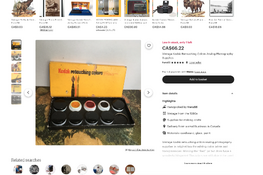
I started out 60 years ago using Kodak spotting colors: three plastic squares with a water based opaque 'something' (a bit like tempra paint) that came off with a wet brush. The squares were in white, black and sepia, the colors were mixed to match the print tone; the white was needed to get greys. The spotting would show up as matte blobs if the print was looked at from the side.
 
For film atop a lightbox I use a large diameter Edmund 7X magnifier which has a cutout on its transparent skirt to allow your retouching instruments easy access. I do prints at a special retouching station with excellent quality light using real color matching tubes in an adjustable swing-arm lamp, along with a comfortable leather chair, since the sessions can take awhile.
 
Spotone sets do turn up on eBay from time to time. (I expect mine will one day, but I hope you can’t wait that long!) It’s worth setting up a search with notifications, because the stuff doesn’t go off. Just check that there is something on the bottles, because some nutters seem to collect the bottles for their own sake.
 
Interesting, Cliveh. But don't be surprised if I'm highly skeptical of your claim, and I have a true cleanroom setup if needed.

Mr bikerider - how do you contend with the how inks sit on the surface of the emulsion, rather than penetrating? There must be a sheen difference involved.

I have never had a problem! Using glossy, but unglazed, fibre based paper from Ilford and remnants of the same (similar) paper from Kentmere. It is always used when the paper is still damp (not soaking wet) and quite dilute with a wetting agent added to the dye which ensures it is absorbed before it is dried in a flatbed paper dryer. Having said that I only very rarely get dust marks or hairs and even less the instances of scratches.

Before you ask, I don't use resin coated paper.
 
These days I use a combination of Peerless sheets melted in water and good ol' Spotone, both in a tray made for watercolors. I used them dry and add a wet brush.

I've never heard of a pencil for a glossy print so I got out my pencils. Used a 8b which is the softest I think I have, and it didn't do squat to ILMGWT. On a matt print it did sort of work, but the sheen was way different and obvious.

I've heard of people using gum arabic and india ink, but I think that is like really old school. I've never tried it.

One tip is to learn to use the biggest brush you can. A really good brush will have a super fine point no matter the size of it. The one I use the most is a #2 Winsor and Newton series 707 pure sable. Worth every penny. Saves tons of time.

I agree with Patrick about brush size , I use a #3 Windsor
 
I just purchased this kit thanks to this thread, I used these extensively back in the late 70's to bring down tones, apply with a soft cloth, air breath on the cake put on a bit on cloth and apply, when finished steam the print and the dye goes into the print and there is no evidence.
 

Attachments

  • Screen Shot 2025-01-12 at 9.01.26 AM.png
    Screen Shot 2025-01-12 at 9.01.26 AM.png
    1.1 MB · Views: 73
I agree. In fact allowing the film to dry without using a wetting agent can potentially lead to differential drying marks if you’re unlucky. Skipping Photo-Flo or Ilfotol is plain bad advice.
Cliveh, I've tried all kinds of things. What you've described only relates to drying the film dust-free; but dust can land on a negative all kinds of other ways, including inside an enlarger. I always allow film to air dry by hanging, whether suspended from a line over the sink, or within a drying cabinet with filtered air. And I do use Photoflo or Ilfosol; the idea with that it that just want a few drops of it in your final distilled water rinse.
 
I don’t know about all, but at least some of the PhotoFlo-type products are anti-static, which is a huge benefit in avoiding the need to retouch prints. So too are good negative sleeves.
 
bikerider - do you even recognize the distinction between dyes and inks? A water based dye might or might not penetrate better with a tiny bit of Photoflo mixed into the dilution water (a lot depends on when the print was made - days or decades before?). But inks typically have a water-resistant "vehicle" (the appropriate technical term), such as shellac in this case, and inherently dry on the surface of the gelatin.

But here on this thread we're entangling two different applications of Photoflo - one pertaining to its use in helping film dry streak-free, the other in relation to print spotting technique.

Brush sizes? The quality of the tip when moist is more important than the exact size. And good spotting brushes don't come cheap; you don't find them at photo suppliers. Go to a serious art store. But I typically use small sizes : 000, 0000, and even 00000 sometimes. Plus a pair of strong reading glasses.
 
I learned on "Gamma Black" in college about forty years ago. I'm already on my second tube as it only lasts about thirty years. It's a paint tube that you buy at an art supply store. There are different blacks you can buy but Gamma Black is the one I use. If you take a print to the art store with you you might find a better match, especially if you print with warmtone papers. So I'm applying a dot of paint on the spot with a #1 brush. You could use a smaller brush but not sure why you would... it's the point that matters. You lighten the colour by adding a touch of water until you get the tone you like. So easy to learn.
 
Photrio.com contains affiliate links to products. We may receive a commission for purchases made through these links.
To read our full affiliate disclosure statement please click Here.

PHOTRIO PARTNERS EQUALLY FUNDING OUR COMMUNITY:


Ilford ADOX Freestyle Photographic Stearman Press Weldon Color Lab Blue Moon Camera & Machine
Top Bottom