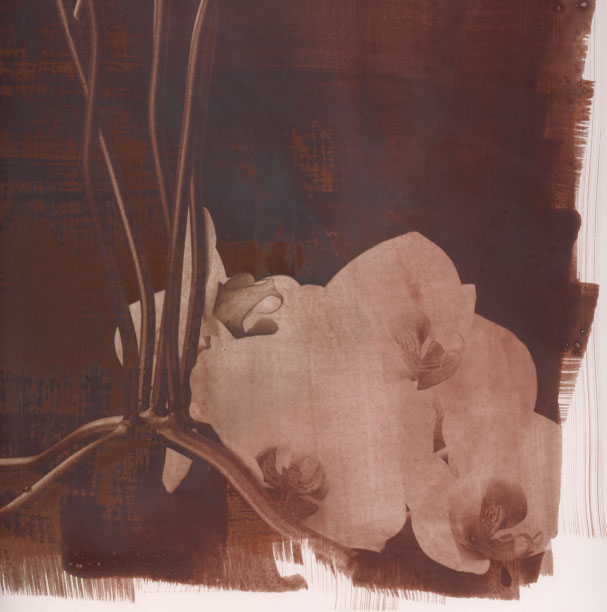


Hi all,
I just today tried to copper-red tone a handcoated developed print. The paper was coated with Rollei Black Magic VC and the toner I used was a copper based toner consisting of two components that need to be mixed in one tray for creating the working solution:
- Component 1 is a regular Potassium Ferricyanide bleach
- Component 2 is Copper (II) Sulphate
So these are simply mixed in one tray in which the print is dunked.
All seemed to go well initially, with the black of developed print slowly being replaced by copper red. However, after a while (about 10 min), when large parts of the print were already toned to completion, with no silver black left, I started noticing a number of big black stains that seemed to resist the toning action.
And so they did... :rolleyes:
Initially, I thought the solution might be exhausted, as the stated capacity was not that big, and the print was heavy black all over, but adding another set of toning bottles to the solution, did NOT solve the black stains and toning issue.
I finally, after about 1 hour(!) ended up leaving the print in the toning solution (heck, it was already ruined likely) and went out to do some other things.
After about 5 hours I came back and noticed the resistant black stains were gone, only to be replaced by now lighter "holes". So instead of the copper red replacing the silver (or whatever the stains were), the toning solution ended up just bleaching the stains away.
So now I have a print that for 80% of the surface looks "normal" and is properly toned, while the other 20% looks like if the "wall paint" came of a red painted wall...
What went wrong :confused:
I can tell you the resistant stains were at the position of the thickest layer of emulsion. I coat with a brush, so inevitably, the coating tends to be a bit messy with thicker and thinner layers present.
I may easily have had processing issues because of this: undeveloped but exposed silver emulsion, improperly fixed due to thick layer...
But how would that explain "resistant" black stains????? :confused:
I just can not think of options. For example, if the thicker emulsion was not propely fixed all the way through the emulsion, how would that explain a dark black stain resistant to the bleach and toning??
Any clues highly welcome!!
I just today tried to copper-red tone a handcoated developed print. The paper was coated with Rollei Black Magic VC and the toner I used was a copper based toner consisting of two components that need to be mixed in one tray for creating the working solution:
- Component 1 is a regular Potassium Ferricyanide bleach
- Component 2 is Copper (II) Sulphate
So these are simply mixed in one tray in which the print is dunked.
All seemed to go well initially, with the black of developed print slowly being replaced by copper red. However, after a while (about 10 min), when large parts of the print were already toned to completion, with no silver black left, I started noticing a number of big black stains that seemed to resist the toning action.
And so they did... :rolleyes:
Initially, I thought the solution might be exhausted, as the stated capacity was not that big, and the print was heavy black all over, but adding another set of toning bottles to the solution, did NOT solve the black stains and toning issue.
I finally, after about 1 hour(!) ended up leaving the print in the toning solution (heck, it was already ruined likely) and went out to do some other things.
After about 5 hours I came back and noticed the resistant black stains were gone, only to be replaced by now lighter "holes". So instead of the copper red replacing the silver (or whatever the stains were), the toning solution ended up just bleaching the stains away.
So now I have a print that for 80% of the surface looks "normal" and is properly toned, while the other 20% looks like if the "wall paint" came of a red painted wall...
What went wrong :confused:
I can tell you the resistant stains were at the position of the thickest layer of emulsion. I coat with a brush, so inevitably, the coating tends to be a bit messy with thicker and thinner layers present.
I may easily have had processing issues because of this: undeveloped but exposed silver emulsion, improperly fixed due to thick layer...
But how would that explain "resistant" black stains????? :confused:
I just can not think of options. For example, if the thicker emulsion was not propely fixed all the way through the emulsion, how would that explain a dark black stain resistant to the bleach and toning??
Any clues highly welcome!!