• Welcome to Photrio!
    Registration is fast and free. Join today to unlock search, see fewer ads, and access all forum features.
    Click here to sign up

Water spots with and without deionised water?

Tompkins Square Park

A
Tompkins Square Park

  • 6
  • 0
  • 74
Siesta Time

A
Siesta Time

  • 2
  • 1
  • 56

Recent Classifieds

Forum statistics

Threads
202,859
Messages
2,846,695
Members
101,573
Latest member
IanSeehorn
Recent bookmarks
0
I’m curious about the OP’s water quality out of the tap and whether filtration wouldn’t help here. My darkroom sink has an inline filter installed with carbon block that filters the water down to 5 microns. I don’t use distilled water or hang m roll film at an angle. No issues with spots with the use of photo flo.

In my area my water supply doesn’t have a whole lot in it in terms of mineral content and carbonate. I’d wonder whether a final soak of any reasonable time is just inadequate with, say, very hard water out of the tap?
 
In my experience you cannot use just distilled water for final rinse as you risk differential drying marks.
That's counterintuitive, given that you'd expect distilled water to be more pure than demineralized or deionized water. Btw, I'd expect the practical difference between all types to be unnoticeable in this application.
 
That's counterintuitive, given that you'd expect distilled water to be more pure than demineralized or deionized water.

Agreed. Extremely high purity water, whether from distillation or high efficiency deionisation,* contains only a vanishingly small amount of dissolved minerals so should leave no discernable residues whatsoever on the film once dried, regardless of whether a wetting agent is used or not. This is of course assuming that the film was previously washed thoroughly, then with a penultimate distilled/deionised wash/soak (as I already described) to ensure residual minerals within the film itself or the tank are already removed.

*Note that not all "deionised" waters are created equal. Some cheap commercial ones actually still contain non-trivial levels of dissolved minerals.
 
Differential drying - at least as Kodak describes it and possible issues - has to do with different local drying rates (droplets…) potentially causing deformities in the emulsion which can apparently print with different density. In other words, a surfactant/wetting agent is recommended to break the surface tension no matter how pure the water. I don’t know whether or not this is the problem OP has.

Edit: Apologies for editing this after posting.
That's counterintuitive, given that you'd expect distilled water to be more pure than demineralized or deionized water. Btw, I'd expect the practical difference between all types to be unnoticeable in this application.
 
Last edited:
It's really strange that traces appear after deionized water. Could these spots have formed during development?
The wetting agent is dissolved in deionized water, right? In high concentrations, it can cause stains.
I stopped using a wetting agent - just hanging up the film, shaking it out and gently going over the back with soft paper. This seems to work very well for me.
 
In my experience you cannot use just distilled water for final rinse as you risk differential drying marks. Unless you squeegee.

What I meant was just using distilled water without a wetting agent and hanging to dry.

I have no experience with deionized water or demineralized water. I’ve never used them.
 
I’m curious about the OP’s water quality out of the tap and whether filtration wouldn’t help here. My darkroom sink has an inline filter installed with carbon block that filters the water down to 5 microns. I don’t use distilled water or hang m roll film at an angle. No issues with spots with the use of photo flo.

In my area my water supply doesn’t have a whole lot in it in terms of mineral content and carbonate. I’d wonder whether a final soak of any reasonable time is just inadequate with, say, very hard water out of the tap?

I'm in a very soft water area and can't see deposits on the surface of the film. But I have to say I am borderline conspiracy theorist about UK water atm and better filtration is a good shout generally.

I'm first trying simple drying stage adjustments before looking at water supply again. Another conspiracy I have is that this deionised stuff is just crudely filtered tap water, hence not seeing much difference with or without it. But again, no visible deposits either way.
 
Another conspiracy I have is that this deionised stuff is just crudely filtered tap water, hence not seeing much difference with or without it. But again, no visible deposits either way.

Deionized water is very important in a number of processes. If (un)filtered water is used, it can cause very serious damage to a number of facilities and consequently trigger a lawsuit with large fines. The deionization process is not that complicated and expensive - hardly anyone would risk it.
 
Another conspiracy I have is that this deionised stuff is just crudely filtered tap water

"Conspiracy" is a generous term for this notion. How about "fantasy".

I have no experience with deionized water or demineralized water. I’ve never used them.

Really? Distilled water is pretty expensive due to the energy cost.
I suspect that much of the "distilled" water you can purchase is in reality deionized or even demineralized. I don't think labeling is particularly strict, especially in the consumer/hardware store market.
 
Deionized water is very important in a number of processes. If (un)filtered water is used, it can cause very serious damage to a number of facilities and consequently trigger a lawsuit with large fines. The deionization process is not that complicated and expensive - hardly anyone would risk it.

Good shout yeah. I think this further supports the differential idea then as most plausible, given same marks are visible with and without deionised and with different Ilfotol dilutions tried.
 
Basically it comes down to your local water supply. I have always lived in areas that the local tap water does not require me to use distilled water.
 
I suspect that much of the "distilled" water you can purchase is in reality deionized or even demineralized. I don't think labeling is particularly strict, especially in the consumer/hardware store market.

Precisely. Any cheap stuff you buy in the shops should be treated with caution. I bet if you tested them with a good TDS meter you would find them to be all over the place.

Better to distill your own (machines for doing this can be bought relatively inexpensively). I can get ultrapure deionised water from work, but transportation is a hassle.
 
Really? Distilled water is pretty expensive due to the energy cost.
I suspect that much of the "distilled" water you can purchase is in reality deionized or even demineralized. I don't think labeling is particularly strict, especially in the consumer/hardware store market.

I assumed they were similar. I went through years of trial and error dealing with the same things the OP is dealing with now. When I figured out what worked I don’t mind paying 1.50 a gallon for distilled water to get perfect negatives!
 
I assumed they were similar. I went through years of trial and error dealing with the same things the OP is dealing with now. When I figured out what worked I don’t mind paying 1.50 a gallon for distilled water to get perfect negatives!

That is really, really cheap for true distilled water.
 
Do not use wetting agent. The last liquid your film should be in, is deionised water. Agitate your film in deionised water for about 30 seconds and hang to dry. No drying marks.
 
First of all, great to see this community still very active.

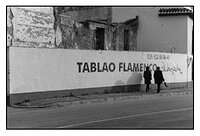
I've recently been battling a water spot problem as shown in the attached. I thought I got rid of this about two years back with a filter on my tap.

Of note:
- This is 120 HP5. Image attached is top right of frame 10 (6x6). Usually happens on one or more of last 3-4 frames.
- Up until the issue has appeared again, I have always used tap water for every step of the process. Upon seeing the water marks reappear a couple weeks ago, I decided to change to bottled deionised water just for an extra two Ilford washes (which includes 3 min soaks), then also for the wetting agent mix (1:200 or 5ml to 1l) which I leave the film to soak for another 2 mins.
- I have tried more and less wetting agent with no change, all else equal.
- Wetting agent is Ilfotol, brand new as are all chems.
- I use a Patterson tank and do everything in the tank until taking the reel out and putting it in a jug with the wetting solution.
- I then simply take the film off the reel and hang to dry, always ensuring there is an unbroken sheet of water on both sides of film. No squegee, no fingers.
- I dry in a bathroom after running shower. Usually have the radiator on and it's about 25-30C in there. Have tried with and without radiator though, down to about 10C ambient temp on this last roll.

Are water spots like these always from the crap in the water, or could it be from elsewhere? Interestingly, I can't actually see the marks on the surface of the film, neither emulsion or non-emulsion. So I was wondering if this could be happening during development and it's actually in the emulsion? Using deionised or distilled water for the whole process feels a step too far for me as I worry about the storage and recycling of all those 5L bottles. But if anyone really thinks it could be happening during dev I could give it a go for sanity. Conversely, as I am using deionised water now for the most critical stage for water spots with no change, seems like I could just as well go back to tap water.

I use tap through the process and do a final rinse with distilled. Might want to agitate a bit more at the start to make sure your negative is totally coated.
 
Steam distilled water in my part of the US is $1.29/gallon at the grocery store. I don't know of anybody (though I am sure there is somebody) who is palming off DI water as distilled.

Distilled water is funny stuff. It pours differently - sort of silky - and produces no bubbles as it pours.

It also makes good coffee with the added benefit that your coffee maker doesn't lime-up.

Steam distilled water doesn't use all that much energy. The most brute force method takes ~3kWH/gallon - or about $0.33 electricity / gallon. Industrial regenerative and vacuum methods use much less power than this.
 
Last edited:
John, I’ve been down this road. Using only distilled water final rinses and NO wetting agent can leave differential drying marks. This is when the water cannot slide off the film and a drop or so of water sits on the film a long time and causes density changes around where the drop sits.

The answer is to use a wetting agent after the distilled water rinses to allow the water to slide off the film. But too much drying agent can cause marks which appear much like the picture you’ve attached. The key is to find the correct amount of wetting agent. Usually the manufacturers recommended dilutions are too strong. For 120 HP5 I use 5 drops in 500ml of distilled water. Here is my final wash routine. For me this works perfect every time.

Final wash in running water for 8 minutes. Fill tank with distilled water agitate 20 times, let sit for a minute. Dump and refill tank with distilled water second time and agitate 20 times, let sit for one minute. I do these two distilled water rinses because I have very hard tap water. After these two rinses I add 5 drops of photo flo and fill the tank (with the reels out) with distilled water, drop the reels in and let sit for 30 seconds or so. Take out, take film off and see saw the film through the photo flo one last time and hang to dry, no touching. Now the one thing I do that I also highly recommend is hanging at an angle. Doesn’t have to be 45 degrees but any kind of angle you can do even if it’s 20-30 degrees helps the water flow off without needed to make it all the way to the bottom off the film. If you cannot do this I would recommend after see sawing the film through the photo flo to hold the film in front of you at an angle for about 10-15 seconds, then hang to dry.

I’ve also found the for my 35mm film I need 20 drops in 500ml of distilled water to not get marks. You can test this with a scrap piece of film. Take a film strip already developed and put in distilled water and take out, you can see how the water wants to bunch together and form a line almost. Start adding drops off photo flo to that water and dip film again, and again. At some point the water will form a thin even layer when you pull the film out. This is the amount of photo flo you should use.

I’d recommend using less photo flo and hanging at an angle if you can. But don’t give up the final distilled water rinses. Just need to find the right amount of drops of wetting agent.

This is very similar to what I do, just check when taking the film out of the final photoflo bath that it is evenly coated with no drops, keep it well wetted and hang to dry at an angle. Works for me.
 
Do not use wetting agent. The last liquid your film should be in, is deionised water. Agitate your film in deionised water for about 30 seconds and hang to dry. No drying marks.

In my experience this will lead to differential drying marks. Might not happen every roll but it will at some point. Now if you squeegee the water off then you wouldn’t have to worry.
 
I should have attached this to this thread sooner. But here is my original thread from years ago detailing my struggle. Please read all the way to the end because there are a few updated times where I thought I had fixed my problem and I had not.
 
I live in a very hard water area. I use tap water for washing the film, but deionised for the final rinse (with Tetenal Mirasol, of which I have enough to see me out!). Generally I see no water marks, but on the rare occasion they occur, they are always down the centre of the (35mm) film, and on the non-emulsion side, where they are easily removed by rubbing very lightly with a soft cloth dipped in deionised water and blotted dry.
 
In my experience this will lead to differential drying marks. Might not happen every roll but it will at some point. Now if you squeegee the water off then you wouldn’t have to worry.

Deionised water contains no calcium deposits and can therefore never cause drying marks.
 
Deionised water contains no calcium deposits and can therefore never cause drying marks.

I thought the same thing at one time until I learned about differential drying marks. I was in denial for quite a while until I did some research. I’m sure many here could explain better than me. But when a drop of water continues to sit on an area of film and the rest of the film around it dries, the emulsion is “stretched” and causes the area around the drop to form a change in density.

Thus the need for a wetting agent to allow the film to dry evenly.
 
Photrio.com contains affiliate links to products. We may receive a commission for purchases made through these links.
To read our full affiliate disclosure statement please click Here.

PHOTRIO PARTNERS EQUALLY FUNDING OUR COMMUNITY:


Ilford ADOX Freestyle Photographic Stearman Press Weldon Color Lab Blue Moon Camera & Machine
Top Bottom