• Welcome to Photrio!
    Registration is fast and free. Join today to unlock search, see fewer ads, and access all forum features.
    Click here to sign up

Water quality for the darkroom

Grill

H
Grill

  • 4
  • 0
  • 58
Cemetery Chapel

H
Cemetery Chapel

  • 3
  • 0
  • 81

Recent Classifieds

Forum statistics

Threads
202,785
Messages
2,845,520
Members
101,522
Latest member
marlinspike
Recent bookmarks
0

JJB

Member
Allowing Ads
Joined
Dec 17, 2007
Messages
67
Location
NJ
Format
Medium Format
I have seen a bunch of darkroom portraits and noticed a lot had a water filter system in place. We have hard water, with a good amount of calcium in it. Is this
something I should filter for? I am looking to start printing with fiber paper soon.

Thanks!
 
JJB

Water filters are a good idea if you have particle contamination in the water (rust for example). If you have other contamination (such as organic matter) you have bigger problems than print washing. Water hardness is harmless as long as the calcium is dissolved but can be a problem if calcium particles form during processing. This can be the case with self-made hypo-clearing agent for example (a bit of Photo Calgon can fix that). However, water softeners are not recommended, because hard water is actually more efficient in print washing than soft water.

So, water filter: yes if needed; water softener: no!
 
I never worried about my water quality, until we moved, then I began noticing crap on my negatives. Initially I fought the "dust battle" then I invested in an under counter water filtration system and began to get clean negatives again. I didn't spend a lot of money but it has made a difference. Water quality is crucial in film development, there's no second chance. When printing I don't think it's as important.
 
Thanks for the info! I will use the $ for some more paper...
 
I have the same question as the OP. Will any residential grade water filter do or would I need a commercial grade one? Should I be looking for a particular specification when choosing one (like microns for an air filter)?


Thanks,
Omid
 
I have very hard water and I do nothing. If there is a problem then do something about it. Do not go looking for problems with water when there are so many other places to have problems.
 
I do nothing with the water as I only use water for presoak and wash. I mix my chemical with distilled water. I do mostly only RA-4 processing.
 
Not just for the OP but anyone else who is still on the site....

I live in a very hard water area, and not only did my 80s school dark room (purpose built) not have any filtration but at home I develop film in the bathroom. Never used a water filter and have never brought in distilled or deionised water. And as soon as I discovered photo-flo....I've never had any issues with residue on films.

Your water supply will only be an issue if you draw off, say, a litre and let it sit in a container....and then notice particles in the bottom after a while. That simply doesn't happen here. There is no doubt CaCO3 and other substances dissolved in the water but no solid particles.
 
I have the same question as the OP. Will any residential grade water filter do or would I need a commercial grade one? Should I be looking for a particular specification when choosing one (like microns for an air filter)?


Thanks,
Omid
Usually a 5 micron filter will be adequate. Less and you need to change more often. If your water is smelly then a carbon filter will help, some filters do both. I have a 5 micron filter on both hot and cold, dont know if it was necessary, but was no big deal for me. I like to drink plenty of water in my darkroom, so even a particle filter makes tap water taste better.
 
The matter does not only concern the municipal water supply or more general the water entering your house, but the piping inside your house too.

I got a 40µ filter at the house inlet. But I still got much larger green particles at the sieves of the aerators at the taps: Carbonates formed in the copper tubes of the house and then washed off.

Also steel, copper and lead tubes can give off ions into the water. Basically a matter of ph but also of carbonates that may form a protective lining inside the tubing. One should not overestimate such issue as in general processing works at most different places, but it shoud be something on ones mind if otherwise inexplainable faults show up.
Sad enough manufacturers have not published limits for contamination.
 
Sirius Glass "I have very hard water and I do nothing. If there is a problem then do something about it. Do not go looking for problems with water when there are so many other places to have problems."
+ 1

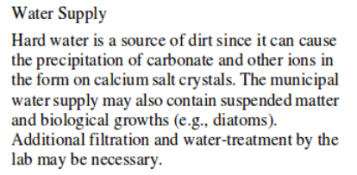
Kodak recommends the following in connection with water used in film processing:
"Water Supply
Hard water is a source of dirt since it can cause
the precipitation of carbonate and other ions in
the form on calcium salt crystals. The municipal
water supply may also contain suspended matter
and biological growths (e.g., diatoms).
Additional filtration and water-treatment by the
lab may be necessary."
https://www.kodak.com/uploadedfiles...t_en_motion_support_processing_h242_h2402.pdf
Processing KODAK Motion Picture Films, Module 2 pag.2-39

George
 

Attachments

  • Water Supply.png
    Water Supply.png
    66 KB · Views: 122
Ancient OP...water is filthy in many parts of the country. 'Toilet to tap' is how many municipalities roll nowadays. You wont believe what can be in your water supply.

See the photos...

Google: Distilling water is a quick acid test you can do to find out what residue is in your water

For darkroom, distilled water is best. But as previous responder said, if things work good with tap then why complain. I prefer distilled myself. Too much chemicals and filth in our water supply.
 
Do you guys get an annual water report? Here in Oklahoma, once a year they send us a letter in the mail that details all of the stuff found in our municipal water supply. It lists pH, particulates, microbes, chemicals, and radioactivity, and compares them to EPA standards. Then, if a number is particularly high or over the EPA standard, it will suggest possible reasons for that. Of course, it doesn't work if you live off well water. But I find it quite useful, assuming I don't throw it away thinking it's more junk mail. And I would have thought that if Oklahoma did it, the most environment hating state in the union, that most other places would do it too.

In any case, my water is thankfully pretty clean. I still use distilled water for mixing chemicals, but have no problems using tap water for washing film and prints.

 
Here in the UK you can look up the exact content of your water supply online. I'm not aware that any US location I've visited has water that is actually bad, and that includes well water used by hillbillies living in the Missouri forest.
 
Do you guys get an annual water report?

In the long past we got it once or so with the annual bill, now it seems it gets published annually in their customers magazine we get in the mail box. But it is online too.

(11 parameters: ph, hardness, Ca2+, Mg2+, Na+, K+, NO3-, SO42-, Cl-, HCO3-, Pesticides)
 
Last edited:
Do you guys get an annual water report? Here in Oklahoma, once a year they send us a letter in the mail that details all of the stuff found in our municipal water supply. It lists pH, particulates, microbes, chemicals, and radioactivity, and compares them to EPA standards. Then, if a number is particularly high or over the EPA standard, it will suggest possible reasons for that. Of course, it doesn't work if you live off well water. But I find it quite useful, assuming I don't throw it away thinking it's more junk mail. And I would have thought that if Oklahoma did it, the most environment hating state in the union, that most other places would do it too.

In any case, my water is thankfully pretty clean. I still use distilled water for mixing chemicals, but have no problems using tap water for washing film and prints.
Ditto what you said, however, I did install a filter that filters out particulate matter out of all of the tap water that is used in the darkroom sink for film and print washing. The filter was not expensive, was easy to install, and gives me peace of mind. I consider the money spent on filtering water, worth every penny.........Regards!
 
Hillbillies aren't necessarily limited to the Missouri forest. Might be a few in Yorkshire. But, use distilled, RO or DI water for the developer, you won't regret it.
 
Photrio.com contains affiliate links to products. We may receive a commission for purchases made through these links.
To read our full affiliate disclosure statement please click Here.

PHOTRIO PARTNERS EQUALLY FUNDING OUR COMMUNITY:


Ilford ADOX Freestyle Photographic Stearman Press Weldon Color Lab Blue Moon Camera & Machine
Top Bottom