
• Welcome to Photrio!
    Registration is fast and free. Join today to unlock search, see fewer ads, and access all forum features.
    Click here to sign up

Very grainy FP-4

Do Not Come Here

A
Do Not Come Here

  • 9
  • 3
  • 94
Heavy

H
Heavy

  • 13
  • 5
  • 135

Recent Classifieds

Forum statistics

Threads
201,931
Messages
2,832,220
Members
101,023
Latest member
scodth
Recent bookmarks
0

Cybertrash

Member
Joined
Nov 1, 2012
Messages
238
Location
Stockholm, Sweden
Format
Multi Format
I developed a roll of 35mm FP-4 a while back, and yesterday I made some 10x15cm prints from the negatives, and it struck me that the results were very grainy.

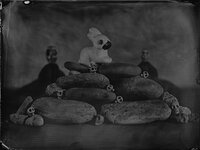
Here's a scan of one of the prints, and the grain is observable without a loupe. I realise that 35mm is grainy, but I didn't realise that a ASA125 film would be *this* grainy. Maybe with Rodinal, but this is in HC-110B, which I thought had at least some solvent action going on to reduce grain slightly.

Have I done something wrong somewhere, or is FP-4 supposed to be this grainy? Maybe I've been spoilt by 120 and 4x5.
 

Xmas

Member
Allowing Ads
Joined
Sep 4, 2006
Messages
6,398
Location
UK
Format
35mm RF
Please try Formapan 400, HP5+ or Trix next...
 

Rick A

Subscriber
Allowing Ads
Joined
Mar 31, 2009
Messages
10,033
Location
Laurel Highlands
Format
8x10 Format
I think you have been spoiled by larger negatives. I like the grain in that photo, lends a certain quality that smacks of "this is real" just like life.
 

snapguy

Member
Allowing Ads
Joined
Jan 1, 2014
Messages
1,287
Location
California d
Format
35mm
no grain, no pain

Well, 35mm film is not grainy unless you do something wrong. I have used many combinations of film and developers over many decades and ended up with fabulous no-grain negatives from 35mm. The best was Panatomix-X and Rodinol. You have to experiment around to see what works for you. I might get great results and you might get bum ones, from the same film/developer combination, or the other way around. Your darkroom and quality of water and how accurate the thermometer is and a million other details like agitation can vary. Having said that, I am a very big fan of big negatives such as 120. When you get into the darkroom those big negs are hard to beat. Let's face it, it's easier to get non-grain prints from big negs. But not impossible from 35mm or even half frame 35mm.
I knew professional photographers who shot portraits on Olympus Pen half frame cameras and got no-grain photos. The Pen is a great camera for portraits but I digress.
 

cliveh

Subscriber
Allowing Ads
Joined
Oct 9, 2010
Messages
7,805
Format
35mm RF
I don't think FP4 should be that grainy and certainly not from that size of print. May I ask have you cropped into the image when enlarging? Perhaps you should also look at your development process in terms of time/temperature and dilution.
 

Richard S. (rich815)

Member
Allowing Ads
Joined
Jan 14, 2003
Messages
4,924
Location
San Francisco
Format
Multi Format
Did you underexpose perhaps? That bright background would "fool" any in-camera meter unless you compensated for the bright background or used a spot meter.
 
OP
OP

Cybertrash

Member
Joined
Nov 1, 2012
Messages
238
Location
Stockholm, Sweden
Format
Multi Format
I don't think FP4 should be that grainy and certainly not from that size of print. May I ask have you cropped into the image when enlarging? Perhaps you should also look at your development process in terms of time/temperature and dilution.

Nope, no cropping to speak of. I figured that development could be the issue, but I was following recommendations (9 minutes at 20C). I exposed the film at EI 100 though, rather than 125, maybe I should have reduced my development time?

Something that also struck me is that the roll has been lying around in my fridge for about a year, expiry date is March 2016, but could the long cold storage been affecting it somehow?

Did you underexpose perhaps? That bright background would "fool" any in-camera meter unless you compensated for the bright background or used a spot meter.

Nope, the only fault I can find with the negatives (apart from the grain) is that they're a bit contrasty, but density is good (I used a flash meter to meter the background and subject independently).
 

Urmonas

Member
Allowing Ads
Joined
Aug 25, 2006
Messages
52
Format
Medium Format
The grain should not be an issue on such a small print. You mention the negative is contrasty. This suggests some overdevelopment. Also check the film surface it is possible some type of micro-reticulation is happening which can look like bad grain. Cold storage should not affect the film. Exposing at EI 100 will only improve shadow detail by 1/3 stop. Developing time controls contrast, exposure controls shadows + highlights.
 

bdial

Subscriber
Joined
Jan 2, 2005
Messages
7,516
Location
North East U.S.
Format
Multi Format
Your scan settings or post-processing may accentuate grain too, but that's really a Hybridphoto topic.
 
OP
OP

Cybertrash

Member
Joined
Nov 1, 2012
Messages
238
Location
Stockholm, Sweden
Format
Multi Format
Your scan settings or post-processing may accentuate grain too, but that's really a Hybridphoto topic.

You see the same effect when looking at the print in daylight as well, so it's sure to be the film.
 

Gerald C Koch

Member
Allowing Ads
Joined
Jul 12, 2010
Messages
8,131
Location
Southern USA
Format
Multi Format
HC-110 should produce grain very similar to that of D-76/ID-11. However grain is dependent on such things as correct exposure and development. Without further information it would be hard to tell.
 
OP
OP

Cybertrash

Member
Joined
Nov 1, 2012
Messages
238
Location
Stockholm, Sweden
Format
Multi Format
HC-110 should produce grain very similar to that of D-76/ID-11. However grain is dependent on such things as correct exposure and development. Without further information it would be hard to tell.

As I mentioned I exposed at EI 100, and developed in HC-110 B for 9 minutes at 20 degrees C, continuous inversion the first minute, then three inversions every minute.

I recieved suggestions that I should switch developer to something like D76 or Xtol, but according to the Kodak Developer chart HC-110 B should give at least as fine grain as D76 (allthough supposedly Xtol is better), and personally I'd rather stick to HC-110 due to it's keeping properties and economy.

(On a completely different note, I usually see D76 1+1 referenced as the "classic fine grain developer", but I wonder, wouldn't diluting the developer give you less fine grain than using it stock?)
 

cliveh

Subscriber
Allowing Ads
Joined
Oct 9, 2010
Messages
7,805
Format
35mm RF
As I mentioned I exposed at EI 100, and developed in HC-110 B for 9 minutes at 20 degrees C, continuous inversion the first minute, then three inversions every minute.

You don't mention if the HC-110B was stock or diluted for use.
 

pentaxuser

Member
Joined
May 9, 2005
Messages
20,352
Location
Daventry, No
Format
35mm
I get what appears to be a massive enlargement of the print? It's much bigger than a 10x 15cm print.

If this is a true replica of a 10x15cm print from an FP4+ neg then I have never seen grain on a print anything like this. If you hadn't stated that this is a replica of a 10x15cm print I'd have said I was looking at an enlargement of a very small portion of the negative.

I am totally puzzled and as you seem to have done everything correctly in terms of processing then I can only hope for Ilford's sake that this is a one-off problem and nothing to do with FP4+ :D

pentaxuser
 
OP
OP

Cybertrash

Member
Joined
Nov 1, 2012
Messages
238
Location
Stockholm, Sweden
Format
Multi Format
You don't mention if the HC-110B was stock or diluted for use.

Diluted for use, 1 part zirrup, 31 parts water.


I get what appears to be a massive enlargement of the print? It's much bigger than a 10x 15cm print.

If this is a true replica of a 10x15cm print from an FP4+ neg then I have never seen grain on a print anything like this. If you hadn't stated that this is a replica of a 10x15cm print I'd have said I was looking at an enlargement of a very small portion of the negative.

I am totally puzzled and as you seem to have done everything correctly in terms of processing then I can only hope for Ilford's sake that this is a one-off problem and nothing to do with FP4+ :D

pentaxuser

It's a scan of a 10x15cm print, I'm not sure how it translates to digital resolution (I scanned it at 3200dpi), but for me I can see the grain when looking at the print in daylight, and it's extremely obvious when looking at the print with a loupe.
 

37th Exposure

Member
Allowing Ads
Joined
Feb 5, 2010
Messages
208
Location
The Land of
Format
35mm
Reticulation?

I assume the temperature of all solutions including the wash were the same? Stop bath not too strong?
 

Roger Cole

Member
Allowing Ads
Joined
Jan 20, 2011
Messages
6,069
Location
Atlanta GA
Format
Multi Format
I agree that when I click to see it full size I get something vastly larger than that size print. So what I'm seeing digitally is in effect a further enlargement, and then the grain is obvious. I don't see any grain when the print is sized to fit my monitor. So it's hard to say without seeing the actual print.

I will say that I personally do not see any visible grain from a print this size from 35mm negatives on medium speed films. I have 10" square prints from 6x6 negatives on both FP4+ and Tri-X hanging on my wall, which is about the same degree of enlargement, and I don't see any visible grain at all from the FP4+ and can only see it on the Tri-X if I take off my glasses (I'm very near sighted) and look closely from less than 6" and then it's barely visible.
 

MattKing

Moderator
Moderator
Joined
Apr 24, 2005
Messages
55,262
Location
Delta, BC Canada
Format
Medium Format
Something that also struck me is that the roll has been lying around in my fridge for about a year, expiry date is March 2016, but could the long cold storage been affecting it somehow?

That year in the fridge - was it before you exposed the film, or was it after exposure and before development?
 

NedL

Subscriber
Allowing Ads
Joined
Aug 23, 2012
Messages
3,421
Location
Sonoma County, California
Format
Multi Format
As I mentioned I exposed at EI 100, and developed in HC-110 B for 9 minutes at 20 degrees C, continuous inversion the first minute, then three inversions every minute.

I expose 135 FP4+ at EI 100 and develop a bit less than 9 minutes ( 8:30 to 8:45 ) in dilution D at 20C, with "Ilford-style" agitation 4 gentle inversions per minute. This is for a cold light enlarger, so I like the negatives to have some contrast. So, to me, 9 minutes using dilution B sounds like too much. But that depends on a lot of things like how we meter.

Grain is visible on 8x10 prints if I burn with high contrast filter in the sky for example, and it usually looks nice on the print, but often looks ugly in my scans of the prints. I don't know how to scan a print to make it look nice. You example does look extreme to me.
 

snederhiser

Member
Allowing Ads
Joined
Oct 14, 2010
Messages
161
Format
Medium Format
Hello;
I believe that you are suffering from overdevelopment. Thinking that 6 minutes would have been the correct time @ dilution b. Also cut down on the agitation! It takes 6ml of HC110 to develop a 36exp roll of 35mm. I would use a 1 to 49 dillution for 300ml developing solution for a 9min time, Steven.
 

Gerald C Koch

Member
Allowing Ads
Joined
Jul 12, 2010
Messages
8,131
Location
Southern USA
Format
Multi Format
As I mentioned I exposed at EI 100, and developed in HC-110 B for 9 minutes at 20 degrees C, continuous inversion the first minute, then three inversions every minute.

I recieved suggestions that I should switch developer to something like D76 or Xtol, but according to the Kodak Developer chart HC-110 B should give at least as fine grain as D76 (allthough supposedly Xtol is better), and personally I'd rather stick to HC-110 due to it's keeping properties and economy.

(On a completely different note, I usually see D76 1+1 referenced as the "classic fine grain developer", but I wonder, wouldn't diluting the developer give you less fine grain than using it stock?)

Sorry did not catch the information when I returned to this thread. Development fits usual recommended parameters.

You are right D-76 at 1+1 will not produce as fine a grain as FS.
 

cliveh

Subscriber
Allowing Ads
Joined
Oct 9, 2010
Messages
7,805
Format
35mm RF
Sorry did not catch the information when I returned to this thread. Development fits usual recommended parameters.

You are right D-76 at 1+1 will not produce as fine a grain as FS.

Why not?
 
OP
OP

Cybertrash

Member
Joined
Nov 1, 2012
Messages
238
Location
Stockholm, Sweden
Format
Multi Format
A lot of people are suggesting that the grain is due to overdevelopment, I suppose I ought to try agitating a litlte less or cutting down on development time next time. What's strange is that Ilford recommend 9 minutes in their datasheet for FP-4+, and I've always used the same agitation routine without issues before (granted the times I've souped FP-4 in 35mm it has always been a little grainy).

EDIT:

The plot thickens, I just scanned some negs from the same roll that were taken on a different lighting set up (black background), and there is much less grain... Now I don't understand anything.
 
Last edited by a moderator:

cliveh

Subscriber
Allowing Ads
Joined
Oct 9, 2010
Messages
7,805
Format
35mm RF
Because the full strength has higher sulphite concentration thus more solvent effect. Finer grain at some expense to sharpness.

Surely if the dilution of all constituents is in the same ratio for a given time and temperature (pH dependent) it should not make a difference. Developers based on the Phenidone/hydroquinone mixture only show a small fall-off in activity for a large degree of dilution. This should have little if no effect on grain size.
 
Photrio.com contains affiliate links to products. We may receive a commission for purchases made through these links.
To read our full affiliate disclosure statement please click Here.

PHOTRIO PARTNERS EQUALLY FUNDING OUR COMMUNITY:


Ilford ADOX Freestyle Photographic Stearman Press Weldon Color Lab Blue Moon Camera & Machine
Top Bottom
