
• Welcome to Photrio!
    Registration is fast and free. Join today to unlock search, see fewer ads, and access all forum features.
    Click here to sign up

Using Graded paper vs VC paper

9/50

H
9/50

  • 1
  • 2
  • 8
Beachside picnic, 1920's.jpg

A
Beachside picnic, 1920's.jpg

  • 1
  • 1
  • 42

Forum statistics

Threads
201,218
Messages
2,820,653
Members
100,595
Latest member
keithberry
Recent bookmarks
1

Jed Freudenthal

Member
Allowing Ads
Joined
Nov 22, 2004
Messages
226
Location
Bilthoven, T
Format
4x5 Format
A few notes:

It would be interesting to know how it is planned to determine the CI of a pyro negative.

A point to keep in mind is that the stain to silver ratio isn't necessarily linear. Some combinations of film and developer are, some aren't. This throws a big monkey wrench into attempts at using a densitometer. It is possible to correlate densitometer readings to print densities - but the densitometer readings themselves have little meaning when it comes to measuring the niceties of the image.

Low sulfite pyro formulations go bad minute-by-minute from oxidation with contact with the air. Sensitometric results are not repeatable. Additionally these formulations produce copious and variable amounts of over-all stain; the overall stain is often mistaken for image stain as it masks a true appreciation of the real amount of image stain.

I, also was thinking how to solve these things. how the hell are you going to solve that!

Concerning the low sulfite, there are no concerns. I usually add a very tiny amount (0,2 garm per liter developer ) to avoid auto-oxidation. Then, when you add the developer to the alkali just before development there is no problem with the reproducibility. In case of catechol, I dissolve the catechol a few minutes before the development process. In case of pyrogallol, I have a acidified solution as a stock solution ( this because of the toxicity of pyrogallol, I do not handle this as a dry substance in my darkroom).

Jed
 

Jed Freudenthal

Member
Allowing Ads
Joined
Nov 22, 2004
Messages
226
Location
Bilthoven, T
Format
4x5 Format
Last week I cleaned the place up and in the general tossing of things threw out about 100 step-wedge pyro negatives that were used in the development and testing of the Pyro enlarging meter. Never wanted to see the damn things ever again. Oh, well, c'est la vie.

.

There are boundaries to replace the human mind with a machine.:D
 

RalphLambrecht

Subscriber
Allowing Ads
Joined
Sep 19, 2003
Messages
14,859
Location
K,Germany
Format
Medium Format
... I would suggest to Ralph, just try the staining developers and see how they behave. There are properties you cannot see in density measurements. The artistic note. ...

Jed

Sorry, but I only believe in hard quantifiable evidence. The rest is the stuff myths are made of!
 

RalphLambrecht

Subscriber
Allowing Ads
Joined
Sep 19, 2003
Messages
14,859
Location
K,Germany
Format
Medium Format
... Low sulfite pyro formulations go bad minute-by-minute from oxidation with contact with the air. Sensitometric results are not repeatable. Additionally these formulations produce copious and variable amounts of over-all stain; the overall stain is often mistaken for image stain as it masks a true appreciation of the real amount of image stain.

I'm starting to think this stuff ain't worth the effort.
 

Ian Grant

Subscriber
Allowing Ads
Joined
Aug 2, 2004
Messages
23,370
Location
West Midland
Format
Multi Format
I'm starting to think this stuff ain't worth the effort.

Don't believe everything you read, if you'd used developers like Pyrocat HD or PMK you'd see and realise that those comments are rubbish.

Comments based on half truths and conjecture are worthless.

There is some truth that once made up and dilute Pyrogallol and Pyrocatechin developers begin to oxidise, but it's not that fast, and any develper will go off left waiting.

Some like staining developers, Lindan doesn't that's his prerogative. He's made his anti-staining dev views very clear but never been able to substantiate his perverse opinions.

Ian
 

Bill Burk

Subscriber
Allowing Ads
Joined
Feb 9, 2010
Messages
9,455
Format
4x5 Format
...Lindan doesn't {like staining developers} that's his prerogative. He's made his anti-staining dev views very clear...

Doesn't make sense to me. How could Nicholas have an anti-staining view, and still develop the Pyro meter?

I recommend using one of his Darkroom Automation Pyro meters to determine the CI of the Pyro and D-76 negatives.
 

Jed Freudenthal

Member
Allowing Ads
Joined
Nov 22, 2004
Messages
226
Location
Bilthoven, T
Format
4x5 Format
Last week I cleaned the place up and in the general tossing of things threw out about 100 step-wedge pyro negatives that were used in the development and testing of the Pyro enlarging meter. Never wanted to see the damn things ever again. Oh, well, c'est la vie.
.

Apparently, you got stuck on these pyro negatives. Probably in the interpretation of the density readings. As soon as detailed ( on the level of grain) information is significant, the density reading loses its meaning in relation to the human visual perception. And in pyro-negatives this is the case.
I would like to refer to the paper of M.A. Kriss, Im,age structure, The theory of the photographic process 4 th ed. Th. James ed.
On p. 618, Kriss shows three pictures with the same density, but they differ in microstructure. The appearance for the human eye is very different. The meaning of a density measurement disappears.
In no time you are struggling with the laws of physics. The situation gets even worse when you are going to use a modern lens ( good modulation transfer in the high spatial frequencies).
The human eye is a perfect detector, Be carefull, whether it is allowed to replace the human eye by a densitometer.
[ Btw this is the result of physical properties. Properties that are often present in pyro-negatives in a significant way, but may be present in other developers as well. In particular when modern lenses are used].

Jed
 

Nicholas Lindan

Advertiser
Advertiser
Joined
Sep 2, 2006
Messages
4,301
Location
Cleveland, Ohio
Format
Multi Format
Apparently, you got stuck on these pyro negatives...
...I would like to refer to the paper of M.A. Kriss, Im,age structure, The theory of the photographic process 4 th ed. Th. James ed. On p. 618, Kriss shows three pictures with the same density, but they differ in microstructure...
...In no time you are struggling with the laws of physics...

I was stuck on the shear tedium of reading stacks of pyro step tablets and the tedium of reading even greater stacks of prints of said step tablets.

I agree with you about the effects of 'microstructure' on the look of a picture. There isn't any need to invoke anything exotic - grain certainly effects the look of a picture. The HD curve obviously doesn't tell all. Staining developers, with their dye/stain cloud formation, effect the look of the grain.

The question at hand, though, is that of the gross macro effect of the stain on the HD curve. It is a question that, to the best of my knowledge, has never had a definitive answer. There is little in the literature about tanning/staining developers, but as Kodak abandoned pyro developers a long time ago it isn't surprising.

Unless the contributing effects of the 'pyro look' can be separated the issue devolves into the usual polemic about things that can't be measured. All physical things can be measured, though one may often not know how.

That's why I feel a good starting point is an instrumented approach looking just at the effect of pyro stain on the transfer of negative exposure to print tone. Start with things that can be measured without requiring the resources of Perkin Elmer.

MTF techniques may fall short when it comes to looking at micro effects in film. MTF assumes the system under consideration is linear and continuous. At the micro scale photographic images aren't analog anymore, they are a very messy digital form consisting of fuzzy brillo-pad like grains, grain clumps and, in the case of pyro, clouds of dye. MTF will, like any measurement technique, gladly throw out numbers when fed data - any data, and one has to be careful one isn't falling into the old GIGO trap.

Making proper micro scale measurement is going to require a scanning micro-densitometer. Not something most people have access to. A possible starting point might be the computer analysis of a photomicrograph of an edge - say a contact print of a razor blade.

* * *

On the macro side, a good starting point might be to look at the effect of a uniform pyro stain. Make a pyro contrast filter by bleaching the silver from a pyro negative of a blank wall, leaving uniform stain. Does the insertion of the pyro contrast filter have any effect on the HD curve of a print of a step tablet? - if not, there isn't any reason to go further with investigating the effect of pyro on macro-contrast. Maybe someone has already published the results of such an experiment?
 

Nicholas Lindan

Advertiser
Advertiser
Joined
Sep 2, 2006
Messages
4,301
Location
Cleveland, Ohio
Format
Multi Format
Some like staining developers, Lindan doesn't that's his prerogative. He's made his anti-staining dev views very clear but never been able to substantiate his perverse opinions.

Apart from it's rudeness, this statement makes no sense.
 

Nicholas Lindan

Advertiser
Advertiser
Joined
Sep 2, 2006
Messages
4,301
Location
Cleveland, Ohio
Format
Multi Format
I recommend using one of his Darkroom Automation Pyro meters to determine the CI of the Pyro and D-76 negatives.

Ah, there's the rub.

The meter doesn't measure the density of a pyro negative. It correlates the meter's measurement of the negative's density to the paper's response to the negative's density.

Well, all meters do that, but...

The issue is straight-forward with silver negatives as the negative attenuates all light wavelengths equally. Therefore the different spectral sensitivities of the meter and the paper don't really matter.

The stain, however, has color. And with VC paper the paper is color sensitive. Now the different spectral responses of the paper and the light sensor, be it a meter or a densitometer, become an issue. If the ratio of stain to silver is held constant it would be possible to calculate the effective density the paper will see to the density the densitometer sees. This approach has been tried and found wanting.

Instead, it appears that some aspect of the stain-to-silver ratio isn't always constant. Some film-developer-paper combinations have a linear relationship and some don't. Meter calibration determines the factors of this non-linearity and sets it into the meter for each film-developer-paper-VC grade-enlarger light source combination. Needless to say, calibration is an involved affair. Because of the large number of factors that can effect the relationship the chances are that there are no two people with the same combination of factors - making it impossible to supply meaningful calibration data with the meter.

Because of the large number of variable involved it is very hard to say with certainty that the non-linearity effect is only seen by the meter or only seen by the paper - from all indications it is seen by both, but differently.

It is, however, possible to have the meter predict what the paper will do if the end effect of the non-linearity is known.
 

Jed Freudenthal

Member
Allowing Ads
Joined
Nov 22, 2004
Messages
226
Location
Bilthoven, T
Format
4x5 Format
I was stuck on the shear tedium of reading stacks of pyro step tablets and the tedium of reading even greater stacks of prints of said step tablets.

I cannot imagine you are going to read all silver and stain densities on the negatives and the densities on the prints without evaluating the readings. What was the result of only a few readings?

I agree with you about the effects of 'microstructure' on the look of a picture. There isn't any need to invoke anything exotic - grain certainly effects the look of a picture. The HD curve obviously doesn't tell all. Staining developers, with their dye/stain cloud formation, effect the look of the grain.

It is not just the look is different on a picture, but the perceived density as well. See the paper of Kriss.

The question at hand, though, is that of the gross macro effect of the stain on the HD curve. It is a question that, to the best of my knowledge, has never had a definitive answer. There is little in the literature about tanning/staining developers, but as Kodak abandoned pyro developers a long time ago it isn't surprising.

There is a lot of information published on tanning/staining developers in the European literature. These developers were the common developers for professional photographers. However, all these results are to be translated to the optics of modern lenses. The old lenses always masked the details in the final print.

Unless the contributing effects of the 'pyro look' can be separated the issue devolves into the usual polemic about things that can't be measured. All physical things can be measured, though one may often not know how.

All physical things can be measured. Therefore we can measure the densities of stain etc. But how we perceive these densities with our eyes is also a matter of our brains. For that reason, the density measuments are of limited value ( see paper of Kriss)

That's why I feel a good starting point is an instrumented approach looking just at the effect of pyro stain on the transfer of negative exposure to print tone. Start with things that can be measured without requiring the resources of Perkin Elmer.

MTF techniques may fall short when it comes to looking at micro effects in film. MTF assumes the system under consideration is linear and continuous. At the micro scale photographic images aren't analog anymore, they are a very messy digital form consisting of fuzzy brillo-pad like grains, grain clumps and, in the case of pyro, clouds of dye. MTF will, like any measurement technique, gladly throw out numbers when fed data - any data, and one has to be careful one isn't falling into the old GIGO trap.

MTF is a description, not a technique. The manufacturers of lenses and film give their data. Within that range of spatial frequencies they are applicable, and extremely useful. I used it even in combination with microdensitometry in scientific applications.

Making proper micro scale measurement is going to require a scanning micro-densitometer. Not something most people have access to. A possible starting point might be the computer analysis of a photomicrograph of an edge - say a contact print of a razor blade.

* * *

On the macro side, a good starting point might be to look at the effect of a uniform pyro stain. Make a pyro contrast filter by bleaching the silver from a pyro negative of a blank wall, leaving uniform stain. Does the insertion of the pyro contrast filter have any effect on the HD curve of a print of a step tablet? - if not, there isn't any reason to go further with investigating the effect of pyro on macro-contrast. Maybe someone has already published the results of such an experiment?

The proposal to bleach the silver and print the remaining stain image has been done before. I do not know whether it has been published, but I have seen the results once. I may have a look in the older German literature.
 

Jed Freudenthal

Member
Allowing Ads
Joined
Nov 22, 2004
Messages
226
Location
Bilthoven, T
Format
4x5 Format
Some like staining developers, Lindan doesn't that's his prerogative. He's made his anti-staining dev views very clear but never been able to substantiate his perverse opinions.

Ian
I certainly like staining developers. I do not have the impression, that Lindan does not like them. In my opinion, Lindan doesnot like the fact that he cannot control them sufficiently with densitometric procedures.

I have used ( micro) densitometers a lot for scientific work, but never in the darkroom. I trust my eyes in the dark. And from a scientific point of view, I would not try to find a densitometric solution ( see the Kriss paper why).

Jed
 

Nicholas Lindan

Advertiser
Advertiser
Joined
Sep 2, 2006
Messages
4,301
Location
Cleveland, Ohio
Format
Multi Format
In my opinion, Lindan does not like ...

... original post here deleted, not really appropriate on second reading.

You are right in that Lindan does not like to measure things that don't stay still long enough to be measured.

Discussions about what one likes and doesn't like are in the end rather pointless. Good to know someone's tastes if you are having them over for dinner, but pretty irrelevant otherwise.

I'm an Engineer: if I can't measure it - if it doesn't effect its surroundings in some non-subjective way - I'm not sure it exists outside of someone's imagination.

And the things I love the most are ones I can measure the least.
 
Last edited by a moderator:

Nicholas Lindan

Advertiser
Advertiser
Joined
Sep 2, 2006
Messages
4,301
Location
Cleveland, Ohio
Format
Multi Format
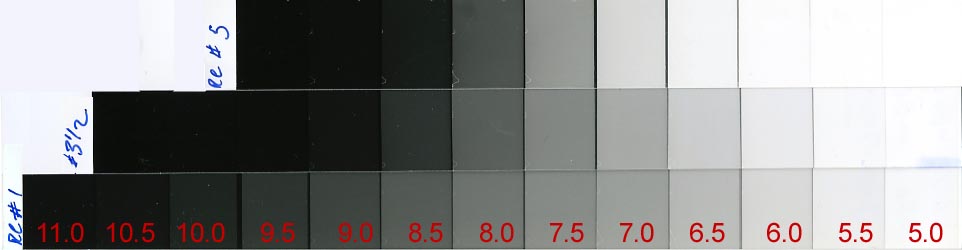
A visual non-densitometric demonstration of VC paper's contrast bugaboo

VC paper’s contrast control is a bit peculiar: at low contrast all the contrast control is in the shadows and midtones with no effect in the highlights; at high contrast all the change is in the highlights and almost no change takes place in the shadows. This post is a visual demonstration of this property.

The image below shows 3 grey patch strips for MGIV RC paper. The exposures were made at 0.5 stop intervals with no negative in the enlarger and with #1, #3 1/2 and #5 contrast filters.

mgivrczt.jpg


The numbers on the strips are exposure given to the #1 strip, as measured in the DA system. The other strips have been given the same exposure sequence but they have been shifted to align a mid-grey at around 7.5 to 7.0 stops of exposure.

Shadows and midtones

Grade #1 shadow/midtones have a 3.5 stop range that runs from 11.0 to 7.5. By grade # 3 1/2 the tonal range is compressed to 2 stops, running from 9.5 to 7.5. The shadow midtone contrast doesn’t change, but remains at 2 stops wide, through to grade #5.

Highlights

In grades #1 to #3 1/2 highlights have a 2.5 stop range, laying between 7.5 and 5.0, and are constant in contrast between the grades. At grade #5 the highlights are compressed to a 1.5 stop range between 7.5 to 6.0.

0.5 stops is one zone system tone at grade #2 contrast - that's pretty coarse and so all the numbers here are approximate. It's not really about numbers in this post - it is instead a visual appreciation of the shift in tonal ranges.

This shows that at normal printing contrasts all the contrast control is in the mid-tone to shadow region. It is only until one gets to unusually high contrasts - #4 through #5 - that any significant contrast change takes place in the highlights.

If increased highlight contrast is needed in a medium grade print the highlights need to be held back and burned back in with a #5 filter. This has always been the advice, but the above grey strips show that actually this is the only way to do it.

Instructions for making zone/tone strips are on the support files section of the Darkroom Automation web site.

http://www.darkroomautomation.com/support/zonestrp.htm
 
Last edited by a moderator:

Nicholas Lindan

Advertiser
Advertiser
Joined
Sep 2, 2006
Messages
4,301
Location
Cleveland, Ohio
Format
Multi Format
The proposal to bleach the silver and print the remaining stain image has been done before...

Yes, I have seen the results.

A trick demonstrated in an American magazine was to bleach the silver back to silver halide with ferricyanide + bromide and then develop it again in pyro developer, repeating the process many times to build up the stain level.

What I was proposing was something much simpler. Bleach the silver away from a uniformly stained pyro negative with no image (well the image of a blank wall or some such). Use the stained negative as an auxiliary contrast filter. See if this filter will alter the contrast obtained with say, #1, #3 1/2 and #5 filters.

Although this sounds silly at first thought, it may give a negative result. This would be significant, the reasoning being:

VC paper doesn't change highlight in contrast until one gets above #3 1/2 and so the stain may not have much effect of lowering highlight contrast at normal printing grades. The highlight contrast at normal grades is already at its lowest point and has no place lower to go.
 
Last edited by a moderator:

Bill Burk

Subscriber
Allowing Ads
Joined
Feb 9, 2010
Messages
9,455
Format
4x5 Format
Sounds like a great test.

I expect a pyro-stain "filter" would tend to block blue light (#4 filter) and would allow green light to pass (#1 filter).

So if you graphed "Pyro + #4" plotted over "#4 alone" I would expect a significant spread between curves. Then plot "Pyro + #1" over "#1 alone" and I expect a significantly different graph, maybe both curves touching.

But if both graphs are similar, then it would be a negative outcome.
 

Jed Freudenthal

Member
Allowing Ads
Joined
Nov 22, 2004
Messages
226
Location
Bilthoven, T
Format
4x5 Format
What I was proposing was something much simpler. Bleach the silver away from a uniformly stained pyro negative with no image (well the image of a blank wall or some such). Use the stained negative as an auxiliary contrast filter. See if this filter will alter the contrast obtained with say, #1, #3 1/2 and #5 filters.

Although this sounds silly at first thought, it may give a negative result. This would be significant, the reasoning being:

VC paper doesn't change highlight in contrast until one gets above #3 1/2 and so the stain may not have much effect of lowering highlight contrast at normal printing grades. The highlight contrast at normal grades is already at its lowest point and has no place lower to go.

You are assuming that the optical properties are the same after bleaching. How are you validating this assumption?

I did once an even more simple experiment: I put oxidized pyrogallol on a glass plate. Then I put the glass plate in the filter drawer of the enlarger. Oh yes it works. But what does it tell you?

Jed
 

Jed Freudenthal

Member
Allowing Ads
Joined
Nov 22, 2004
Messages
226
Location
Bilthoven, T
Format
4x5 Format
I have no idea. Why would I?

How did it work? What did it tell you?

It was just filtering like yellow, and that was what I expected. It looks like a silly experiment, but I wanted to use as to calibrate the pyrogallol stain. I never finished this. It might bring more insight in the nature of the stain. But, the photographic results prevail.

Jed
 

Nicholas Lindan

Advertiser
Advertiser
Joined
Sep 2, 2006
Messages
4,301
Location
Cleveland, Ohio
Format
Multi Format
Last edited by a moderator:

Jed Freudenthal

Member
Allowing Ads
Joined
Nov 22, 2004
Messages
226
Location
Bilthoven, T
Format
4x5 Format
Then it is not really worth talking about anymore, is it?


What results? I'm under the impression you said the 'experiment' never went anywhere?

On the subject of these stains are so many publications, that I think, is there not anything that can be added. Of course much of this information is done with spectrophotometry and other analytical methods. But, what can one add to all that is known? Apparently, you want to use it with other analytical methods to investigate the properties of stain. But, it is up to you to solve that.
Maybe you might get a proper insight in stain with simple procedures. But scientifically, this will not add much. I as a scientist, consider spectrophotometry a quite simple approach.

Jed
 
Photrio.com contains affiliate links to products. We may receive a commission for purchases made through these links.
To read our full affiliate disclosure statement please click Here.

PHOTRIO PARTNERS EQUALLY FUNDING OUR COMMUNITY:


Ilford ADOX Freestyle Photographic Stearman Press Weldon Color Lab Blue Moon Camera & Machine
Top Bottom