
• Welcome to Photrio!
    Registration is fast and free. Join today to unlock search, see fewer ads, and access all forum features.
    Click here to sign up

Using Graded paper vs VC paper

9/50

H
9/50

  • 1
  • 2
  • 26
Beachside picnic, 1920's.jpg

A
Beachside picnic, 1920's.jpg

  • 1
  • 1
  • 57

Forum statistics

Threads
201,218
Messages
2,820,665
Members
100,595
Latest member
keithberry
Recent bookmarks
0

Ian Grant

Subscriber
Allowing Ads
Joined
Aug 2, 2004
Messages
23,370
Location
West Midland
Format
Multi Format
That's the theory Vlad but not borne out in practice, well in my experience anyway.

What you get with a a stained negative and VC/MG papers are negatives that are wonderfully easy to print, rich highlights, less prone to being burnt out.

Now I use Pyrocat HD in the harsh sunlight in the Summer here in Turkey and the dim dull dank days in the UK, it gives me great negs easy to print in all lighting conditions.

I've been printing well over 40 years and VC/MG papers will do all I need, with superb results, I've used alongside graded papers and there were no disadvantages, but a lot of benefits.

If I put a set of images in front of you there's no way you'd be able to tell whether the print was on Graded paper or VC/MG even of stained negatives.

Ian
 

piu58

Member
Allowing Ads
Joined
May 29, 2006
Messages
1,545
Location
Leipzig, Germany
Format
Medium Format
First, there is a characteristic of many VC papers to merge mid-tones at one point in the curve when used at low-medium contrast.

See here: ....

I make photos im my laboratory since nearly 40 years and rarely learn something totally new. Your text "the workings of variable contrast papers" gave me new and deep insight in the virtues and drawbacks from this papers. I understand now my observation that harder grades gives best results. Fortunately my subject requires rather high contrast.
 

Marco B

Subscriber
Allowing Ads
Joined
Jan 13, 2005
Messages
2,736
Location
The Netherla
Format
Multi Format
I bemoan the loss of Grade 5 paper --I cannot seem to get Grade 5 with Magenta filters in my LPL or Durst with the built-in filters and have tried some 'below lens' filters and they seem to have faded .

Get a true dedicated B&W head like the Ilford 500H exposure system. I have one, and recently had to print a negative at grade 5 on Ilford Multigrade IV FB. I made some test strips at grade 4 1/2 and 5, and there was a clear difference. The final print at grade 5 blew me away, it saved the day on a to soft developed negative.
 

Cor

Member
Joined
Aug 21, 2006
Messages
220
Location
Leiden, The
Format
Multi Format
Ralph, I've stated the reasoning above. :smile:
The brown/green/orange stain blocks blue light to some extent, and its density is proportional to silver density. The more silver there is in the negative, the more blue light is blocked in addition to that blocked by the silver itself. This, on a paper sensitive only (or mostly) to blue, increases the contrast. The effect is stronger in the highlights, where it's most needed (because the stain is denser there). On a VC paper the stain, by blocking blue light, acts as a sort of variable yellow filter, decreasing the contrast in proportion to its density. More stain equals less blue light, which on VC paper means less contrast.

I am with Vlad on this one. With the caveat it is only clearly apparent with strongly stained Pyrocat-HD negatives.

I shoot a lot of EFKE 4*5 IR film, and the density of the highlights are unpredictable, they can end up massively over exposed and dense. The inherent stain prints the highlights nicely softer on Ilford MG VC paper. But sometimes it's too soft, and you cannot get punch in the image, also not by switching to a grade 4 or 5 (after all the highlight stain stays the same and thus the softer gradation there). Printing that same negative on fixed grade brings snap back (but sometimes there is too much density you cannot print decent highlights..:sad:..)

I have seen this effect many times, ranging from subtle to clearly apparent.

Best,

Cor
 

Vlad Soare

Member
Allowing Ads
Joined
Jan 16, 2009
Messages
261
Location
Bucharest, R
Format
8x10 Format
Ralph, a comparison would be very easy to make. I might do it when I have the time, and if I do it I'll post the results.
All it takes is a stained negative of a full-scale scene, having very bright but highly detailed highlights. Print it on graded paper. Then print it on VC paper, trying to match the midtones and shadows as well as possible by using one single VC filter. No manipulations, no split printing. Just a straight print. When the midtones and shadows match as closely as they can, see if there's any difference in the highlights.
It's an easy test to make, and I'll try to make it when I have the time.

OK, the theory aside, another thing I like about graded papers is that they're less sensitive to the middle and lower part of the light spectrum, which allows you to use more powerful safelights, or more comfortable colors (for instance, yellow-green filters, which are extremely comfortable but unfortunately fog the bejesus out of VC papers). This is not theory, it's something I've experienced myself. I use four red LED bulbs, which are so strong that they fog VC papers within five minutes unless I shade them (or unless I use just two of them instead of four), but are perfectly safe for over ten minutes with graded paper.

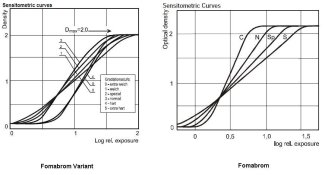
I've been using Fomabrom Variant for a while. It's a paper I really like. At one time, about two years ago, I ordered one box over the telephone and forgot to utter the word "Variant". So they sent me a box of normal grade Fomabrom. "Normal grade" in Europe is approximately what grade 3 is in the US.
Well, some of the best prints I've ever made were made on that paper. No matter how hard I try to reprint them on Fomabrom Variant, something is missing. I don't know what. I can't put my finger on it. I can match the contrast and details exactly, and yet I still like my older prints on graded Fomabrom better.

I think the reason for the difference I perceive is that the VC version doesn't really emulate the characteristic curves of the graded one. In the attached picture we see the curves from Foma's published technical sheets. Not only is the D-max noticeably higher on the graded version, but the curves of its different grades are much better separated, while on Fomabrom Variant they are much closer to each other. The curve of "N" on graded Fomabrom doesn't exactly match any of the curves of the Variant, which may be why I'm unable to get a perfectly identical print on Variant.

OK, the curves are just theory, but that I can see a difference in prints of the same negative made on Fomabrom versus Fomabrom Variant is a fact.

Indirect sepia toners, either with sodium sulfide or with thiourea, give different colors on graded and VC Fomabrom. I'm not saying one is better looking than the other, that's of course a matter of taste, but it can be a good reason for someone to prefer one over the other.
 

Attachments

  • fomabrom.JPG
    fomabrom.JPG
    49 KB · Views: 139
Last edited by a moderator:

RalphLambrecht

Subscriber
Allowing Ads
Joined
Sep 19, 2003
Messages
14,859
Location
K,Germany
Format
Medium Format
Ralph, a comparison would be very easy to make. I might do it when I have the time, and if I do it I'll post the results.
All it takes is a stained negative of a full-scale scene, having very bright but highly detailed highlights. Print it on graded paper. Then print it on VC paper, trying to match the midtones and shadows as well as possible by using one single VC filter. No manipulations, no split printing. Just a straight print. When the midtones and shadows match as closely as they can, see if there's any difference in the highlights.
It's an easy test to make, and I'll try to make it when I have the time. ...

Vlad

I don't understand your test proposal. You have too many variables to cover it in one test. Why would the test prove that the effect comes from the stained negative? It could simply be the difference between the two paper characteristics.

I think you would need another unstained negative of the same gradient and repeat your test with it to show the effect of staining. However, that's not that easy of a test anymore. Unfortunately, it needs to be done to prove the claim.
 

Vlad Soare

Member
Allowing Ads
Joined
Jan 16, 2009
Messages
261
Location
Bucharest, R
Format
8x10 Format
Why would the test prove that the effect comes from the stained negative? It could simply be the difference between the two paper characteristics.
You're right. Good point.
OK then, how about bleaching the silver and printing the remaining image, made of stain only? :smile:
If the theory is correct, then we should get an image on graded paper, and almost no image on VC paper. Considering that during normal printing this image would be superimposed on the one effected by the silver, we could conclude that the stain has a more pronounced effect on graded than on VC paper. Would this be a valid argument?

Or how about this one: develop two identical negatives in a non-staining developer, say D-76. Then bleach one of them completely, followed by complete redevelopment, with the lights on, in a staining developer. The second developer will create the same amount of silver that existed in the negative prior to bleaching. No more (because there is only so much silver halide to develop), no less (because we'd use a long enough time to ensure full development). So the two resulting negatives will have identical silver images, but one of them will have an extra stain added on top.
I think that printing them both would show the effect of the stain on both kinds of paper.
Does this sound like a valid test? :unsure:
 
Last edited by a moderator:

Cor

Member
Joined
Aug 21, 2006
Messages
220
Location
Leiden, The
Format
Multi Format
Vlad

. Why would the test prove that the effect comes from the stained negative? It could simply be the difference between the two paper characteristics.

That is indeed the weakest point in the test, and also in my own reasoning, I mean when I do not get the "punch"I want on Ilford MG I switch to Fomabrom N..talking about comapring apples and oranges...:smile:..still I believe there is a effect of the stain on VC versus graded, but to prove this...

Best,

Cor
 

archer

Member
Allowing Ads
Joined
Jun 29, 2009
Messages
228
Format
4x5 Format
The first time I went to work in a studio was just after I learned to print and about 4 months after I started in photography. As luck would have it I got stuck printing the film brought in from the high schools that were our customers. You never saw so many difficult to print negatives and I remember that the paper I used was Polycontrast and Haloid. I had never used variable contrast paper before and I remember changing the contrast filters that slid into a holder under the lens. This was in 1964 and I developed such a dislike for the look I didn't try VC paper again until 1980. I thought the stuff was still not worth using because it hadn't changed that much in all those years. Five years ago I tried again and was surprised just how much it had improved but I still prefer the look of graded papers and I can tell the difference most of the time but the primary reason for my preference for graded papers is that they just respond to developer changes in a more predictable manner and I don't believe there is any argument regarding that difference, I'm just glad we have a choice.
Denise Libby
 

Ian Grant

Subscriber
Allowing Ads
Joined
Aug 2, 2004
Messages
23,370
Location
West Midland
Format
Multi Format
Five years ago I tried again and was surprised just how much it had improved but I still prefer the look of graded papers and I can tell the difference most of the time but the primary reason for my preference for graded papers is that they just respond to developer changes in a more predictable manner and I don't believe there is any argument regarding that difference, I'm just glad we have a choice.
Denise Libby

Denise, I wonder about your comment on how MG papers respond to development controls.

My experience with the MG papers I've used is they respond very well to development controls, and very predictably. Maybe that's because I tend to stick with one paper, only changing when that's been forced on me by circumstances.

To start with I didn't want to use MG papers but when Record Rapid was dropped, the replacement was Agfa MCC, it didn't take long to before I could match the feel tonality/image colour I was getting previously however the paper was designed to be that way.

I don't think other papers have been designed to be that close, Ilford Galerie and Multigrade FB are very different, and neither were close to the now discontinued Ilfobrom.

Printing is very very much down to personal preferences and working methods, I use basically the same techniques and development controls with MG papers as I did (and still occasionally do) with Graded papers. So my experience is quite different but then our actual paper choices may be the reason.

Ian
 

RalphLambrecht

Subscriber
Allowing Ads
Joined
Sep 19, 2003
Messages
14,859
Location
K,Germany
Format
Medium Format
All testing must be preceded by a claim. Let's assume the claim is: Staining developers create more contrast in the highlights than in the shadows? OK, then we should be able to show the effect by turning staining on and off, without changing any other variable (unless we believe in interactions, in which case we need to perform a proper design of experiments DOE).

To prove the above claim, you need two negatives of the same overall contrast range and print them on the same paper. One negative is developed in, let's say, D76 1+1, the other in a staining developer. Getting the same contrast range out of both is tricky unless you have a proper film test conducted for each. Nevertheless, it needs to be done. Then, print a step tablet with both negatives but on the same paper. Overlay the characteristic curves, and the conclusion will be obvious. Until then...

Also, please remind ourselves: If the contrast range is the same for both negatives, and highlight contrast is increased in the stained negative, then somewhere else, contrast must be reduced. Where is that? Will I like notice it? Is it worth the contrast increase in the highlights?
 

Jed Freudenthal

Member
Allowing Ads
Joined
Nov 22, 2004
Messages
226
Location
Bilthoven, T
Format
4x5 Format

Pyrogallol negatives can have a significant amount of proportional stain. Using graded paper it will add to the contrast, without adding to the silverdensity, which is a considerable advantage.
Using VC paper, it will change the contrast most in the highlights and less in the shadows.
The results on the ywo papers are incomparable.
Whether to use graded or VC paper depends on the situation.
Graded paper is easy to use. VC papers have many possibilities (choices) and as a consequence are hard to use to get an optimum result with stained negatives.
With little printing experience, I would recommend a graded paper. After a while one could try a VC paper.

Jed
 

Mainecoonmaniac

Member
Allowing Ads
Joined
Dec 10, 2009
Messages
6,297
Format
Multi Format
Here's my 2 cents worth. I would start of with VC paper as a beginner. When I first learned learned BW photography. My negatives were inconsistent at best and printing on VC paper was a a God send. Then later when some has been shooting, processing negs and has been printing for a while maybe try graded paper if one has their exposure and developing dialed in. I've been shooting and printing BW for over 20 years and I still haven't reached that point yet. I still don't like to be stuck with one grade with a box of paper.
 

RalphLambrecht

Subscriber
Allowing Ads
Joined
Sep 19, 2003
Messages
14,859
Location
K,Germany
Format
Medium Format
... Using VC paper, it will change the contrast most in the highlights and less in the shadows. The results on the ywo papers are incomparable ...

Jed

Change from what to what? If there is a difference in contrast, it can be measured.
 

Mainecoonmaniac

Member
Allowing Ads
Joined
Dec 10, 2009
Messages
6,297
Format
Multi Format
Hey Ralph. Tell me if I'm wrong, but I print for my highlights and use the contrast grade to control the shadows. Does that answer Jed's question?
 

Ian Grant

Subscriber
Allowing Ads
Joined
Aug 2, 2004
Messages
23,370
Location
West Midland
Format
Multi Format
Hey Ralph. Tell me if I'm wrong, but I print for my highlights and use the contrast grade to control the shadows. Does that answer Jed's question?

Often it's necessary to use contrast grade to control and open up the shadow detail, and printing controls to control the highlights.

So reverse of what you're saying.

Ian
 

Jed Freudenthal

Member
Allowing Ads
Joined
Nov 22, 2004
Messages
226
Location
Bilthoven, T
Format
4x5 Format
Jed

Change from what to what? If there is a difference in contrast, it can be measured.

The influence of proportional stain on the print is most significant with pyrogallol developers, if developed to maximum proportional stain. One does not need a measurement to see the difference in the effect. Many other developers (particularly hydrochinon and catechol developers) have a stain that is less or difficult to observe without special methods.
I have developed a pyrogallol developer with a lot of proportional stain. I have to go to a printing latitude that one does not expect that from the negative by looking at it. A relatively thin negative and long exposure times for the print. And as a result excellent high lights. So far the practical and most important part for most Apuggers.
Of course, one can measure the contribution of the stain. But that is a scientific approach. One approach we did in the past ( with catechol stains) is microdensitometry in a wave length window. Or bleaching of the silver. etc.
But, I think, most photographer are interested in the result , and not in a theoretical approach.
I, personally, I using negatives with a proportional stain. And I use graded as well as VC paper. But I apply the papers, depending on the light condition. The VC papers absorb specular highlights good and details in the deep shadows. The graded papers are better in cases where specular highlights are not that important ( 1oo% diffuse reflection), in general the more common situation. And, as I said before, the graded papers are easy; the VC papers have many possibilities with the stained negatives, but it requires a lot of experience.
But, another question is; who tells you what negative is stained or not. If a negative has stain and one is not aware, it is stained, one can have trouble understanding the prints. So, if you do not want a stained negative, you better proof it is unstained. This is one of the reasons I have chosen for a stained negative. No problems, take whatever is best: graded or VC.

Jed
 
Photrio.com contains affiliate links to products. We may receive a commission for purchases made through these links.
To read our full affiliate disclosure statement please click Here.

PHOTRIO PARTNERS EQUALLY FUNDING OUR COMMUNITY:


Ilford ADOX Freestyle Photographic Stearman Press Weldon Color Lab Blue Moon Camera & Machine
Top Bottom