
• Welcome to Photrio!
    Registration is fast and free. Join today to unlock search, see fewer ads, and access all forum features.
    Click here to sign up

Using CMY Controls as Neutral Density Control

Romy

A
Romy

  • 0
  • 0
  • 4
Abandoned Grain Silo 3

H
Abandoned Grain Silo 3

  • 0
  • 0
  • 33

Forum statistics

Threads
204,407
Messages
2,868,101
Members
102,255
Latest member
brianalog
Recent bookmarks
0

Dan Rainer

Member
Joined
Mar 28, 2024
Messages
73
Location
Georgia, USA
Format
Multi Format
About a year ago, I upgraded my Beseler 67 from a condenser head to a diffusion head with Dichro color filters. I mostly print small, often 5x7, so I use a neutral density filter under the lens to maintain an optimal aperture and feasible print times. This has worked well enough, but I recently had a thought—could I use the dichro filters as a sort of built-in ND?


If the paper needs a grade 3 filter for the desired contrast I would set the magenta knob to 40. Alternatively, could I set the magenta knob to 200 and both the yellow and cyan to 160? Would this still give the correct contrast, while using the remaining joint density of the three dichro filters as an ND?
 
With actual CMY dichro coloheads, if the filters are still in good condition and clean, then by equally adjusting (increasing) all three dials or readouts, you hypothetically get consistent neutral density. But different brands of coloheads have used different cc spacings or values. Some provide a scale or list of how much density this involves in their own specific increments, some don't. I have an easel densitometer or cc reader which makes this easy, regardless of which colorhead I'm using.

Your colorhead math is correct, but doesn't automatically mean you'll get your exact desired result. You could try it with a test strip as your starting point and see what happens.
 
Page 3 here
tells us Beseler uses Kodak numbers and tells you which dual controls to use.
Assuming we are talking about Black and White, Cyan is not usually used as it acts as a minus red and red is the safelight colour.
I have always found that the amount of Blue light is a more dramatic response and so multiplying both yellow and magenta by the same factor is problematic.
As you can see in the dual settings (which are meant to keep a consistent time) the difference in 0 (90 yellow)and 00 (162 yellow) maintains approximately the same time.
 
It also depends on if there is internal monitoring feedback to the light output, since over the long run, the main dichroic filters can degrade due to heat as well as grime build-up.
Those don't technically fade like dyed filters, but can spall off some of their coating, and eventually perform less effectively, and even a little differently from one another.

One of my 8x10 Durst colorheads has a table containing both Kodak and Durst cc increments in relation to its own settings. But in actual practice, that's only approximate. Yet when it comes to B&W VC printing, rather than color printing, approximate is generally adequate.

The ratio of sensitivity to blue vs green light varies somewhat between different VC papers.
But using my true additive RGB colorheads, instead of CMY, the green layer behaves as more sensitive. I won't go into the specific of why here; but in its practical sense, it is worth noting. CMY filtration is somewhat different, because that always includes an amount of "white" light spillover.
 
Last edited:
It also depends on if there is internal monitoring feedback to the light output,

Definitely not in the Beseler 67 dichroic head.
Which type did you get - there are at least three? :smile:
The newest has the power supply in the head.
The oldest two I'm aware of (and had at one time) had separate power supplies feeding the head and the 82V halogen bulb inside.
One used a proprietary connector between the power supply and the head.
The other used what look like a normal plug for a wall outlet - what could go wrong???? And how do I know the answer to that question? :whistling:
FWIW, when I used mine, I worked from the appropriate "speed matched" contrast setting table and just added equal amounts of all three filter settings to reduce the intensity - usually in increments of 30. 30 of course being a remnant from my days doing colour printing.
I know that the cyan was probably unnecessary, but it just seemed to feel appropriate!
Drew is almost certainly accurate about it being both not strictly linear - the contrast probably changes a very tiny amount - and the non-linearity not mattering enough to matter for B&W variable contrast work.
 
For black-and-white enlarging, you don't need to dial in any cyan. The paper is blind to red, so you don't need to remove it. Equal amounts of Y and M should get you neutral density, then add whatever extra you need for contrast on top of that. That will make the image a bit easier to see too.

Since you're testing for contrast as you go, there is no need to worry about how matched the increments are, just get to a reasonable printing time with equal parts of Y and M and then find your final contrast by adding more Y or M. EZPZ.

But, since you've already got a ND filter, that's a sure thing and also easy to use. Either is fine.

Doremus
 
Ilford‘s dual filter settings essentially use the neutral density trick; that is magenta and yellow together equals neutral density (for a red insensitive substrate. ) Just as you had suspected.
 
Matt - I don't have any Beseler enlargers. I have "hot-rodded" (cannibalized, highly customized) three Beseler "U" RGB power supplies and controls with feedback to two custom setups, one of them on a Durst 138 5X7 chassis. Push-button ND is easy, but I prefer other ways of doing that if necessary. Has no relation to any of their small MF enlargers, nor to their older "U" designated beehive units and various darkroom gadgets.
There would be no way to incorporate the power supply into head of one of these; too much heat. These were their brief venture into expensive pro units, though nowhere near the price or nuclear meltdown league as the contemporaneous ZBE Starlight of Ciba days.

Plus I have a separate 12X12 high-output blue-green V54 cold light dedicated to only b&w printing.

The VC-only version of those simply had the dichroic red filter removed, and an ND filter put in its colorhead position instead; and the control panel was modified for sake of that.
But one could hypothetically switch back and forth if they wished. Although actual RGB filters are involved (all 3 for color applications), the panel readout is translated into more convenient CMY units via appropriate feedback filtration in the mixing box. That's why it's important to keep those secondary filters clean too. Electronics can be fussy. My wife was awakened early this morning by a spider getting into the smoke alarm. I'm diligent to keep them from getting into my colorheads.

The Beseler "U" is rather electronically temperamental. When they work, they work great;
but one has to understand what gives them tantrums : any kind antistatic generators or solid-state ballasting in the same building; sudden voltage fluctuations in the incoming wiring or in the air. I unplug them if utility work is being done in the neighborhood, or if there's a lighting storm. It took me years to predictably psychoanalyze them; but now I've gone nuts due to that - so there's a tradeoff.

I have a 6x9 color neg in my smaller 4x5/5x7 unit right now, but didn't print with it today because it's a little too warm for the fussy feedback system. My conventional CMY 10X10 Durst unit on the L184 chassis would do fine; but there's an 8x0 color neg presently in that.
My smaller 4x5/5x7 RGB head uses three pulsed halogen 250V bulbs; the larger 8X10 custom version uses six.

Beseler basically walked away from their warranty and service obligations to those models,
since they could get away with that due to a change in ownership. The theory was excellent, and these were much more powerful and intuitive to use than their previous RGB xenon mini-flashtube system; but they underbuilt the electronics, and tried to cram too many components into too tight a space, plus other design flaws. There is an independent power supply specialty service which can make corrections starting at $500.

After that episode, Beseler went back strictly to conventional CMY halogen colorheads.
 
Last edited:
Drew,
I would be amazed if you said you used one of those Beseler 67 enlargers - they were simply good enlargers, aimed strictly at the amateur and school market.
I sold mine a couple of years ago. I bought it in the 1970s, and it served me very well as a black and white condenser enlarger, until I started picking up the dichroic light sources some time after 2000. I never had the variable contrast head, but I wanted one :smile:.
I would still be using mine if its inclined column and largish footprint worked with my current space constraints.
Here it is in my bathroom/darkroom temporary space in our previous place:
Beseler dichro 67_0028b-resized.JPG
 
Thanks for all the helpful replies! My dichro head is in great shape and the filters seem solid. I have an RH Designs Analyzer Pro, so I'll play with the baseboard light meter attachment and see how much density I can generate from Ilford Dual Color Filter Chart and compare with my previous CMY settings at the same grade. It might just be a good supplement to my ND filter. Sometimes an ND 0.9 just isn't enough for 5x7 prints.
Page 3 here
tells us Beseler uses Kodak numbers and tells you which dual controls to use.
Assuming we are talking about Black and White, Cyan is not usually used as it acts as a minus red and red is the safelight colour.
I have always found that the amount of Blue light is a more dramatic response and so multiplying both yellow and magenta by the same factor is problematic.
As you can see in the dual settings (which are meant to keep a consistent time) the difference in 0 (90 yellow)and 00 (162 yellow) maintains approximately the same time.
I was unaware of this data sheet. Incredibly helpful read. I was making my Grade-to-CMY conversion from the Beseler manual, but I think I'll probably use Ilford's Dual Color Filter chart going forward.
Definitely not in the Beseler 67 dichroic head.
Which type did you get - there are at least three? :smile:
The newest has the power supply in the head.
The oldest two I'm aware of (and had at one time) had separate power supplies feeding the head and the 82V halogen bulb inside.
One used a proprietary connector between the power supply and the head.
The other used what look like a normal plug for a wall outlet - what could go wrong???? And how do I know the answer to that question? :whistling:
FWIW, when I used mine, I worked from the appropriate "speed matched" contrast setting table and just added equal amounts of all three filter settings to reduce the intensity - usually in increments of 30. 30 of course being a remnant from my days doing colour printing.
I know that the cyan was probably unnecessary, but it just seemed to feel appropriate!
Drew is almost certainly accurate about it being both not strictly linear - the contrast probably changes a very tiny amount - and the non-linearity not mattering enough to matter for B&W variable contrast work.
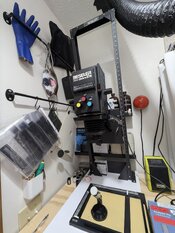
I got the latest model with the power supply in the head! I was walking into the used camera store with my fiancée. She asked if I was planning on buying anything. I said "No, the only thing I could possibly want is a Beseler 67 dichro head. But what are the odds they'll have THAT?" The words were barely out before I saw the mint Beseler 67 with the dichro head. I walked away with it for $100.☺️
 

Attachments

  • PXL_20251219_023010075.jpg
    PXL_20251219_023010075.jpg
    384.6 KB · Views: 9
No, Matt, the only 6x7 enlarger I ever had was very briefly a Chromega "B" colorhead version about 50 yrs ago which I quickly replaced with the 4x5 "D" version. My "smallest current colorhead is 5X7 INCH film capacity, using the power supply and controls, and certain other components from the 4x5 Beseler "U" RGB 750W halogen system, but otherwise highly customized and improved by myself, and adapted to a true commercial Durst floor-standing 138 Chassis.

My 8x10 RGB equivalent is in an entire league of its own - fully customized from the ground up and 14 ft tall. The precision machined 30X40 vac easel alone weighs around 350 lbs (I cannibalized that from a 22 ft long Japanese process camera which originally cost $200,000 - my cost, zero - even borrowed a forklift and truck crew for free). It's currently being ignored due to needing updated maintenance to its power supplies (plural). I don't think my wife even knows that huge enlarger exists - she does daily see some of the framed prints made with it.

My backup "ordinary" Durst CMY L184 10X10 rig is just fine for the kind of RA4 color printing I'm doing now. The dedicated additive system had a distinct advantage back in Cibachrome days, but no longer.

I'm currently printing on Fuji Maxima paper, now that it's finally available in the US, cutting it from a 30 inch wide roll. And wow!, what an amazing paper it is, printed either way (RGB or CMY).
 
Last edited:
I got the latest model with the power supply in the head! I was walking into the used camera store with my fiancée. She asked if I was planning on buying anything. I said "No, the only thing I could possibly want is a Beseler 67 dichro head. But what are the odds they'll have THAT?" The words were barely out before I saw the mint Beseler 67 with the dichro head. I walked away with it for $100.☺️

Well done :smile:.
And I'm glad that Bill drew your attention to the Ilford data sheet about contrast control, because I'd assumed that you already had it.
So that you understand, the speed matching, dual colour tables are, by necessity, based on keeping one particular tone constant, while others change with the change of contrast. I believe that the tone chosen for that consistency is a mid-to-highlight tone roughly consistent with how a Caucasian skin tone might render.
The approach is very helpful, but not perfect. When you change contrast, you often have to follow with a tweak to the exposure too.
 
If the paper needs a grade 3 filter for the desired contrast I would set the magenta knob to 40. Alternatively, could I set the magenta knob to 200 and both the yellow and cyan to 160? Would this still give the correct contrast, while using the remaining joint density of the three dichro filters as an ND?
It's very simple: yes.
 
Photrio.com contains affiliate links to products. We may receive a commission for purchases made through these links.
To read our full affiliate disclosure statement please click Here.

PHOTRIO PARTNERS EQUALLY FUNDING OUR COMMUNITY:


Ilford ADOX Freestyle Photographic Stearman Press Weldon Color Lab Blue Moon Camera & Machine
Top Bottom