• Welcome to Photrio!
    Registration is fast and free. Join today to unlock search, see fewer ads, and access all forum features.
    Click here to sign up

US made cameras around 1944

Recent Classifieds

Forum statistics

Threads
202,968
Messages
2,848,234
Members
101,564
Latest member
noelchenier
Recent bookmarks
1
I have a roll of recent Efke film in 127, procured through Freestyle, but don't know anything about its current availability.

I love the Argus C3 as well, and have a few of them. Terribly underrated cameras!
 
That film is no longer stocked at Fotoimpex.
 
That's what I figured, AgX. Freestyle seems to have a bit of remaining Efke stock at present, but other than that, only Rollei Crossbird and Nightbird are available. It seems that with regard to "regular" B&W and color negative film, the 127 format is pretty much dead now.
 
That b&w film is also still available in Germany and quite "regular".

And a 800 ISO colour film... ist that not ideal for a MF low speed camera?
 
I think the Kodak 35 would be in the running as well: http://en.wikipedia.org/wiki/Kodak_35_Rangefinder

For a wartime 35mm I second the Kodak 35, from what I recall Kodak made a miltary version is olive drap or black, I have seen a few that were modified for use with parascopes. But the Speed was the most common camera in use, at the end of the war the Combat Speed was issued and were used as late as Vietman.
 
(there was a url link here which no longer exists)

That is a wicked cool photo. A "brick" on a brick with a brick wall background. Each brick subject has an aperture too.
 
From US-Army documentation it is clear that the mainstay of camera equipment was made up by Speed Graphics especially this type (PH-47):
http://www.speedgraphic.fr/PH-47E_UK.html


In 35mm it was the Kodak 35 in military version (olive-green outer and click-stop aperture):
Dead Link Removed


Later a special designed camera was used (PH-501):
http://www.peterlanczak.de/simmon_combatcamera.htm


In small quantities Leicas and Rolleiflexes were stated to be used, bought off the shelves or 2nd hand. Though not modified and though not the standard cameras these two, as the two above, were put into type-related, designated camera kits.


Also private owned cameras were used by photographers when they considered them superior to the standard one. (Zeiss Super Ikonta B above the standard Speed Graphic)

 
International press photographers covering the Korean War 1952. Werner Bischof

Dead Link Removed
 
The US Govt. bought some Leicas during WWII through intermediaries in Switzerland and South America. They were shipped through Vichy France and the Iberian peninsula to South, then North America. Leitz Canada is a post war creation. E Leitz New York is a wartime creation. Kodak Ektar lenses can be dated by the first two letter in the serial number. EC is 1941 EA 42, EM 43, EE 44, ER 45.

David
 
Mopar_guy is correct. Do it right and bring a Deardorff V8 with a Ries tripod! :smile:

So, I made a deal with my Sweetie. I told her she could take that extra suitcase full of shoes if she would carry my camera.:devil:


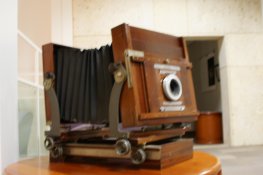
DSC04009.jpg
 
nice camera jim !

if you are interested in an argus a, let me know !
 
nice camera jim !

if you are interested in an argus a, let me know !

Thanks for the offer. I did get a circa 1941 Argus C3 in pristine condition. So, I will pretend I'm Tony Vaccaro, although I don't plan to go "Into Germany". I'm also in the process of acquiring a French manufactured Lumiere 6X9 folder circa 1937. Both cameras were family heirlooms, so that makes them even more special to me.
 
From US-Army documentation it is clear that the mainstay of camera equipment was made up by Speed Graphics especially this type (PH-47):
http://www.speedgraphic.fr/PH-47E_UK.html


In 35mm it was the Kodak 35 in military version (olive-green outer and click-stop aperture):
Dead Link Removed


Later a special designed camera was used (PH-501):
http://www.peterlanczak.de/simmon_combatcamera.htm


In small quantities Leicas and Rolleiflexes were stated to be used, bought off the shelves or 2nd hand. Though not modified and though not the standard cameras these two, as the two above, were put into type-related, designated camera kits.


Also private owned cameras were used by photographers when they considered them superior to the standard one. (Zeiss Super Ikonta B above the standard Speed Graphic)


@AgX

Would the Kodak 35 that you mention still operate if it got wet? I'm writing a novel--historical fiction--about a journalist aboard the U.S.S. Princeton when it's sunk at the Battle of Leyte Gulf.
 
The camera mechanics should work even under water.

On the optics however the lens and camera body would be useless after a certain amount of water has got inside. Also the film might suffer, in any case it would not be easy to handle it later.
 
The camera mechanics should work even under water.

On the optics however the lens and camera body would be useless after a certain amount of water has got inside. Also the film might suffer, in any case it would not be easy to handle it later.

Thanks for answering: Do you have any idea if a journalist, back then, would have traveled with it (on board a carrier, for example) in a way that would protect it from water?
 
@AgX

Would the Kodak 35 that you mention still operate if it got wet? I'm writing a novel--historical fiction--about a journalist aboard the U.S.S. Princeton when it's sunk at the Battle of Leyte Gulf.

Moisture between the shutter blades would likely cause it to stick, and salt water in the shutter mechanism (gear train and escapement) would destroy it in a few days. The Kodak 35 was my very first high quality camera ca. 1975, I was 14.
 
Moisture between the shutter blades would likely cause it to stick, and salt water in the shutter mechanism (gear train and escapement) would destroy it in a few days. The Kodak 35 was my very first high quality camera ca. 1975, I was 14.

edit - I don't know of any waterproof case for that camera. Protection from spray/splashes would have been an oilcloth or rubberized waterproof bag or other sort of covering.
 
Hmm. OK. I will either have to remove my journalist from the scene of the sinking, or make it so somehow he keeps his camera from getting wet. The joys of historical fiction.

Many thanks @E.von Hoegh
 
@AgX

Would the Kodak 35 that you mention still operate if it got wet? I'm writing a novel--historical fiction--about a journalist aboard the U.S.S. Princeton when it's sunk at the Battle of Leyte Gulf.

The armory aboard the Princeton would have had a variety of watertight ammunition boxes that an enterprising journalist may have obtained for keeping a camera, film, and journal dry in emergencies. The common .50 caliber machine gun ammo box probably wouldn't hold a 4x5 Anniversary model Speed Graphic, but the 3.25x4.25 model or smaller cameras should fit. Journalists often used their personal equipment, or gear loaned by whoever they were working for. Some, like Eugene Smith, carried a variety of cameras. "When he started from the Pacific Coast for Hawaii, Gene Smith had two Ikoflexes, a Rolleiflex, a 4x5 Graflex, a Speed Graphic for color and another fitted for aerial work, a Contax with five lenses, and a Kodak Medalist." Eight months later most needed repairs. W. Eugene Smith : the life and work of an American photographer by Jim Hughes. This might be a good book for background information on a great photojournalist in WWII and later.
 
We should distinguish between

-) camera sealed or put in sealed casing to be submerged for underwater photography or terrestial photography with immense water pressure as within waterfalls

-) camera stored waterproof (those ammunition boxes)

-) camera protected against heavy water spray (as on a sailing boat)

I guess Writer Girl is referring to the latter.
 
Indeed, I am referring to the latter.

@Jim Jones. You my friend, are a wealth of knowledge. I'll be reserving the book about Smith at the library. :smile:
 
Protection against spray might suffice for civilian recreational sailors, but the rigors of Navy service make camera protection against immersion and shock desirable. I doubt that most Navy men provided such protection, even of their own equipment. Certainly I didn't, but my chances of being in combat were slim. Personal storage space aboard Navy ships was meager. I had little convenient storage space, with rarely used items stored elsewhere with limited access. This was years after WWII when living conditions were quite improved.
 
As stated above, submerging in salt water is deadly for most cameras if not washed out quickly. And even then you're probably looking at a complete clean and re-lubrication.

A Kodak 35 could most certainly be in the hands a journalist during World War 2, as they were introduced in 1938. The Kodak 35 RF too.

One of U-96s crewmembers brought Lothar Buchheim's Leica camera back to life while still out at sea. The camera had jammed solid from the build-up of salt from the constant spray he suffered while out in the conningtower of the submarine.
 
Photrio.com contains affiliate links to products. We may receive a commission for purchases made through these links.
To read our full affiliate disclosure statement please click Here.

PHOTRIO PARTNERS EQUALLY FUNDING OUR COMMUNITY:


Ilford ADOX Freestyle Photographic Stearman Press Weldon Color Lab Blue Moon Camera & Machine
Top Bottom