
Yep, but that means taking the filter off, metering, then reattaching. A hand held would be simpler, not sure if OP has a hand held meter, so maybe only option is to meter without the filter.You could use the camera meter without the filter then apply the filter factors.
-
Welcome to Photrio!Registration is fast and free. Join today to unlock search, see fewer ads, and access all forum features.Click here to sign up
- Home
- Forums
- Analog Workflow Forums (100% Analog/Traditional)
- Analog Equipment
- 35mm Cameras and Accessories
You are using an out of date browser. It may not display this or other websites correctly.
You should upgrade or use an alternative browser.
You should upgrade or use an alternative browser.
TTL metering and filters
-
A
- Thread starter garpet
- Start date

Recent Classifieds
-
For Sale Sinar Tripod Head
- Started by Jammoh
-
For Sale Heiland LED for Leitz V35 setup for contact prints
- Started by Jammoh
-
For Sale Sinar camera accessories
- Started by Jammoh
-
For Sale Sinar Extra long 60cm 5x7 Bellows
- Started by Jammoh
-
For Sale Sinar Geared Bank Holder / Bench Holder
- Started by Jammoh
Forum statistics
- Joined
- Jul 14, 2011
- Messages
- 15,218
- Format
- 8x10 Format
I don't shoot 35mm very often, but when I do, it might be on a rainy day stealth snapshot style, with the camera tucked under my parka, or else out on a brisk walk just having some fun, or scouting out a location prior to lugging in bigger equipment. In such cases, I'm apt to have a deep orange 22 or 24A filter in place when using B&W film, and will get an OK response selectively TTL metering through that. But if I choose a red filter instead, all bets are off, and I'll take a handheld spotmeter reading instead. A couple times of year I'll repeat these kinds of applications, just to keep my Nikon metering skills honed. For everything else, MF and LF, I strictly do handheld spot metering, then apply the filter factor, which itself has been determined by careful testing in advance.
OP
OP

Sadly I don't have a hand held meter. Maybe in the future if taking the filter off and putting it back on again becomes a hassle. It would be nice if there were filters that had quick releases like a lens capYep, but that means taking the filter off, metering, then reattaching. A hand held would be simpler, not sure if OP has a hand held meter, so maybe only option is to meter without the filter.

You
You should look into filters with magnetic mounts or, if working from a tripod, rectangular ones which are easy to insert into and remove from their holder. There are solutions for this problem but a simple handheld meter should be about the same cost.It would be nice if there were filters that had quick releases like a lens cap

Sirius Glass
Subscriber
I prefer to take the light reading without any filters [other than UV or warming filter] and adjust the exposure for the filter that I will be using. Why? Because testing exposures through denser filter versus without filters and adjusting for the filter, differ; less dense filters, not so much.
- Joined
- Jul 14, 2011
- Messages
- 15,218
- Format
- 8x10 Format
With some monorail camera systems like Sinar, hinged flip-away filter accessories are available.
It is easy enough to TEST yourself...
- aim camera meter at a blank uniformly illuminated wall (ideally when illumination is not fluctuating, perhaps artificially illuminated) and
- take a reading (without filter), apply filter and take another reading.
- Compare that experimental difference vs. the stated filter factor, and draw your own conclusion for that filter.
Repeat test method with other filters. Figure out if the meter reading varies by the same or different amount from the filter factor...then you know which filters work with TTL meters, and which ones do not.
This is a good test except for two intervening variables -- the color of the filter and the color of the subject. TTL metering using a red filter, for example, exposing a woman in a red dress will give you a very different exposure than a blue dress. With a 25A filter you should open-up 3 stops, but all of the red light will get through the filter to the TTL meter and you won't open up enough -- and you get a dark dress instead of light. With a blue filter on the lens, you'll have the opposite problem. The meter will tell you to open up too much (not much light gets to the meter), and you'll end up with a light dress instead of dark.

This is a good test except for two intervening variables -- the color of the filter and the color of the subject. TTL metering using a red filter, for example, exposing a woman in a red dress will give you a very different exposure than a blue dress. With a 25A filter you should open-up 3 stops, but all of the red light will get through the filter to the TTL meter and you won't open up enough -- and you get a dark dress instead of light. With a blue filter on the lens, you'll have the opposite problem. The meter will tell you to open up too much (not much light gets to the meter), and you'll end up with a light dress instead of dark.
Explaining why many folks say metering with filter works fine...there are exceptions to the general rule. Leading us back around the circle to the advice...meter without the filter, apply filter factor to reading, set exposure and place filter and shoot.
OP
OP
Got a word back from Nikon: They no longer have any information on the F2 or its pentaprisms due to their age... supposedly... eh, guess it's time to start really digging. maybe find some broken one where the sensor itself still responds to reverse engineer and try to identify it or just measure its response curves directly. not to avoid testing the lenses because that's DEFINITELY easier but rather just to scratch the itch.
Sadly I don't have a hand held meter. Maybe in the future if taking the filter off and putting it back on again becomes a hassle. It would be nice if there were filters that had quick releases like a lens cap
Well there is, Cokin and Lee filter system use an adapter with slide in and slide out filters. The adapters come in different thread sizes, I use mine with MF and LF, not often with 35mm, but I have a set of adapters for 49 to 73mm.

MartinCrabtree
Member
Got a word back from Nikon: They no longer have any information on the F2 or its pentaprisms due to their age... supposedly... eh, guess it's time to start really digging. maybe find some broken one where the sensor itself still responds to reverse engineer and try to identify it or just measure its response curves directly. not to avoid testing the lenses because that's DEFINITELY easier but rather just to scratch the itch.
My FM2n manual says to meter through the filter is OK except for an R60 in which you apply 3 stop plus in daylight.
- Joined
- Jul 14, 2011
- Messages
- 15,218
- Format
- 8x10 Format
I don't care what the FM2n manual states about this; I've done my own very careful testing with my own specific filters and predominant film choices. Nikon did offer its own version of a red filter (the R60), a little on the weak side compared to most 25's; and the reading with this particular filter in place would probably be at least half a stop off; and the recommended 3 stop filter factor is basically correct based my own experience.
But what happens when you have a red-orange 23 filter in place, like I sometimes use on my Nikon? It's brighter to view and focus through than a 25, but distinctly stronger than a deep orange 22. Then there are stronger red filters like a 29, really nice for cutting through haze with TMX, but which might require a 4X filter factor depending. This is why personal testing is important.
So what Nikon states is correct in terms of THEIR OWN limited filter selection, at least in relation to most black and white films, but certainly not all, since metering with contrast filters in place fails to take into account differences in spectral response between various black and white films. In other words, their advice is valid as a generalization; but there are numerous exceptions to generalizations.
For example, the real world filter factor difference between TMax 100 and Delta 100 with a medium green filter in place is half a stop, even though the meter reading itself would make no such distinction. Throw in Acros 100, which is orthopanchromatic, and you're a full stop off. This isn't the fault of the Nikon meter, which uses a silicon cell quite similar to that in Pentax and Minolta spotmeters, but demonstrates how films themselves differ in filter factors. And even the same filter number might differ somewhat between different manufacturers, or lot to lot within the same manufacturer.
And what one can get away with in a moderate contrast scene might turn out quite disappointing in a high contrast scene, where there is less latitude for exposure error.
But what happens when you have a red-orange 23 filter in place, like I sometimes use on my Nikon? It's brighter to view and focus through than a 25, but distinctly stronger than a deep orange 22. Then there are stronger red filters like a 29, really nice for cutting through haze with TMX, but which might require a 4X filter factor depending. This is why personal testing is important.
So what Nikon states is correct in terms of THEIR OWN limited filter selection, at least in relation to most black and white films, but certainly not all, since metering with contrast filters in place fails to take into account differences in spectral response between various black and white films. In other words, their advice is valid as a generalization; but there are numerous exceptions to generalizations.
For example, the real world filter factor difference between TMax 100 and Delta 100 with a medium green filter in place is half a stop, even though the meter reading itself would make no such distinction. Throw in Acros 100, which is orthopanchromatic, and you're a full stop off. This isn't the fault of the Nikon meter, which uses a silicon cell quite similar to that in Pentax and Minolta spotmeters, but demonstrates how films themselves differ in filter factors. And even the same filter number might differ somewhat between different manufacturers, or lot to lot within the same manufacturer.
And what one can get away with in a moderate contrast scene might turn out quite disappointing in a high contrast scene, where there is less latitude for exposure error.
Last edited:
OP
OP
Found an old manual for the f2SB that says the same thing, except it (as well as the manual for the f2 photomic) only specifies +1 stop under tungsten light for the R60My FM2n manual says to meter through the filter is OK except for an R60 in which you apply 3 stop plus in daylight.
OP
OP
I didn't even consider this. It might be worth while to crowdsource a table for this with as many film, filter, and meter combinations as possibleI don't care what the FM2n manual states about this; I've done my own very careful testing with my own specific filters. Nikon did offer its own version of a red filter, a little on the weak side compared to most 25's; still, the reading with filter in place would probably be at least half a stop off. Metering with strong contrast filters in place also fails to take into account variations in spectral response between various black and white films.
For example, the real world filter factor difference between TMax 100 and Delta 100 with a medium green filter in place is half a stop, even though the meter reading itself would make no such distinction. Throw in Acros 100, which is orthopanchromatic, and you're a full stop off. This isn't the fault of the Nikon meter, which uses a silicon cell quite similar to that in Pentax and Minolta spotmeters, but demonstrates how films themselves differ in filter factors. And even the same filter number might differ somewhat between different manufactuers, or lot to lot within the same manufacturer.
- Joined
- Jul 14, 2011
- Messages
- 15,218
- Format
- 8x10 Format
There are just way too many inherent variables, not to mention all the different shooting styles in play. The different filters alone might number in the hundreds, even though most people only use between two to five. The classic Wratten filter handbook by Kodak gives actual spectrograms and transmission values for every one of their true gel filters, if one knows how to interpret those kinds of specs. True gels have gotten expensive and are no longer used much in the field due to their fragility. But still, it can be quite informative reading through a manual like that. Those still sometimes turn up at used bookstores.
Meters could only be factored if they are industry standard calibrated all the same, and if people know how to correctly use them.
Then take cheaper filters which are not even coated, and you introduce the possibility of flare factors.
In other words, it's a lot more reliable to do your own bracketing tests on your own representative subject matter, using your own favorite films and filters. Just another fun project in the learning curve.
Meters could only be factored if they are industry standard calibrated all the same, and if people know how to correctly use them.
Then take cheaper filters which are not even coated, and you introduce the possibility of flare factors.
In other words, it's a lot more reliable to do your own bracketing tests on your own representative subject matter, using your own favorite films and filters. Just another fun project in the learning curve.
MartinCrabtree
Member
And I don't care to be dismissed like an errant child for trying to assist another forum member. Just in case ya missed that I wasn't talking to you.I don't care what the FM2n manual states about this; I've done my own very careful testing with my own specific filters and predominant film choices. Nikon did offer its own version of a red filter (the R60), a little on the weak side compared to most 25's; and the reading with this particular filter in place would probably be at least half a stop off; and the recommended 3 stop filter factor is basically correct based my own experience.
But what happens when you have a red-orange 23 filter in place, like I sometimes use on my Nikon? It's brighter to view and focus through than a 25, but distinctly stronger than a deep orange 22. Then there are stronger red filters like a 29, really nice for cutting through haze with TMX, but which might require a 4X filter factor depending. This is why personal testing is important.
So what Nikon states is correct in terms of THEIR OWN limited filter selection, at least in relation to most black and white films, but certainly not all, since metering with contrast filters in place fails to take into account differences in spectral response between various black and white films. In other words, their advice is valid as a generalization; but there are numerous exceptions to generalizations.
For example, the real world filter factor difference between TMax 100 and Delta 100 with a medium green filter in place is half a stop, even though the meter reading itself would make no such distinction. Throw in Acros 100, which is orthopanchromatic, and you're a full stop off. This isn't the fault of the Nikon meter, which uses a silicon cell quite similar to that in Pentax and Minolta spotmeters, but demonstrates how films themselves differ in filter factors. And even the same filter number might differ somewhat between different manufacturers, or lot to lot within the same manufacturer.
And what one can get away with in a moderate contrast scene might turn out quite disappointing in a high contrast scene, where there is less latitude for exposure error.
- Joined
- Jul 14, 2011
- Messages
- 15,218
- Format
- 8x10 Format
Who says I was correcting you specifically, or anyone else personally for that matter? I wasn't. Lighten up. Once things get posted, including mfg advice, it's general information open to fair discussion. In this particular case, for sake of later Nikon F series owners, it's valid to clarify that what is in the owner's manual regarding filters probably realistically applies only to their own limited selection. How could it be otherwise? I wish I knew things like that when I started out.
And I could have taken it to yet another level, and have pointed out how lots of older Nikon filters are somewhat different from current ones, and are often yellowed too. Is that worth knowing or not? I'd sure want to know it if I was shopping for Nikon filters.
And I could have taken it to yet another level, and have pointed out how lots of older Nikon filters are somewhat different from current ones, and are often yellowed too. Is that worth knowing or not? I'd sure want to know it if I was shopping for Nikon filters.
Last edited:
OP
OP
Well there is, Cokin and Lee filter system use an adapter with slide in and slide out filters. The adapters come in different thread sizes, I use mine with MF and LF, not often with 35mm, but I have a set of adapters for 49 to 73mm.
View attachment 409023
maybe in the future, but at that point it might make sense to just get a handheld meter rather than buying all new filters
I use a number of hand held meters, the Gossen SBC has a built in correction dial with Filter Factors, easy to take a reading then adjust with a twist of the dial. Even when using a red filter I have found the filter factors to be accurate.

What do you do with a polarizing filter where the filter factor can vary 1 to 2 stops depending upon the position of the filter?
Averaging would work in most cases, and so woul be paying attention to how much polarization is being used and compensating accordingly.
Is it more accurate to use an exposure meter through the polarizing filter?
Is it more accurate to use an exposure meter through the polarizing filter?
How much more “accuracy” do you really think you need? Why not do a quick study and figure out the answer to your question?? I suspect it depends on the meter. Some in-camera meters, for instance, don’t work well with linear polarization.
Last edited:

Petrochemist
Member
There are just way too many inherent variables, not to mention all the different shooting styles in play. The different filters alone might number in the hundreds, even though most people only use between two to five. The classic Wratten filter handbook by Kodak gives actual spectrograms and transmission values for every one of their true gel filters, if one knows how to interpret those kinds of specs. True gels have gotten expensive and are no longer used much in the field due to their fragility. But still, it can be quite informative reading through a manual like that. Those still sometimes turn up at used bookstores.
Meters could only be factored if they are industry standard calibrated all the same, and if people know how to correctly use them.
Then take cheaper filters which are not even coated, and you introduce the possibility of flare factors.
In other words, it's a lot more reliable to do your own bracketing tests on your own representative subject matter, using your own favorite films and filters. Just another fun project in the learning curve.
Old copies of it are also available as a PDF's in places like Archive.org I downloaded a copy & gathered similar info for many of my filters when I had access to a spectrometer at work.
Some filters like the 'Red enhancer' / Neodymium & astro light pollution filters have numerous sharp bands of absorption. They can darken light from specific sources while having much reduced effect on continuum sources. Filter factors are completely useless for these when the specific light source is present. Such as sodium lights/glass blowing with the neodymium.
Polarizers are another case where specific circumstances make filter factors useless. The shot below was lit from behind by a laptop LCD screen (a polarized light source) and a CPL on the lens rotated to block the screen in the background.
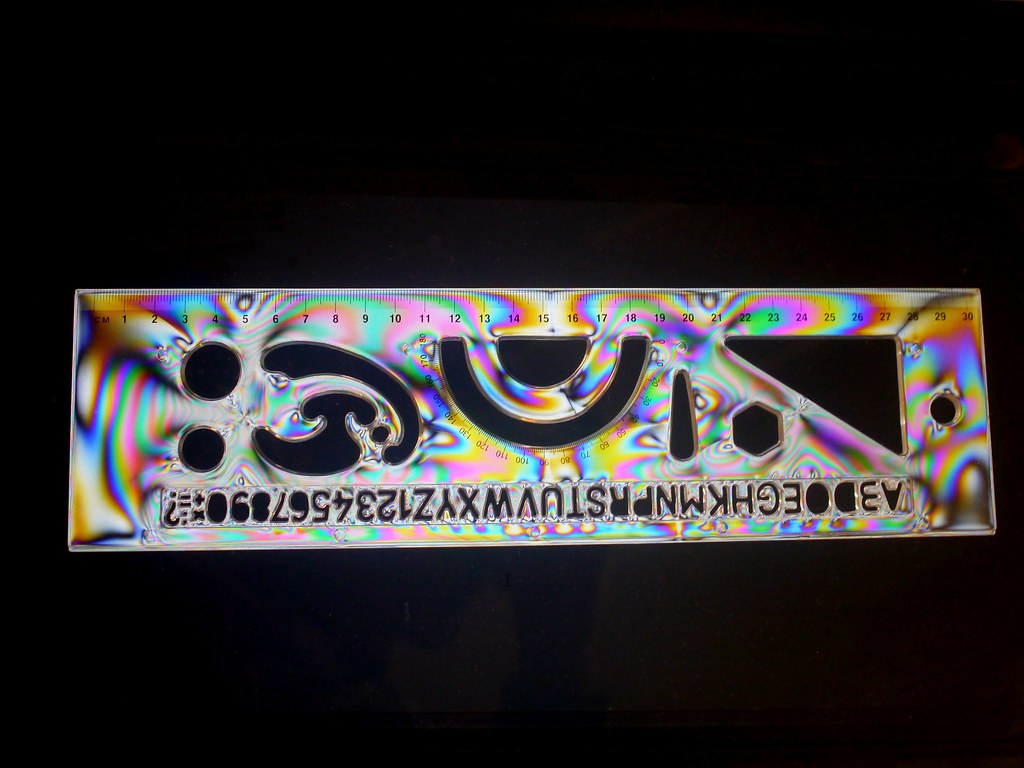 stressed stencil by Mike Kanssen, on Flickr
Not much of the white screen is visible!
Last edited:
| Photrio.com contains affiliate links to products. We may receive a commission for purchases made through these links. To read our full affiliate disclosure statement please click Here. |
PHOTRIO PARTNERS EQUALLY FUNDING OUR COMMUNITY:  |