

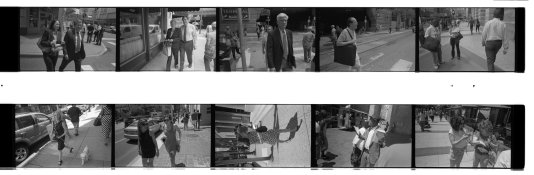
I apologize in advance to any of those that are tired of this very dead discussion. With the recent increase (and later fall) of the price of Tri-x 400, I took it on myself to test Hp5 since they had cost about the same. With a trial run of 30 rolls to use for my daily shooting for about a week or so, I began by developing the first two along with the last roll of Tri-x 400 I have just shot. Conditions are the same as they are on the same day, both loaded into the same camera (Leica M4 with 28mm f2.8 V4 Elmarit), and developed in D76 together for 12 minutes using normal agitation (initial 30 seconds including pouring and 5 seconds of inversion for ever 30 seconds thereafter with two firm raps). The dilution is 1 to 1.166 (300ml developer to 350ml water) at 68F. Posted along with this are the two films scanned at the same time in an Epson V750 scanner. The shots are not exactly the same, but you can infer how the films perform under the same conditions and processing. Both films were shot at EI 800. Any levels adjustments or effects of the scanner were applied to both negative strips at the same time during the same scan, so that has been eliminated, the comparisons here are therefore relative to each other and not necessarily indicative of the comparison to films. For bonus fun, the films are not labeled which strip is which! Which do you think is which film?
Physical observations:
Hp5 lies very flat upon drying, it is very easy to scan while Tri-x in most cases tends to curl more. The film base is roughly the same density for each. Tri-x feels to be a thicker substrate than Hp5.
Physical observations:
Hp5 lies very flat upon drying, it is very easy to scan while Tri-x in most cases tends to curl more. The film base is roughly the same density for each. Tri-x feels to be a thicker substrate than Hp5.



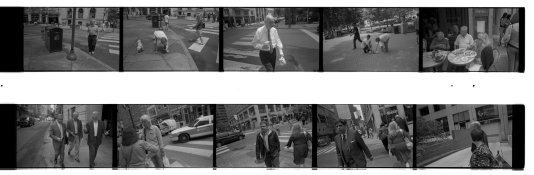
 They looked fairly similar to the results I get.

