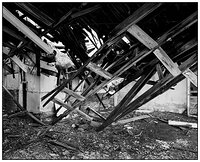
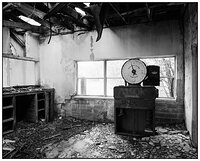
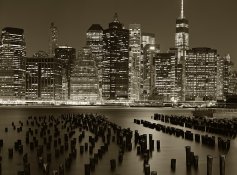
Film can definitely handle this much contrast if you know what you are doing. There is no need to go to exotic developers or stand development. Just a good developer at the right dilution in a tray.
The tonal range in the Royal Tire Factory when Ray McSavaney made his beautiful photographs was 15-18 stops. He was able to control this in a very simple way. One ounce of HC 110 syrup in a gallon of water. The film was developed in this solution by shuffling through the film in one corner of a 16x20 tray. Of course not many people are as patient as he was. His development times with this method ran up to 35 minutes.
By the way if you have never seen this work, look it up.
Your comments are actually quite true and may Ray rest in peace. He was a huge talent in the contemporary world of traditional process black and white photography.
I was fortunate to learn of Ray's HC 110 technique through a mutual friend back in the early 80's as I recall. It was actually a mistake which lead Ray to his discovery. He made an exposure in the Uniroyal factory with the lens wide open and determined that it was 6 stops overexposed, rather than discard the film he decided to process the film in a very dilute solution with intermittent agitation for a half hour. His results lead to the very technique you speak off.
I used this very technique for 20 years and countless scenes of ultra high contrast, the process works, however not without serious concessions.
With the HC 110 technique, film speed is dramatically reduced, likely 3-4 stops when compressing 6 stops of excess contrast, in other words I would regularly expose highlights 3-4 stops higher than I ultimately wanted them to print because the extremely dilute developer would suppress all tonalities equally in the neg leaving no shadow information. Essentially, one had to expose shadows on Zone 7 in the hopes they would reproduce on the print to a Zone 3 density. Secondly, with a non Pyro developer such as HC 110 the emulsion is not hardened in the very early stages of development and thus the emulsion continues to swell promoting Silver Migration which leads a significant loss of film sharpness and micro contrast. The only solution back in those days was to over compress the highlights beyond where you wanted them so that one could use the hardest contrast printing paper possible to restore the appearance of a sharp image.
I greatly enjoy this type photography and was fortunate myself back in 2004 to stumble upon a dilution and scheme which worked with what is now known as Extreme Minimal Agitation film processing. The major difference in the two methods is there is no lose of film speed, mid tone micro contrast is actually enhanced and by the nature of the process the highlights are suppressed to whatever degree you choose.
As I'm sure you are aware, with the HC 110 process the negs look extremely weak, in fact unprintable, yet they do indeed produce wonderful prints of extreme contrast scenes. With EMA negatives their appearance is uniform no matter what contrast they are controlling, expanding a low contrast scene of only 3 - 4 stops or scenes of contrast in the neighborhood of 15 stops. All while enhancing THE most difficult part of a negative to control, mid tone micro contrast. As an FYI, my developing times range from only 12 minutes up to 90 minutes to control 6 stops of contrast on either side of normal.
So thanks for the opportunity to recall Ray's wonderful imagery and to offer another way to skin the cat.
Cheers !