I thought I had.
I'd like to find one or two finer-grained black-and-white films to use once the weather stops keeping me indoors -- after upgrading back to film I've shot a lot of Tri-X, which I love, but now I have a list of stuff to try for finer grain, and T-Max is not on that list. I shot a lot of T-Max back in the day, particularly in school, because that's what the teacher said to use, but wasn't planning to try it now because I didn't like the look of it so much. So, apparently I'm wrong about that and ought to give it another chance. Great, maybe I will, if I find an approach that shows promise. I'm a lot better at this now than I was back then, after all.
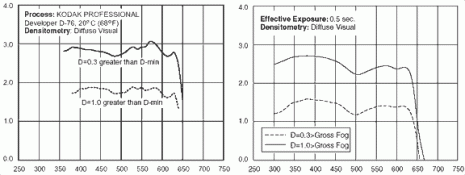
I could only find the following question from your posts: "Does it really change the curve of TMY that much?" and you appeared to dismiss it for cost reasons and the lack of examples on flickr in the preceding and following sentences. So in context, the question you're asking already having been answered, it doesn't appear to me to be a real request for info as much as a statement of disbelief. That aside:
I think TMY-1 underwent at least one change, and TMY-2 is again different, so if you're comparing current TMY to the first offering, which is what you likely tried in 1990 or earlier, it's different. I worked in a lab doing 2,000 custom B&W prints a month on two D5's and a roller transport processor just after TMax films were introduced. Many of our customers across a wide range of skill levels shot the first version TMY and our film processing, by hand in small tanks, used Kodak's recommended times in TMax developer. With the abuse the film took from the shooters (often pushing it way too hard) and TMax developer by the book, I often had to work very hard to get good prints on the Polycontrast III RC the lab used, and I learned to dislike printing other people's work with it. I often had to print with the lowest contrast filter and pre-flash to hold the highlights. I finally got with the film processor in the next room and we ran some trials with shorter times, and I even convinced him to try less agitation, so we got things adjusted to print on grade 2 with decent people behind the camera and normal scenes. He was military trained, so the reduced agitation bit took some convincing. But after that, the films worked well and customers were happy.
When I did try the TMax films for myself and found the developers (not TMax) and methods that suited my taste, I liked TMX, TMY, and TMZ just fine, and I was a Verichrome Pan, Tri-X, and Panatomic-X shooter. John Sexton, who was a major product tester for the TMax films, preferred D-76 and the RS version of TMax developer in 1987.
http://www.largeformatphotography.info/articles/sexton-tmax.html
Try TMY-2 in Edwal 12 replenished. Buy two liters and refresh from the second liter, or if you're just trying it out one roll at a time, just split one liter and replenish from the second 500ml. It needs about 4-5 rolls/liter run through it to season properly before you start replenishment. Edwal 12 was designed to give a little boost for flat, gray midwestern winter shooting on the films of about 70 years ago. I found that reduced agitation could bring the contrast down to a Zone System normal or perhaps lower. This also lowers the shoulder a bit.
Getting what you want from a new film requires learning how to implement all the controls, exposure, developer, dilution, agitation routine, time and temp to make it do what you want. It takes time and testing. No short answers and everyone does it a little differently. Only you will know if Edwal 12 will give you what you want with TMY, and then only if you give it a shot.
Lee