
• Welcome to Photrio!
    Registration is fast and free. Join today to unlock search, see fewer ads, and access all forum features.
    Click here to sign up

TMax Sheet Film Developers

Recent Classifieds

Forum statistics

Threads
202,814
Messages
2,845,821
Members
101,542
Latest member
sshhane
Recent bookmarks
0
When I shot TMY 4x5 and 8x10, I developed it mainly in Xtol 1+1. I also developed them in Pyrocat-HD. TMY took on a very special look/feel in semi-stand, slightly more dilute Pyrocat-HD.

How does PyrocatHD act on the emulsion, is it more of a developer for special circumstances......sounds like some use as general purpose.
 
Last edited:
First, I missed the warning and tried T-Max with sheet film one time without issues. After seeing the warning I have used Xtol 1+1 and occasionally Rodinal for TMX.
 
Well I think


How does PyrocatHD act on the emulsion, is it more of a developer for special circumstances......sounds like some use as general purpose.

Chuck..... There has been a lot written about staining developers. My journey began by seeing some incredible prints...then my friend processed some film for me.... then reading "The Book of Pyro"... It's been my standard developer for over 20 yrs now.

 
This echoes posts #4 and #12.

I developed T-Max sheet films in the standard version of T-Max Developer for several years before I learned of Kodak’s warning to instead use T-Max RS or some other developer to avoid the POSSIBILITY of dichroic fog.

By that time, I had successfully processed a significant number of T-Max sheet films with no hint of dichroic fog (or any other problems). Is it possible, that Kodak altered the emulsion at some point so that it’s no longer particularly susceptible to dichroic fog when developed with T-Max Developer? I don’t know.

I continue to use T-Max Developer with 4” x 5” and 8” x 10” T-Max sheet films without any discernible problems. I use the ASA 100 version of the film exclusively, so I don’t know if the problem might be more likely with faster speed film.
 
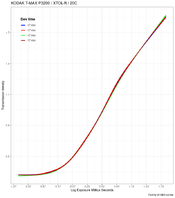
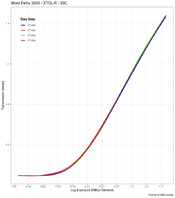
Though I am fairly new to replenished XTOL, I have found it to be very stable, once it's been seasoned. Here are the results of four subsequent seventeen-minute developments of KODAK T-MAX P3200 and ILFORD Delta 3200 in XTOL-R. As you can see, the developer is very consistent. It produces well-formed curves, which can be simply interpreted as very nice tonality. It is also clean-working and produces very fine grain with respectable sharpness. I am currently testing T-MAX 100 in XTOL-R and, so far, I am finding it to be a great pairing.

kodak_P3200_individual_intro.pngilford_D3200_individual_intro.png
 
Like Andrew O, I use Pyrocat and have used that and PMK before for over 20yrs. Super economical and great results. I buy the 50 litre kits from Photo Formulary. 5ml@/500ml for roll film. 10ml@/1 litre for sheet film in trays.

Pyrocat-HD is a fantastic developer, and Xtol-R is next. Sadly, my bottle of Xtol-R tipped over in the sink, emptying out half its contents. With all these developer testing I've been doing, I haven't gotten around to replenishing it... 🙄
 
Well I think


How does PyrocatHD act on the emulsion, is it more of a developer for special circumstances......sounds like some use as general purpose.

It's a staining developer.
 
I see the stock Kodak D-76 is used in the chart but no mention of D-76 1:1, which is more often than no, no?
 
I've always done one shot. In my mind the consistency factor when replenishing would be harder to maintain, as it relates to my ZS testing, personal EI, developing times for expansion and contraction, etc............I admit I'm ignorant on replenishing since I've never done that. Why is it that you say you get better results with replenished developers?

Replenished XTOL gives better tonality and even finer grain.
 
I see the stock Kodak D-76 is used in the chart but no mention of D-76 1:1, which is more often than no, no?

D76 was designed and formulated to be replenished, it gives the best results replenished, however its sales are too low as is ID-11, to warrant either company manufacturing a replenisher. Dilute use was quite late, it wasn't mentioned when I started, then amateurs began using them dilute and both Kodak and Ilford gave times for 1+1 and 1+3. In practice 1+2 is a far better option.

Unlike D76/ID-11 Xtol is self repleninishing and a far better developer anyway, and that hastened the withdrawal of D76.ID-11 Replenishers. At the same time the use of deep tanks for professional work almost completely died out, with the switch to Digital.

Ian
 
I've developed a lot of TMAX-100 in Rodinal 1:50 over the years. Including 4x5 with continuous rotary agitation. Developing times are long, but it has been very reliable for me. I haven't shot TMX 4x5 in quite a while though.

I have recently been developing TMAX-400 in E-76, but only 35mm, using the recommended times from the film datasheet at stock strength. This is quite recent for me, I've scanned some and they scanned very nicely, have not made SG prints yet.
 
I've developed a lot of TMAX-100 in Rodinal 1:50 over the years. Including 4x5 with continuous rotary agitation. Developing times are long, but it has been very reliable for me. I haven't shot TMX 4x5 in quite a while though.

I have recently been developing TMAX-400 in E-76, but only 35mm, using the recommended times from the film datasheet at stock strength. This is quite recent for me, I've scanned some and they scanned very nicely, have not made SG prints yet.

I am looking forward to see your Sirius Glass prints soon. 🙄
 
Though I am fairly new to replenished XTOL, I have found it to be very stable, once it's been seasoned. Here are the results of four subsequent seventeen-minute developments of KODAK T-MAX P3200 and ILFORD Delta 3200 in XTOL-R. As you can see, the developer is very consistent. It produces well-formed curves, which can be simply interpreted as very nice tonality. It is also clean-working and produces very fine grain with respectable sharpness. I am currently testing T-MAX 100 in XTOL-R and, so far, I am finding it to be a great pairing.

View attachment 324537View attachment 324538

Do you have a curve for Tmax 100 in XTOL (not replenished)
 
Well, my prior experience with developing 4x5 Tmax 100 is just with HC110. I really like the comparison graph put up by SG in post #6 as compared to HC110 and I think I'd like to go with XTOL this time. I'm hoping my personal EI will be in line with the box speed as well.
 
FWIW, it wouldn't surprise me if the dichroic fog issues with T-Max developer were at least somewhat film dependent - i.e. of more concern with some films than others.
They may have also been affected by the method of agitation - tray developing vs. deep tank vs. inversion vs. continuous rotary.
 
FWIW, it wouldn't surprise me if the dichroic fog issues with T-Max developer were at least somewhat film dependent - i.e. of more concern with some films than others.
They may have also been affected by the method of agitation - tray developing vs. deep tank vs. inversion vs. continuous rotary.

Ron Mowrey (PE) mentioned Kodak's issues with Dichroic fogging after the numerous US atmospheric nuclear tests, this caused issues with first DK20 (Kodatol), and then Microdol with US made Kodak emulsions. This resulted in Eastman Kodak releasing Microdol-X. They also stopped using Active Gelatins with natural sulphur spots, instead they de-activated the gelatins and used Thiosuphate to increase sensitisation.

Here in the UK Microdol stayed in production much longer as the Kodak Ltd emulsions didn't have the same issues. When I first used Tri-X Kodak developers had recommended EI's and development times for Tri-X US, Tri-X Canada, and Tri-X UK, that was a long time ago . . . .

The upside of Rochester's issues was far greater control of emulsion manufacture, so films made outside the US matched those made in Rochester, and at the peak that included Kodacrome 25 & 64.

Ian
 
Photrio.com contains affiliate links to products. We may receive a commission for purchases made through these links.
To read our full affiliate disclosure statement please click Here.

PHOTRIO PARTNERS EQUALLY FUNDING OUR COMMUNITY:


Ilford ADOX Freestyle Photographic Stearman Press Weldon Color Lab Blue Moon Camera & Machine
Top Bottom