
• Welcome to Photrio!
    Registration is fast and free. Join today to unlock search, see fewer ads, and access all forum features.
    Click here to sign up

There's a fungus among us

MIT. 25:35

MIT. 25:35

  • 0
  • 0
  • 24
Lutheran Cemetery Angel

H
Lutheran Cemetery Angel

  • 0
  • 0
  • 32

Recent Classifieds

Forum statistics

Threads
202,945
Messages
2,847,990
Members
101,552
Latest member
rbaltman409
Recent bookmarks
0

Brian Bilgere

Member
Allowing Ads
Joined
Nov 21, 2008
Messages
13
Format
35mm
So I bought a Minolta XD-11 setup from someone a month or so ago on ebay. I'm past my week to return it.

It's a beauty. Black and silver XD-11 with and autowinder D, MD Rokkor 28/2.8, and an MD Rokkor 50/1.7. I thought I'd only need new leather.

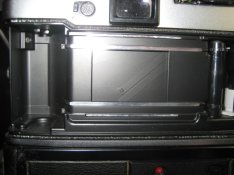
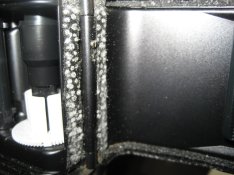
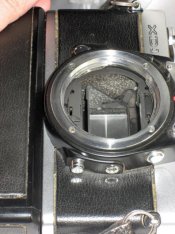
Anyway, it seems to have a fungus issue on the body, but I don't see it on the lenses. I've never had a fungus before. I see white spots on the light seals and in the mirror box.

I've attached some pictures.

So after seeing these, is this a fungus? Is there any hope of removing it?

What would you do with this if you owned it?

Is it at all likely that the fungus would grow on film that is run through the camera? I'd hate to use it and contaminate my pictures or my tanks.

I have the camera and lenses separate from my other gear. I'd love to use those lenses on another body, but I don't want to carry back any spores.

Brian
My photography blog - http://www.365cameras.com
 

Attachments

  • IMG_2778_edited-1.jpg
    IMG_2778_edited-1.jpg
    53.3 KB · Views: 546
  • IMG_2784.JPG
    IMG_2784.JPG
    159 KB · Views: 528
  • IMG_2785.JPG
    IMG_2785.JPG
    161.1 KB · Views: 538
Certainly looks like it to me.
 
I think you are screwed... Perhaps a professional cleaning?
 
Ye Gods!
I've seen tiny spots of fungal growths, but this is extreme.
I'd keep it in a sealed plastic bag lest the fungus migrate to something else; especially if you go overseas and it's discovered at (gulp!) Customs! Removing one area of fungal growth does not necessarily mean the entire camera is free of it, as it migrates. Who knows what the internals are like under the cover??

Pro bench clean, or at worst, toss it.
 
I'd be inclined to ditch it. Fungus like this isn't just going to live where it can be seen, so unless you're capable of stripping it down yourself, the professional cost may exceed the body's value.
 
So after seeing these, is this a fungus? Is there any hope of removing it?

What would you do with this if you owned it?

To me it looks like the light seals deteriorated; I've seen that pattern many times before (the third picture.)

If I owned it, I would scrub it with some alcohol and Q-tips. After getting it clean I would replace the light seals and periodically check it to make sure it's okay. Unless it's not functioning properly I would see no reason not to use it (I used a totally beat-up Trip 35 in the past.)
 
What I would be thinking about is "Do I want to be holding this up to my eye". It looks like it's to late, if you look inside it will probably be worse. Too bad, such a nice camera.
 
That looks like corrosion of the aluminium to me, not fungus. Of course, it could be fungus and I'd hate it to grow on you, but I don't think it's organic. You see the same spotty pattern on aluminium things all the time. Even if it is fungus, it doesn't look like the same species of fungus that inhabits lenses and eats your coatings/balsam - that typically has a fibrous spidery frond-like appearance, not spots.

At least the lenses you got are fine!

I would clean it carefully with isopropanol and then ammonia (just in case it is fungus) and leave it out in strong sunshine for a couple of days. It's probably all through the body though, and a professional CLA may be more than it's worth.
 
Were it mine, I'd give it a thorough cleaning. clean everything I could, then replace the seals, and when not in use store it in a sunny location with lense removed and back open. It wouldnt hurt to place dessicant packs in it. The alternative, it seems, is to toss it or foist onto someone else.

Rick
 
De camera heeft waarschijnlijk vochtig gelegen,kijk maar op foto 3,onderaan het scharnierpunt,ligte roestvorming,dat zou dus ook de schimmel verklaren,het is wel gemakkelijk op te lossen hoor,de schimmel kun je gemakkelijk verwijderen,en de roest ook,vervolgenseen klein druppeltje dunne olie er op,de overtollige olie weg halen,en ook het schuimrubber in de achterwand vernieuwen,daar zit ook de schimmel in.

veel succes,Ruud.
 
O ja,de buitenkant,het leer verwijderen,en alle lijmresten ook,dit kan met Aceton,en vervolgens een nieuw stukje leer kopen en op maat snijden en er op plakken,R.
 
You could zip it up in a bag with some chemical inside it like bleach, ammonia, formaldehyde, hydrogen peroxide ..something that will find its way through the camera killing whatever is lurking
put it on a heater etc
Steam cleanerize it
Blow it out with a compressor or canned
Leave it in kitty litter container for a week to drive out some moisture/smell

I wouldn't worry about fungus inside a camera all that much
Clean the visible and the rest should die off if used or done anything with
 
Does it smell objectionably? If not, I don't know that I'd worry too much. Bleach will kill the fungus (if it needs killing) - use a q-tip gently. I'd pull out the seals and replace them (seems to run about $10 for a kit on ebay). Even if fungus somehow got onto the film, I don't think it's going to survive a run through the chemicals so I don't see how it'll comtaminate the tank.
 
I agree with whoever said this doesn't look like fungus - I'll bet running a Q Tip soaked in bleach will not remove it, I think it is a corrosive action on the surfaces.
 
Drag a toothpick through the slots across the foam. If the foam scrapes up easily, they should be replaced. John
 
Clean it thoroughly. Use Q-Tip and Clorox. Then leave it for a week without the lens, towards the sun.
 
You need to replace all the foam anyway. Just clean it up and be happy. Don't be so afraid of fungus, they make antibiotics.
 
Don't use bleach, the chlorine could corrode steel surfaces in the camera. Use isopropanol on a q-tip to soak the seals and replace them. Open the camera up afterwards and expose it to some direct sunlight for a couple of days.
 
First image. Definitely aluminum corrosion. Have seen it before. Scratch it and will see it is a dry powder, leaving a small crater. Was it fungus, your mirror wouldn’t have look so nice.

Second image. I don’t see any problem. All looks clean.

Third image. Confusing, but if it would have been fungus, it would have migrate, not self-limited to this specific area. I rather suspect corrosion again, but this time triggered not only by humidity, but also by an electric effect due to the proximity of two different metals. And, iron and aluminum are very sensitive to this phenomenon. This would explain both, the aluminum oxide migrate on the light seals, and the iron rust on the door. For confirmation, the axis and spring of the door should also be rusted. These are the parts putting the two metals in close proximity, and this would also explain why this corrosion didn’t showed-up elsewhere on the light seals. Once again, scratch the spots and see if a dry powder (like a very fine salt by touching). You’ll feel if organic or mineral.

If it shows to be corrosion, than mechanical local cleaning, +/-some painting, would be enough. Avoid chemical cleaning, especially bleach, ammonia, vinegar. Alcohol would still be fine (at least but not last, for cleaning).
 
It's mold. I've lived in Florida 30 years, I've seen it on all sorts of things, photographic and others. You can clearly see the mositure this camera was subjected to by looking at the third photo of the seal for the back, look at the nooks and crannies and you will see surface rust in several places. You have a mold problem. Wipe things down with isopropyl alcohol that are affected by the mold. Don't touch the mirror. Then send the camera out for a CLA and foam replacement and replace the leathers on the body. You can use some "Ospho" with a spotting brush to stop the surface rust in it's tracks.
 
If it was galvanic corrosion, how would you explain the spots inside the mirror box? Corrosion of the base aluminum through the paint would probably cause the paint there to blister and peel. I'd say this is on the surface. Fungus likes organic materials like paint, foam and adhesives.

And yes, the steel of the door spring and hinge would probably rust - doubtful that it's stainless steel and any other steel would rust in presence of moisture. For aluminum in contact with steel, acting as a galvanic couple, the aluminum should be expected to corrode first since it is the more active material.
 
If it was galvanic corrosion, how would you explain the spots inside the mirror box? Corrosion of the base aluminum through the paint would probably cause the paint there to blister and peel. I'd say this is on the surface. Fungus likes organic materials like paint, foam and adhesives.

Aluminum can be paint over, or paint might be applied by galvanization. And I’m inclined to consider galvanization for the mirror room, for at least two reasons: the paint must be applied on a textured surface to avoid reflections, and the paint mast be very strong fastened to the aluminum surface. In this case, corrosion works just like in the first photo. Beside that, only the owner can say if these spots are in surface (fungus) or in profusion (corrosion).
 
Photrio.com contains affiliate links to products. We may receive a commission for purchases made through these links.
To read our full affiliate disclosure statement please click Here.

PHOTRIO PARTNERS EQUALLY FUNDING OUR COMMUNITY:


Ilford ADOX Freestyle Photographic Stearman Press Weldon Color Lab Blue Moon Camera & Machine
Top Bottom