
Dan Pavel
Member
As Niranjan suggested in another thread I am opening a new thread to discuss a different, new approach in making Digital Negatives.
I've tried many "calibration" methods for the alternative processes and none of them gave good results in any situation. Most of the time you have to re-trace the curves in PS and make more tests to get a good result. I ended-up with the conclusion that the process of "calibration" itself must be, somehow, wrong or incomplete. Calibration tries to map an extended scale of equidistant grays into one with the same number of grays that keeps the equidistance while respecting the Dmax and the Dmin capabilities of the alternative process/paper involved. Simply saying the "calibration" is a method to compress a gray-scale into another gray-scale keeping the relationships between the grays. At first look it seams a correct approche and mathematically it is, undoubtedly, correct.
But...
As many have noticed it doesn't always lead to good results. Why? IMO, the "Calibration" method is a compressing method very similar with the DOLBY sistem in music (the compress of an extended scale of frequencies to meet the limited recording capabilities of the magnetic tape) with an essential difference - when you play the tape the DOLBY system expands back the scale of frequencies and the sound is perceived correctly. This final stage is completely absent in the Digital Negative "Calibration" methods. It is like playing a DOLBY-recorded tape on a non-DOLBY device - the result is somehow flat, un-natural. That's why the existing "Calibration" methods lead to better results if you start with an image with higher contrast.
The mathematical correctness and the process automation can't automatically lead to a perceptual correct result. In music, on a non-DOLBY device a tape recorded without DOLBY sounds better than one recorded with DOLBY. That's because the frequencies are specially adjusted in studio to meet the tape capabilities - not by trying to record them all (impossible on tape) but by restricting to the ones that ca be recorded on the specific tape and by changing the relation between them in order to make the music sound natural. In Architecture the proportions and straight lines of the Parthenon have had to be altered in order to look correct. If they were kept correct they wouldn't look correct. It's a general principle in Arts - things must LOOK RIGHT and not necessary BE RIGHT, contrary to science/engineering. The same should be true in making a Digital Negative for the Alternative Processes. IMO, a completely different, perceptual approach is necessary.
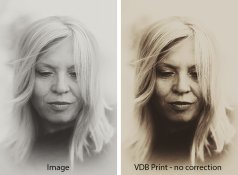
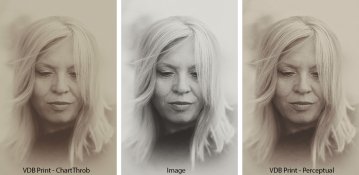
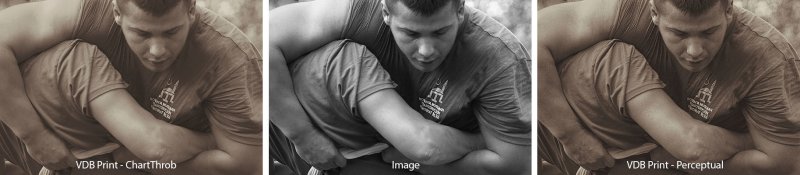
In the last months I have worked at developing the work-flow of such an "perceptual" approach in the creation of the Digital Negatives. It's now in the extended testing stage and, at least for me, it works better and it's more predictable than the traditional ones.
What do you think on the matter?
I've tried many "calibration" methods for the alternative processes and none of them gave good results in any situation. Most of the time you have to re-trace the curves in PS and make more tests to get a good result. I ended-up with the conclusion that the process of "calibration" itself must be, somehow, wrong or incomplete. Calibration tries to map an extended scale of equidistant grays into one with the same number of grays that keeps the equidistance while respecting the Dmax and the Dmin capabilities of the alternative process/paper involved. Simply saying the "calibration" is a method to compress a gray-scale into another gray-scale keeping the relationships between the grays. At first look it seams a correct approche and mathematically it is, undoubtedly, correct.
But...
As many have noticed it doesn't always lead to good results. Why? IMO, the "Calibration" method is a compressing method very similar with the DOLBY sistem in music (the compress of an extended scale of frequencies to meet the limited recording capabilities of the magnetic tape) with an essential difference - when you play the tape the DOLBY system expands back the scale of frequencies and the sound is perceived correctly. This final stage is completely absent in the Digital Negative "Calibration" methods. It is like playing a DOLBY-recorded tape on a non-DOLBY device - the result is somehow flat, un-natural. That's why the existing "Calibration" methods lead to better results if you start with an image with higher contrast.
The mathematical correctness and the process automation can't automatically lead to a perceptual correct result. In music, on a non-DOLBY device a tape recorded without DOLBY sounds better than one recorded with DOLBY. That's because the frequencies are specially adjusted in studio to meet the tape capabilities - not by trying to record them all (impossible on tape) but by restricting to the ones that ca be recorded on the specific tape and by changing the relation between them in order to make the music sound natural. In Architecture the proportions and straight lines of the Parthenon have had to be altered in order to look correct. If they were kept correct they wouldn't look correct. It's a general principle in Arts - things must LOOK RIGHT and not necessary BE RIGHT, contrary to science/engineering. The same should be true in making a Digital Negative for the Alternative Processes. IMO, a completely different, perceptual approach is necessary.
In the last months I have worked at developing the work-flow of such an "perceptual" approach in the creation of the Digital Negatives. It's now in the extended testing stage and, at least for me, it works better and it's more predictable than the traditional ones.
What do you think on the matter?