




Andreas Thaler
Subscriber
Thanks to various service and repair projects at PHOTRIO (Canon T90, Minolta 9000 AF, Nikon F3, etc.), we have a good understanding of the inner workings and basic principles of electromechanical SLRs from the 1980ies.
What’s missing, however, is information about the heart of these hybrid SLRs—namely, their electronic control systems.
From a service and repair perspective, you don’t need to know the exact structure and internal workings of the electronics. It is sufficient to identify and fix faults based on instructions—either by resolving contact issues or replacing defective electronic components.
But it is unsatisfying to view the main part of these SLRs as a black box and, at best, merely observe the gold-colored contacts, multi-pin ICs, and artfully shaped FPCs (flexible printed circuits) without knowing what they are for or how they work.
Light on the matter
I would therefore like to invite all the electronics and digital technology experts gathered here to shed light on the matter together.
My goal is to analyze the circuitry of an electromechanical SLR using the available technical documentation and present it in a way that even interested laypeople can understand.
Why am I not trying to do this on my own?
My qualifications are as follows:
So I'm counting on our experts here.
Minolta X-700
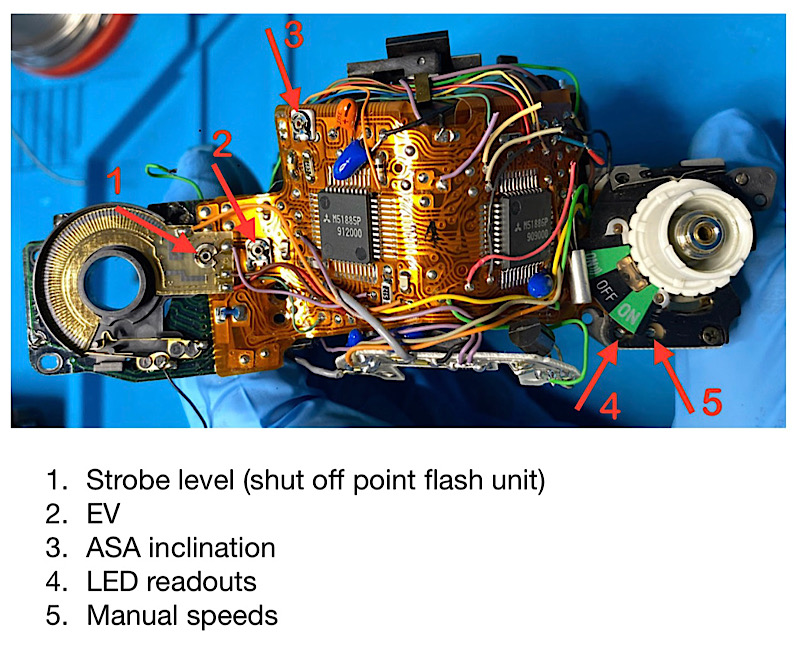
A well-documented electromechanical SLR is the Minolta X-700.
So I would review the available technical documentation (Minolta Repair Manual, SPT Journal, and C & C Guide) and put together an initial overview.
In the next step, I’ll use AI to analyze the circuitry, then compare the results with the documentation and overview and post a draft here for discussion.
From there, I’ll write up a text that I hope will be accepted and understandable to everyone.
Why use AI?
As we have seen in this discussion, AI is capable of generating useful overviews for the circuits of electromechanical SLRs, even for experts. This is particularly true when the AI has access to relevant documentation. However, these overviews must be verified by experts.
See also

 www.photrio.com
Before I begin, I’d like to ask you what you think of this project and how it’s planned being carried out.
What’s missing, however, is information about the heart of these hybrid SLRs—namely, their electronic control systems.
From a service and repair perspective, you don’t need to know the exact structure and internal workings of the electronics. It is sufficient to identify and fix faults based on instructions—either by resolving contact issues or replacing defective electronic components.
But it is unsatisfying to view the main part of these SLRs as a black box and, at best, merely observe the gold-colored contacts, multi-pin ICs, and artfully shaped FPCs (flexible printed circuits) without knowing what they are for or how they work.
Light on the matter
I would therefore like to invite all the electronics and digital technology experts gathered here to shed light on the matter together.
My goal is to analyze the circuitry of an electromechanical SLR using the available technical documentation and present it in a way that even interested laypeople can understand.
Why am I not trying to do this on my own?
My qualifications are as follows:
- Distance learning courses in analog and digital electronics,
- hands-on repair experience,
- a college degree in Communications/PR,
- and 26 years of professional experience in communications.
So I'm counting on our experts here.
Minolta X-700
A well-documented electromechanical SLR is the Minolta X-700.
So I would review the available technical documentation (Minolta Repair Manual, SPT Journal, and C & C Guide) and put together an initial overview.
In the next step, I’ll use AI to analyze the circuitry, then compare the results with the documentation and overview and post a draft here for discussion.
From there, I’ll write up a text that I hope will be accepted and understandable to everyone.
Why use AI?
As we have seen in this discussion, AI is capable of generating useful overviews for the circuits of electromechanical SLRs, even for experts. This is particularly true when the AI has access to relevant documentation. However, these overviews must be verified by experts.
See also
Minolta X-700 electronics: A closer look
I'd like to take a closer look at the X-700's electronics in the coming days. On the one hand, I would like to understand how the circuit basically works, and on the other hand, I am interested in details that can be seen on the flexible circuit board. It's always fascinating to me what...
www.photrio.com
Before I begin, I’d like to ask you what you think of this project and how it’s planned being carried out.
Last edited:
 . In the A-1, solenoids are released via an IC, not capacitors. However, all roads lead to Rome.
 .
.
 .
.