• Welcome to Photrio!
    Registration is fast and free. Join today to unlock search, see fewer ads, and access all forum features.
    Click here to sign up

Test strip maker

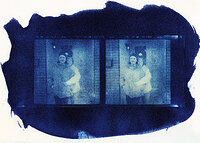
Cyanotype stereo card

A
Cyanotype stereo card

  • 0
  • 0
  • 0
IMG_0025.jpeg

A
IMG_0025.jpeg

  • 0
  • 1
  • 0

Forum statistics

Threads
203,125
Messages
2,850,239
Members
101,690
Latest member
nisherii
Recent bookmarks
0

Mats_A

Member
Allowing Ads
Joined
Jan 31, 2010
Messages
570
Location
Finland
Format
Multi Format
I am 100% sure that this device already exists but I can't seem to find any references to it. Most likely I don't use the right search terms.

A test strip maker consisting of a sheet of plastic with increasing opaqueness. Say 1/3 stop each. Put in the test strip and give one burst of light. This must already exist somewhere.
Most likely this is an old idea that for some reasons not work very well. Us photographers being a lazy bunch, if this worked, everybody would use them.

So what is wrong with it and where can I find one to test. Or how do I build one?

r
 
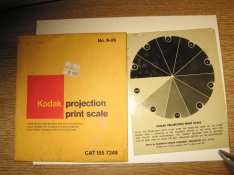
Kodak used to make something like what you are describing. It was 4x5 inches and had a circle with wedges. Each wedge was x amount of difference. I checked Porter’s but I didn’t find it. I have one but I have no idea were it is at the moment. I might be able to look for it in the nest couple of days.

Mike
 
Kodak made a device (and I have made one too) which you placed over the paper and exposed for 60 seconds (I think). You then found the area which gave correct exposure and used the number next to this area as the exposure time.

i.e. if the part which was exposed properly was labelled as 15 seconds then it had a two stop ND filter in it.

I made mine using the ND filters in a Lee Filters sample pack. Mine has 0, 0.5, 1, 2, 3 and 4 stop filters. It's shown in a thread somewhere here but I don't remember which one.

EDIT: I found a picture of mine and a link to the Kodak version.

The Kodak version has more sections than mine and probably is third (or possibly half) stop intervals as you require: http://farm4.static.flickr.com/3190/2504582871_cb4ef0f747.jpg


Steve.
 

Attachments

  • scale.jpg
    scale.jpg
    47.4 KB · Views: 152
Last edited by a moderator:
Thanks all. As I suspected this is an old idea. But the wedge shaped one is not optimal in my opinion. A normal test strip has strips running parallell.
I think a series of ND-filters glued end to end would be better. Maybe I will try to make one and see how it turns out. Any good sources for ND-filter gels?

r
 
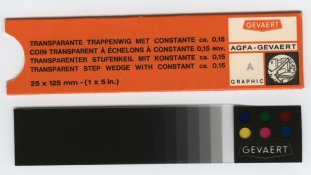
View attachment 17511Maybe this is what you are looking for

Yes, something like that. But I think it should be less steps. Maybe 7. And finer graduation. 0.1 density would be 1/3 stop. And they should be larger. At least 3cm x 10cm. Maybe bigger. You would just slip a suitable sized paper under and give one exposure for what you think is maximum time. And then have a test strip with a 1/3 stop intervals.
Nothing world changing. Would just make test strips a little bit easier to make. I always have trouble moving the shielding paper the right amount in the dark.
Often end up with the last strip too narrow or too wide.
Also if using f-stop printing to make test strips I have to reset the timer after every exposure. That means putting down the shield and losing the position. Not to talk about the trouble I have reading my notes on what series of times to use under safe light.

I know there are timers available that has test strip timing built in. But this would be a cheapo solution.

Now, most likely, someone will point to a very obvious solution and I will look like a fool :D

r
 
Jobo had one mid 80's that was 4x5 that gave the eqivalent of 5, 10, 15 and 20 seconds with a 20 second timer setting. This stepped ND mask sat in one quadrant of an 8x10 easel, where the other 3 quadrants were masked out. You would load a sheet of colour paper, and then flip the mask to expose one quadrant at a time. The easel sat in tray that allowed you to slide the easel to always have the window at the same location, so as to expose each exposure to the same area of the negative.

You could vary the fltration between exposures, and then the result after processing gave you a good shot at getting the right exposre and filtration after the first test print. It was very handy in the days of long EP/2 processing cycles.

A similar device could be fabricated today out of sets of neutral density gels or negatives. Rosco sells .3, .6, and .9 I don't know of any gel sheet vendor that makes large sheets of 1/3 stop ND though. It sounds like a job of exposing your own LF film to get the needed densities.

If a 4x5 window of 6 slots giving a 2 stop spread in 1/3 stops were made, then you could make 4 exposures, at say grade 1, 2, 3 and 4 with VC black and white paper.
 
Mike:
The problem seems to be finding 0.1 density filters. There are some industrial grade filters available for $30 a piece. A bit expensive for just fooling around and testing.
Your idea of using LF film to make a filter sounds plausible.
How does one find out if a film is the right density whithout a densitometer?
If I expose part of a paper for say 4 seconds and then expose an other part for 4 sec + 1/3 stop covered with a filter. Then if both parts show the same fogging the "filter" should be density 0.1. Or...


r
 
Last edited by a moderator:
Kodak's product was called a projection print scale. You put it on your print and exposed through it for 60 seconds. When the print was developed, you could read the correct exposure time beside the wedge with the best exposure. The transmission step wedges I used were all very small and I don't ever remember anything larger than about 3/4" x 4". Agfa had 21 steps and Dupont had 30 steps. AFAIK still available from Stauffer.
 
Projection Print Scale:
 

Attachments

  • IMG_1689.jpg
    IMG_1689.jpg
    527.3 KB · Views: 141
I had the Jobo but ended up giving it away; It was letting students use it and ended up being scratched so badly that I gave it away. I don't miss it, really.
Nova made a "Step and Repeat" b ut I've never seen one and it works in a totally different way.
 
I am 100% sure that this device already exists but I can't seem to find any references to it. Most likely I don't use the right search terms.

A test strip maker consisting of a sheet of plastic with increasing opaqueness. Say 1/3 stop each. Put in the test strip and give one burst of light. This must already exist somewhere.
Most likely this is an old idea that for some reasons not work very well. Us photographers being a lazy bunch, if this worked, everybody would use them.

So what is wrong with it and where can I find one to test. Or how do I build one?

r
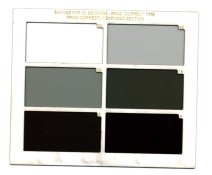
PM me with your mailing address and I'll send you a print projection scale. Just lay it on your test sheet and use the enlarger settings you think are to be used, expose then develope, gives the closest approximation of proper time to use.

Rick
 
PM me with your mailing address and I'll send you a print projection scale. Just lay it on your test sheet and use the enlarger settings you think are to be used, expose then develope, gives the closest approximation of proper time to use.

Rick

You find my email by clicking on my user name.

r
 
Mike:
The problem seems to be finding 0.1 density filters. Your idea of using LF film to make a filter sounds plausible.
How does one find out if a film is the right density whithout a densitometer?

I would suggest that you, in a controlled manner, flash a piece of 4x5.
Perhaps f/22 in the enlarger, enlarger at the top of its column for say 10 seconds as a starting point if using lith film, which has a speed similar to projection speed photo paper.

Then develop and agitate consistently for a fixed time with a one shot developer. Dry, slice film up and tape three slices together. On photo paper expose one part to get a light tone, and next part under the three piece of film pack for twice as long. If the same tone is achieved, you have found the 0.1 density exposure. Iterations will be required, in all likelyhood.

I would suggest that you stick with the multiple layers for deeper filtration effects. Getting a film to be off the toe, and not on the shoulder on a range of light values with the right gamma is nigh on impossible, unless you have mastered tech pan film.
 
You find my email by clicking on my user name.

r

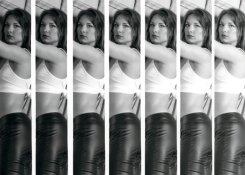
Let us know how it works for you. I kept it as a good example of a terrible tool. In my opinion, good test strips are from the same area of the print. Comparing different areas makes it impossible to make a decent judgement.
 

Attachments

  • TestStrip.jpg
    TestStrip.jpg
    55.4 KB · Views: 207
Let us know how it works for you. I kept it as a good example of a terrible tool. In my opinion, good test strips are from the same area of the print. Comparing different areas makes it impossible to make a decent judgement.

I suppose you are right. It is just the programmer inside of me. Whenever I have a repetitive task to do I will look for ways to make it simpler. Can't help it.

Definition of a programmer: A person who will spend 10 hours writing an algorithm that will speed up a task done twice a month from 2 minutes to 5 seconds.

r
 
Some proposed a transmission step wedge. Now, that is a terrific tool, not to make test strips, but to test your materials and processes. I bought mine from Stouffer directly. Also, check out their transmission projection step tablets.

http://www.stouffer.net/
 
Some proposed a transmission step wedge. Now, that is a terrific tool, not to make test strips, but to test your materials and processes. I bought mine from Stouffer directly. Also, check out their transmission projection step tablets.

http://www.stouffer.net/

How do you use a step wedge? The examples on Stouffers were a bit unclear for me.

r
 
Photrio.com contains affiliate links to products. We may receive a commission for purchases made through these links.
To read our full affiliate disclosure statement please click Here.

PHOTRIO PARTNERS EQUALLY FUNDING OUR COMMUNITY:


Ilford ADOX Freestyle Photographic Stearman Press Weldon Color Lab Blue Moon Camera & Machine
Top Bottom