• Welcome to Photrio!
    Registration is fast and free. Join today to unlock search, see fewer ads, and access all forum features.
    Click here to sign up

Sunny 16-Fact or Fiction?

Indian ghost pipe plant.

H
Indian ghost pipe plant.

  • 2
  • 0
  • 23
2026-01-136.jpg

A
2026-01-136.jpg

  • 0
  • 0
  • 30

Forum statistics

Threads
202,940
Messages
2,847,821
Members
101,546
Latest member
Milanw
Recent bookmarks
0
Metering the palm of my hand works well in situation where the light is very strong such as on a ski slope and I want the exposure to show the people rather than the snow.
 
I've done that and then opened one stop since Caucasian skin typically measures 36% of the light striking it.
 
I've done that and then opened one stop since Caucasian skin typically measures 36% of the light striking it.

^^^ and the rule of thumb about difference of palm vs. 18% grey card reflectance works regardless of race. (However, my own palm actually meters 1.33EV brighter...Asian)
 
Onre-That's one stop more for all conditions than the insert I have(1987) except for the first one.

Kodak has made errors here and there... just sayin' your 1987 insert may be nothing more than proof of somebody not proofing the text well enough rather than Kodak's real recommendation.

It's also important to remember that the insert is only important when someone is unfamiliar with the concept of film speed and lacks a meter; it's not meant to replace "the theory of the photographic process" or my Sekonic L-358. Inserts really can help a new guys though. From Kodaks POV you wouldn't want somebody to have to wait to buy a meter before they started using film, Kodak would want people to make good shots right away.
 
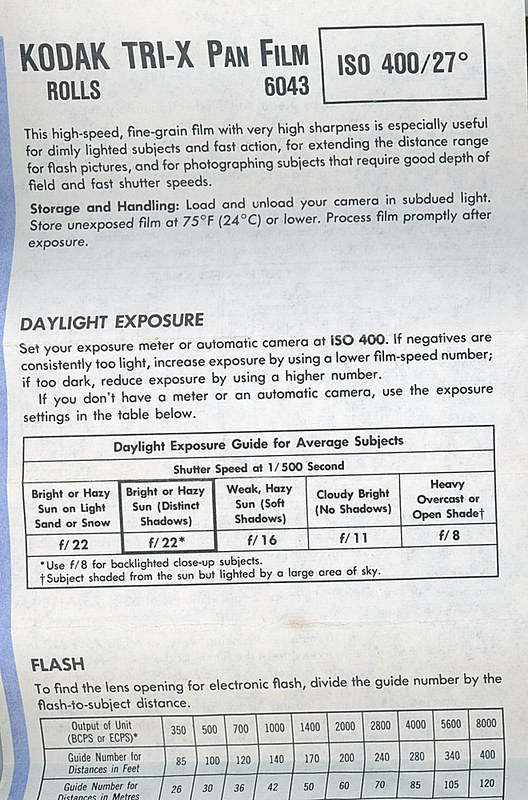
No, Matt, I think it depends on which insert you have. The later ones in the late 90's are different than the one I have in 1987 and that's the only one I kept. It shows this...

500 at f22-Bright or Hazy Sun on light sand or snow.

500 at f22-Bright or Hazy Sun(Distinct Shadows)

500 at f16-Weak Hazy sun(Soft Shadows)

That insert is lying right in front of me.

Definitely bad information! I shot a lot of Tri-X between 1970 and 2000 and I have never seen a datasheet with these recommendations. Somebody at Kodak messed up or is the datasheet a knockoff?

I just checked my Kokak Master Photoguide from 1986 (and several newer sources) and they don't reflect the suggestions in your post. Definitely bad data! The f11/500(400) exposure is the value Kodak recommends for 'Side lighted close ups' in bright sun and f16/500(400) is the recommended exposure for average subjects in bright sun. F11/250(200) is Kodak's recommended exposure for 'Cloudy Bright, no shadows.' You should bin that sheet you have, it's just plain wrong.
 
Last edited by a moderator:
That's the way it reads for whatever the reason and I took it to be in stone since it's Kodak's. You might know the only insert I decided to keep with some mistake. As mentioned earlier, this one is dated 9-87.
 
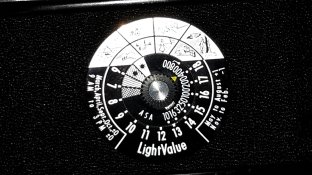
The back of the Olympus S-II had an almost laughable exposure "computer" with various icons for scene types and light conditions. There were even notes for time of day and month of the year. Assuming the brightest setting is full sun on water or snow that gives an f22 and full sun on a normal landscape would be f16.

As others have observed, exposure varies by time of day and time of year, as well as latitude. But also remember f16 assumes the sun is directly illuminating the object. So yes, in the middle of the day in summer in the SW US, with your back to the sun and your subject normal to the incident sunlight, the correct exposer will be f16.
20151128_184912.jpg
 
That's the way it reads for whatever the reason and I took it to be in stone since it's Kodak's. You might know the only insert I decided to keep with some mistake. As mentioned earlier, this one is dated 9-87.

Can you scan it and post it here?
 
I'll see if I can scan so all can see...give me a few minutes.
 
Yep, that is definitely a BIG screw up!

It states f/22, f/22, f/16, f/11 when it should have been f/22, f/16, f/11, f/8.
 
I guess I have a rarity as a keepsake.:smile:
 
Looking back through my old inserts for paper and film I actually found two more of those from the same year and they all had the same mistake on them. I was hoping to find one from the early 90's but didn't find any.
 
Yes, that exposure guide was goofed up as Sirius Glass noted, his figures are consistent with the long established pattern in the Kodak leaflets.

I've always thought that the "open shade or heavy overcast" figure should never have been included. Some heavy overcast is much denser than other heavy overcast, and the sun angle makes a huge difference under overcast. If you're shooting under heavy overcast or shade, use a meter.

Tri-X was rated at 200 before 1961, but the film didn't change. The rating did (the old standard had a "safety factor" to prevent underexposure and assumed some people were using slower developers). I have old Kodak cameras that advised the same exposure for Panatomic-X as for Kodachrome (which at the time was the equivalent of ISO 10 today).

The real hoot about monochrome film is the fact that there is no standard process, like C-41 or E-6 in color films. If you shot Tri-X in bright sun for 1/1000 @f/22 (a 2 1/3 stop underexposure), but developed it in Dektol at 30¤C for 20 minutes, you'll get unusable overexposed black negatives nevertheless.

One thing to remember is that with negative films (especially modern color negative films -but black and white as well), overexpose when in doubt and correct for it in printing (with slide films, the reverse is true - be very careful to avoid overexposure)

As for the original question "is sunny 16 for real?" - I rarely find that 1/100@16 gives the best exposure with 100 films in my Realist. I generally leave the settings on my Realist at 1/100 f13. Nearly all my shots are at 41 - 46¤ North. The street where I grew up had brown brick houses and green lawns. My meters and cameras would read "sunny f8", but 9 or 11 would make better slides with rich colors.
 
Last edited by a moderator:
There are quite a few folks who rate todays Tri-X at 200-250 and have great results. Before, I would shoot it at that speed and undeveloped somewhat by 1-1 1/2 minutes. Regardless the lighting conditions I've found rating it at those speeds with HC-110 Dilution H I get good negatives whether the suns is out or not. Long ago I shot it at 400 on overcast days or late after the sun was nearly down and it did well. Looking back on those negatives I didn't see lost shadow detail by exposing accordingly.

I felt there wasn't something quite right with that exposure guide.
 
Thanks. Did you see that developing time for HC-110 Dil B...3 3/4 minutes at 68 degrees? I think that's another screw up.
 
Thanks. Did you see that developing time for HC-110 Dil B...3 3/4 minutes at 68 degrees? I think that's another screw up.


My Kodak Darkroom Dataguide from c. 1964-66 shows Tri-X Pan HC-100 dilution B as 5.25 minutes, Microdol-X 1:1 as 8.66 min at 68 degrees...that 2007 Kodak guide (post 68) shows 3.75 and 9.25 min. at 68 degrees. Tri-X was ISO 400 back in 1966 so I wonder why the difference?!
 
Last edited by a moderator:
Tri-X was a lot slower back then.:smile:
 
It seems Kodak has been all over the map with their developing times, at least for HC-110. I have one of their periodicals from 1978 called "Kodak Professional Black and White films" page DS 18, that show developing times for this developer at 68 degrees as being 7 1/2 minutes as opposed to the 3 3/4 minutes? Interesting.
 
Data Sheets promoting "Sunny 11"

See scans of film data sheets for Tri-X dated April 1979 and Plus-X dated January 1980. Both these suggest "Sunny 11" rather than "Sunny 16" Curious??
 

Attachments

  • Scan.jpg
    Scan.jpg
    49.6 KB · Views: 114
Too small to read.
 
Photrio.com contains affiliate links to products. We may receive a commission for purchases made through these links.
To read our full affiliate disclosure statement please click Here.

PHOTRIO PARTNERS EQUALLY FUNDING OUR COMMUNITY:



Ilford ADOX Freestyle Photographic Stearman Press Weldon Color Lab Blue Moon Camera & Machine
Top Bottom