
• Welcome to Photrio!
    Registration is fast and free. Join today to unlock search, see fewer ads, and access all forum features.
    Click here to sign up

Summicron-M 50 mm 11817 acquired the GOAT of lenses (and a small melancholy)

spanish market

A
spanish market

  • 0
  • 0
  • 10
Paper Birch.jpg

H
Paper Birch.jpg

  • 0
  • 0
  • 23

Recent Classifieds

Forum statistics

Threads
203,059
Messages
2,849,290
Members
101,627
Latest member
GeorgeGGV
Recent bookmarks
0

RezaLoghme

Member
Allowing Ads
Joined
Apr 6, 2024
Messages
1,657
Location
Europe
Format
Medium Format
Today I did it. After years of circling around, debating, buying “almosts,” and rationalizing detours, I finally picked up a Summicron-M 50 mm 11817 for 1,500 EUR. CLA’d, clean, no surprises. Just the lens. The one.

I know, there are dozens of technically sharper, clinically perfect options out there. But this lens… it’s the end of all discussion. The GOAT. It’s the lens that quietly sits in the middle of Leica’s history — small, unassuming, but with that gentle vintage rendering that gives scenes a kind of built-in melancholic poetry. Not dreamy or “character” in a forced way; rather, a soft authority. It doesn’t shout. It remembers.

There’s also a particular melancholy attached to owning the Summicron. Because once you mount it, the search is over. The excuses, the browsing, the “maybe if I tried this lens” phase — gone. It’s both comforting and strangely final. The smallness of it — that classic 11817 profile — just seals it. It doesn’t need to prove anything.

And it aligns perfectly with Mike Johnston’s “A Leica for a Year” idea. One lens, one body, one film. Learn. See. Photograph. Not fiddle with gear. My go-to film is Ilford XP2, and this lens will sing on it.

The only thing left now is to find a clean, black, CLA’d M6 body — something that I can simply trust and use daily. Once that’s in hand, I can finally stop the endless search for meaning in gear and focus on the work.
 
There’s something about a black M6 paired with a classic M lens (especially the compact Summicron 50) that evokes that period when serious photography was still analogue, deliberate, and quietly ambitious. Think: photo students saving for years to buy a single Leica; Magnum photographers working in B&W; battered Domke bags, Ilford XP2 or Tri-X in the fridge, and the idea that “mastery” meant discipline, not presets.

The black finish reinforces that mood — less glamorous than chrome, more focused. It’s the camera of someone who means business, not someone collecting objets. A black M6 with a Summicron 50 is almost anti-aesthetic chic: pared down, serious, slightly melancholic because it belongs to that pre-digital, pre-irony era when one camera and one lens were meant to last decades.
 
There’s something about a black M6 paired with a classic M lens (especially the compact Summicron 50) that evokes that period when serious photography was still analogue, deliberate, and quietly ambitious. Think: photo students saving for years to buy a single Leica; Magnum photographers working in B&W; battered Domke bags, Ilford XP2 or Tri-X in the fridge, and the idea that “mastery” meant discipline, not presets.

The black finish reinforces that mood — less glamorous than chrome, more focused. It’s the camera of someone who means business, not someone collecting objets. A black M6 with a Summicron 50 is almost anti-aesthetic chic: pared down, serious, slightly melancholic because it belongs to that pre-digital, pre-irony era when one camera and one lens were meant to last decades.

meant to last decades.
meant to last a lifetime.....
 
There’s something about a black M6 paired with a classic M lens (especially the compact Summicron 50) that evokes that period when serious photography was still analogue, deliberate, and quietly ambitious. Think: photo students saving for years to buy a single Leica; Magnum photographers working in B&W; battered Domke bags, Ilford XP2 or Tri-X in the fridge, and the idea that “mastery” meant discipline, not presets.

The black finish reinforces that mood — less glamorous than chrome, more focused. It’s the camera of someone who means business, not someone collecting objets. A black M6 with a Summicron 50 is almost anti-aesthetic chic: pared down, serious, slightly melancholic because it belongs to that pre-digital, pre-irony era when one camera and one lens were meant to last decades.

Very well said.
 
I am now really(!) contemplating the purchase (my 3rd one) of a 90mm Elmar-C. The lens is so small, and embodies the fragile, introvert nature of the M system (unlike the huge Noctilux and its unbearable extrovertitis). The Elmar-C was my first M lens. I bought it on a grey Saturday afternoon in November. And miss it.
 
meant to last a lifetime.....

Meant to last several lifetimes! I'm shooting an M3 that I'm sure has had multiple owners before I acquired it, and probably the first few of them are no more. And since mine's been serviced, it will outlive me and others after. Think of how many people are still shooting 80-year-old Barnacks, and how many generations those have been doing their thing? Our Leicas have lives separate from ours--we are simply temporary caretakers, as they go on imperiously taking the best photos their owners, one after another, can make.

It's a bit amusing considering the fantasy of two '50s-made M3s getting together and comparing notes about their various owners and their quirks and abilities--and disabilities--and all the things they've been through, been subjected to, and shot.
 
Meant to last several lifetimes! I'm shooting an M3 that I'm sure has had multiple owners before I acquired it, and probably the first few of them are no more. And since mine's been serviced, it will outlive me and others after. Think of how many people are still shooting 80-year-old Barnacks, and how many generations those have been doing their thing? Our Leicas have lives separate from ours--we are simply temporary caretakers, as they go on imperiously taking the best photos their owners, one after another, can make.

It's a bit amusing considering the fantasy of two '50s-made M3s getting together and comparing notes about their various owners and their quirks and abilities--and disabilities--and all the things they've been through, been subjected to, and shot.

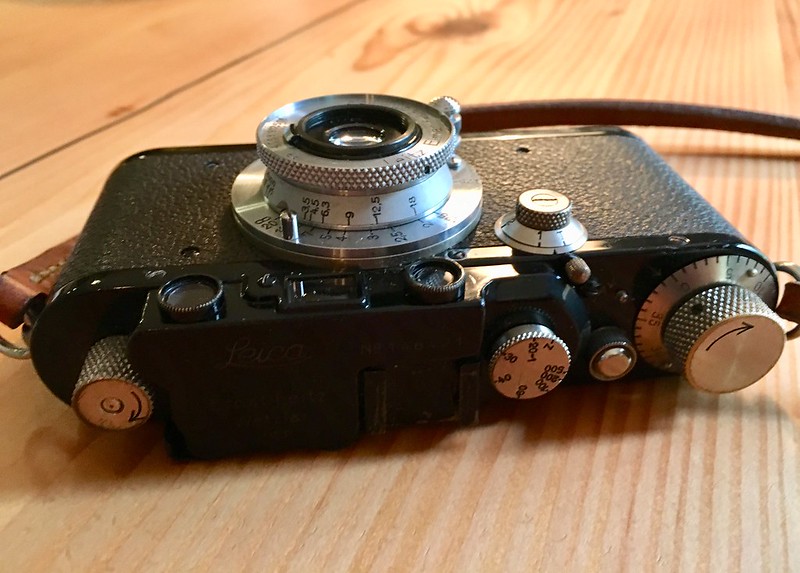
True enough... this '34 worked like a charm.
& I'm sure my user pair will serve photographers as long as there is film.
My M4 is the only Leica I've had serviced in 50 yrs of using them.....
43524758324_d6c2769ea6_c.jpg

IMG_9485 2.JPG
 
Now that I have an 11831 "incoming" as they say.on watch forums I am somewhat redhair-freckled about my Summicron. What to do?
 
My 50 f2 Summicron is mounted on my M7. OK, my M2 is away at DAG. When it comes home, the Summicron will be mounted on it. Think of the great photographers who used only one body and one lens in the 1930s, 1940s, 1950s, and 1960s. HCB in Paris is the first that comes to mind among many.
 
My 50 f2 Summicron is mounted on my M7. OK, my M2 is away at DAG. When it comes home, the Summicron will be mounted on it. Think of the great photographers who used only one body and one lens in the 1930s, 1940s, 1950s, and 1960s. HCB in Paris is the first that comes to mind among many.

My V3 likes to take turns on different M bodies. No surprise, it's great on all of them.
 
Sorry; the GOAT for lenses is the Sonnar.
 
What is a GOAT lens? Seems every Leica lens ever made now has some "special" feature making it the best of the best.
 
To me it seems that the only criteria is that the lens has to cost a small fortune. I have some absolutely marvelous Voigtlander and Zeiss lenses that don't even come close to what a Leica lens costs, but they produce amazing results. Don't get me wrong, I DO believe that Leica makes nice glass. But the prices have gotten so far out of control it is out of the reach of most people. And if you are retired on a limited income forget it. Fortunately for the majority of us you do not have to spend your entire retirement income for the next two years to get your hands on some very, very good lenses.

Sorry for the little rant. But of course, most of you know all this already.
 
To me it seems that the only criteria is that the lens has to cost a small fortune. I have some absolutely marvelous Voigtlander and Zeiss lenses that don't even come close to what a Leica lens costs, but they produce amazing results. Don't get me wrong, I DO believe that Leica makes nice glass. But the prices have gotten so far out of control it is out of the reach of most people. And if you are retired on a limited income forget it. Fortunately for the majority of us you do not have to spend your entire retirement income for the next two years to get your hands on some very, very good lenses.

Sorry for the little rant. But of course, most of you know all this already.

All of what you say is true, but the thing about Leica is - if you take care to buy quality used products - it's "money in, money out". The only people losing money on Leica are those buying it new and trading "up" with the changing fashions.

So, in some sense, I see my Leica purchases as rent free use until such time as I liquidate any given item. That's not quite true, of course. Prices can change over time, and you do losethe use of the money invested in the intervening time .

And yes, I have some LTM Voigtlander Color-Skopars that are just terrific. In fact, I prefer their contrast and rendering to the classic old Leica glass. As one example, I bought a 21mm f/4 Color-Skopar that I use both on a IIIf and M bodies with an adapter ring. That lens is stupidly sharp and contrasty. I got it for about 1/4 the cost of the equivalent modern Leica M mount lens. It's hard to believe the lens costing 4x as much would be 4x "better", at least for monochrome film than this one taken with that lens on an M4 on TMX. Scan of silver print:

1764913335839.png
 
All of what you say is true, but the thing about Leica is - if you take care to buy quality used products - it's "money in, money out". The only people losing money on Leica are those buying it new and trading "up" with the changing fashions.

So, in some sense, I see my Leica purchases as rent free use until such time as I liquidate any given item. That's not quite true, of course. Prices can change over time, and you do losethe use of the money invested in the intervening time .

And yes, I have some LTM Voigtlander Color-Skopars that are just terrific. In fact, I prefer their contrast and rendering to the classic old Leica glass. As one example, I bought a 21mm f/4 Color-Skopar that I use both on a IIIf and M bodies with an adapter ring. That lens is stupidly sharp and contrasty. I got it for about 1/4 the cost of the equivalent modern Leica M mount lens. It's hard to believe the lens costing 4x as much would be 4x "better", at least for monochrome film than this one taken with that lens on an M4 on TMX. Scan of silver print:

View attachment 412778

Thanks for your response to my little rant. In some cases you are probably right, but in others the cost to get in is so extreme that you never get it out. I do enjoy my Leica equipment so I am probably not the right one to argue the point. I think that most cameras, if bought used at the right price and properly cared for can be resold at very nearly the original purchase price, making the end result "rent-free" as you say. But in my mind things begin to break down when I compare the results between cameras and brands. I think that this is where the Japanese camera companies decisively bypassed Leica many years ago.

But, as usual, I have wandered off of the original intent and topic of this thread. I really do congratulate @RezaLoghme on his recent purchases and I hope that he enjoys using those fine lenses for a very long time.
 
Thanks for your response to my little rant. In some cases you are probably right, but in others the cost to get in is so extreme that you never get it out. I do enjoy my Leica equipment so I am probably not the right one to argue the point. I think that most cameras, if bought used at the right price and properly cared for can be resold at very nearly the original purchase price, making the end result "rent-free" as you say. But in my mind things begin to break down when I compare the results between cameras and brands. I think that this is where the Japanese camera companies decisively bypassed Leica many years ago.

But, as usual, I have wandered off of the original intent and topic of this thread. I really do congratulate @RezaLoghme on his recent purchases and I hope that he enjoys using those fine lenses for a very long time.

It's an interesting discussion. For 35mm I own both Nikon and Leica. The Nikon stuff is worth a fraction of its original purchase price. The Leica stuff is worth something closer to the original price.

Fortunately, I bought all of it used, not new :wink: In my case, someone already took the depreciation hit on both brands and I bought them very nearly at what I can sell them for.

There is a cost to owning used stuff like this though - maintenance. I have spent princely sums with people like DAG making sure my stuff is in tiptop shape.

@RezaLoghme I suspect you will love your new 'Cron.
 
Hmmm.. Is there a 28mm lens that would be the equivalent GOAT?
 
Hmmm.. Is there a 28mm lens that would be the equivalent GOAT?

I've not used one but the 28mm f/2.8 Elmarit-M ASPH is claimed to be just that.

Judging from my superb older 35mm f/2 Summicron ASPH, I would expect the 28mm to be a rockstar as well.
 
It is an interesting question. I have been personally enjoying my MS-Optical Perar 28/4 Super Triplet for the past few years so I am not likely the best judge of which M-mount lenses are in the top tier right now. For my purposes this would certainly be a GOAT but I seriously doubt that it would qualify in most camps. My main pictoral targets are landscapes and I do a lot of hiking in the local mountains, so the portability of this little wide angle pancake far exceeds any advantage that other lenses of this focal length may have. With this lens my camera slides easily in and out of my shirt pocket so the camera is always ready at hand when I want it. And I find that at the right aperture most lenses, even simple triplets, provide more than enough quality to allow for large prints when needed, though I find it is better on film than on digital.
 
I've not used one but the 28mm f/2.8 Elmarit-M ASPH is claimed to be just that.

Judging from my superb older 35mm f/2 Summicron ASPH, I would expect the 28mm to be a rockstar as well.

Yes, I have the 35mm Summicron ASPH , and yes it is wonderful, bought new when prices were much lower. But the 28mm Elmarit these days is out of my price range (sob!).
 
To me it seems that the only criteria is that the lens has to cost a small fortune.

well the V3 is the cheapest of all 50mm Summicrons. It is a GOAT for me, because it does so much, for little money.
 
Today I did it. After years of circling around, debating, buying “almosts,” and rationalizing detours, I finally picked up a Summicron-M 50 mm 11817 for 1,500 EUR. CLA’d, clean, no surprises. Just the lens. The one.

I know, there are dozens of technically sharper, clinically perfect options out there. But this lens… it’s the end of all discussion. The GOAT. It’s the lens that quietly sits in the middle of Leica’s history — small, unassuming, but with that gentle vintage rendering that gives scenes a kind of built-in melancholic poetry. Not dreamy or “character” in a forced way; rather, a soft authority. It doesn’t shout. It remembers.

There’s also a particular melancholy attached to owning the Summicron. Because once you mount it, the search is over. The excuses, the browsing, the “maybe if I tried this lens” phase — gone. It’s both comforting and strangely final. The smallness of it — that classic 11817 profile — just seals it. It doesn’t need to prove anything.

And it aligns perfectly with Mike Johnston’s “A Leica for a Year” idea. One lens, one body, one film. Learn. See. Photograph. Not fiddle with gear. My go-to film is Ilford XP2, and this lens will sing on it.

The only thing left now is to find a clean, black, CLA’d M6 body — something that I can simply trust and use daily. Once that’s in hand, I can finally stop the endless search for meaning in gear and focus on the work.

So go shoot with it - no more excuses!
 
Photrio.com contains affiliate links to products. We may receive a commission for purchases made through these links.
To read our full affiliate disclosure statement please click Here.

PHOTRIO PARTNERS EQUALLY FUNDING OUR COMMUNITY:


Ilford ADOX Freestyle Photographic Stearman Press Weldon Color Lab Blue Moon Camera & Machine
Top Bottom