


-
Welcome to Photrio!Registration is fast and free. Join today to unlock search, see fewer ads, and access all forum features.Click here to sign up
You are using an out of date browser. It may not display this or other websites correctly.
You should upgrade or use an alternative browser.
You should upgrade or use an alternative browser.
Strange Film
-
A
- Thread starter alorino
- Start date
Recent Classifieds
-
For Sale Set of 3 glass beakers
- Started by Jon Shiu
-
For Sale 4x5 and 5x7 Black and white sheet film
- Started by Peter Schrager
-
For Sale Set of 4 stainless beakers Leedal, Vollrath
- Started by Jon Shiu
-
For Sale Hasselblad Distagon FE 50mm
- Started by Jammoh
-
Want to Buy Jobo CPP-3
- Started by lifeandmylens
Forum statistics
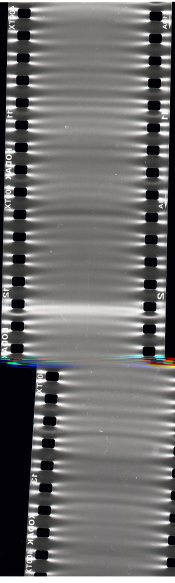

Put the film on the reel backwards, the film kinks at the sprockets and fogs, giving that pattern.
They may have rewound the film backwards into the canister.

This is crinkling fog, something strange happened with the film in your camera.
They may have rewound the film backwards into the canister.
Hm, but then again, lot of cameras wind film backwards to the take-up spool, without any of those effects?
OP
OP
The film was not on backwards and there were no kinks. It was completely smooth and happened to two different students with two different cameras. I'm pretty sure this happened during the development stage. One person has suggested extreme bromide drag and that may be the closest I've come to an explanation. The thing that most confused me was the lack of any image showing up on the film along with the striped pattern.
Thanks for all the hypotheses, I was such a perfectionist in school I didn't encounter some of the stranger mistakes my students make.
Thanks for all the hypotheses, I was such a perfectionist in school I didn't encounter some of the stranger mistakes my students make.

I would think crazy bromide drag as well. something similar happens sometimes when I play with stand development, and there is a similar pattern at the sprocket edges.
If you are not teaching stand development, then I would check freshness of chemicals, and do a through cleaning of all tanks and measuring containers in hot water with a bit of soap, this might be caused by contamination such as residual stop or fixer getting mixed in from unwashed containers which may restrain or prevent development.
If you are not teaching stand development, then I would check freshness of chemicals, and do a through cleaning of all tanks and measuring containers in hot water with a bit of soap, this might be caused by contamination such as residual stop or fixer getting mixed in from unwashed containers which may restrain or prevent development.

From what I see in the picture, I see a fog on the film.
Fog could be done, for me, in a big reel - fog seems quite reproducible.
Use a different type of film and see if it is broken on it - fog / light.
Then you can remove camera and developer.
George
Fog could be done, for me, in a big reel - fog seems quite reproducible.
Use a different type of film and see if it is broken on it - fog / light.
Then you can remove camera and developer.
George
- removed account8
- Deleted
Are the students getting their film from a "bulk loader" or buying single rolls?
Are the students getting their film from a "bulk loader" or buying single rolls?
It does look like there's a light leak problem somewhere in that darkroom.
They may have rewound the film backwards into the canister.
Hm, but then again, lot of cameras wind film backwards to the take-up spool, without any of those effects?
I mean they turned the rewind crank backwards. This bends the film sharply as it rewinds back into the canister causing stress fog.
The image presented has not received exposure in the area between perforation. I see light fog in the perforations area / side.
Fog is about the same intensity and on one side and another side of the film. Seems weak and diffuse fog the heart of the film.
For me, a scan as a slide would be better.
How I see the fog drawing do not think it's possible to realize easy and reproducible by anyone.
George
Fog is about the same intensity and on one side and another side of the film. Seems weak and diffuse fog the heart of the film.
For me, a scan as a slide would be better.
How I see the fog drawing do not think it's possible to realize easy and reproducible by anyone.
George
Man... I wish I could bet everyone here $5 each. That's reversed film rewind... guaranteed. 
- Joined
- Apr 21, 2009
- Messages
- 782
- Format
- Large Format
Man... I wish I could bet everyone here $5 each. That's reversed film rewind... guaranteed.
I'm not taking that bet. I've worked in college and workshop labs and seen about every way to screw up film and never seen anything like that. You seem to have seen this before. Nobody else has an explanation (one comment on crinkling seems to me to support your idea). I'm betting on you.
Now who has a roll of film to waste testing this idea? Any reason to think the emulsion type matters? It looks like the sample is Tri-X and I'm too cheap to blow a roll fo that just to find out.
Mark
Last edited by a moderator:
OP
OP
They are buying single rolls of film. At first I thought the school store might be selling some bad film, but they bought their film from different locations. (Though they could still be from the same batch as they were both using tri-x film)
Mark C. ... Yes, I worked in labs for years. I've seen it more than once. Those are the same folks who loosened/unscrewed their rewind levers and lost the screws. One of them actually twisted and broke the rewind shaft trying to force the film back into the canister. Another time a guy brought his camera in completely jammed... took the camera into the darkroom, removed the canister, cut the can off the film that remained in the take-up spool and salvaged that much of his film... the rest was toast.
OP
OP
OK! I think I have an answer! Rewinding the film backwards makes sense. (I wasn't understanding...I thought you meant when putting it on the reel) I still wonder why neither student got any images at all on their film, they had both had film come out fine before. (this happened during separate semesters) BUT, you never know what they're doing during open lab hours.
Thanks Everyone!
Thanks Everyone!
There should have been images on those films... me smells a couple of flake students... or at least they both messed up in TWO ways. 

Old and Feeble - I too am skeptical of reverse rewinding. Although it can explain the crinkling, how could it explain the complete loss of the image? Think like you say, there can be two or more things at play....
Last edited by a moderator:

I've seen this, I'm with Old-N-(not so) Feeble. Why no images? Well I've seen students load the film incorrectly in the camera, so it is winding in the wrong direction, they try to advance and it goes as far as it can, but binds up, getting jammed up and kinked in the process. So yes, messed up in at least two ways.

OP
OP
For starters, why is this film cut (out of alignment). I have never seen anything like this, but it looks like wrong solution, perhaps some developer with zero agitaion.
The film being out of alignment is basically just because of a scanner malfunction. THe only film scanner I had access to was in it's last throes.

For starters, why is this film cut (out of alignment). I have never seen anything like this, but it looks like wrong solution, perhaps some developer with zero agitaion.
No it's clearly been developed OK, you can see "400TX" in the edges. I agree with the crinkling theory because the densest stress-fog lines are at the corners of the sprockets, which means the film has had some seriously tight bending applied to it.
Note that you can get stress fog without the film looking crinkled. Just bend the film real tight and release it; the backing won't show a fold but the emulsion will be fogged there.
OP - are the students left handed per chance? Maybe due to the way he/she holds the camera to wind it he/she turns it around (lens facing user), and then the inclination to wind reverse could be increased? I might have to test this out this weekend....

I have just come across this thread and having read all the replies, I have to agree with Old-N-Feeble.
I own a minilab in Ireland (for more years than I care to remember!) and have seen this on films many a time and it was always caused by rewinding the film the wrong way, causing stress fog.
It's a pity I'm too late for the bet!!!!!!!!!!!!!!!!!!
I own a minilab in Ireland (for more years than I care to remember!) and have seen this on films many a time and it was always caused by rewinding the film the wrong way, causing stress fog.
It's a pity I'm too late for the bet!!!!!!!!!!!!!!!!!!
| Photrio.com contains affiliate links to products. We may receive a commission for purchases made through these links. To read our full affiliate disclosure statement please click Here. |
PHOTRIO PARTNERS EQUALLY FUNDING OUR COMMUNITY:  |