
• Welcome to Photrio!
    Registration is fast and free. Join today to unlock search, see fewer ads, and access all forum features.
    Click here to sign up

Stop Bath.. How important?

Recent Classifieds

Forum statistics

Threads
202,703
Messages
2,844,458
Members
101,478
Latest member
The Count
Recent bookmarks
0
As Bill Troop says in A&T, the fixer is derived from the fact in Haist that an alkaline fix swells the paper to its maximum allowing rapid diffusion of chemicals in and out of the paper, and also allows rapid washing for the same reason.

The swell, introduced by the alkalinity, is the key here.

PE
 
[QUOTES=Photo Engineer;599474]
"As Bill Troop says in A&T, ..."

And the greater the alkalinity the better; up to " 10.5 ".
From rec.photo.darkroom. There in years gone by Bill has
gone to great lengths discussing the alkaline fix.

"...rapid washing for the same reason."
"The swell, introduced by the alkalinity,
is the key here."

The emulsion becomes more fluid, watery.
Absorbtion and Desorbtion also play a part.
How about an alkaline wash, running or still
water? The later I do, few but long soaks.
After all isn't archival also alkaline? Dan
 
Dan;

Bill got the information in interviews with Haist and from his book. He fully cites his references with credit to Haist. The pH 10.5 fixes were known for years and used by Kodak in the P-122 and Xomat processes.

The emulsion swells, but does not become more fluid, just as a sponge does not become more fluid as it swells. It merely contains more water and this can be measured using a swellometer. As far as stability goes, no, archival is not alkaline. The atmosphere is mildly acidic and oxidizing and the wash water is nearly neutral so the final pH after wash will be close to neutral and swell will have decreased thereby. As it dries, swell goes back to nearly the same value as before processing.

PE
 
I just like that there's something called a "swellometer." Do you have a picture of one?
 
I just like that there's something called a "swellometer." Do you have a picture of one?

David;

Kodak built their own and they don't match anything commercially available.

Basically, there was a 1" square well with a dam around it. A lever with a circular plate was lowered gently onto the photo material being tested, and thickness was measured.

Then the head was raised just a mm or so, and the well was infused with the solution being tested. The plate was dropped immediately and a timer was started as well as a strip chart recorder. This measured initial thickness and then thickness as a function of time. The test was continued until the swell had stabilzed.

The dam could be raised to dump the solution and the next processing step could then be carried out.

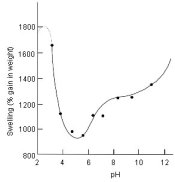
The attached is a commercial swell test posted on the internet. It tracks the gain in weight vs pH using bone gelatin. If you flip the graph on the horizontal axis (but not the pH scale), you get an approximate plot of the swell behavior of pig gelatin vs pH. If you read the scale from right to left, you see an approximate plot of swell for B&W materials during processing, and if you imagine a roughly straight line, you have a B&W material developed, rinsed and then fixed in TF-4. The swell pretty much stays at its maximum level.

PE
 

Attachments

  • gelatin swell profile.jpg
    gelatin swell profile.jpg
    22.7 KB · Views: 208
Thanks, that's interesting.
 
Wow a scientific swellometer - I figured that would be the number of good comments on a posted images indicating how swell it is, or after a big meal that top trouser button that just has to be undone as I swell.
 
I stopped using a stop bath when developing B&W film a few years ago. Given the cost of film (5x4 and 10x8) and the even higher 'cost' of the time to shoot I decided to stop trying to save a few pennies by reusing chemicals and dump them after processing. I find 500ml of dev and fixer for 10 sheets of 5x4 or 5 of 10x8 in an expert drum gives me consitant results with one less step to cock up. I do still wash between the steps when processing E6 though.
 
Stop bath--omission

If a practitioner regularly processes film using a water stop bath (no acid stop bath, just three water changes), what harm, if any, would result from moving the film directly from the developer to the first of the fixing baths???
 
I believe that it would exhaust the fixer rather fast. People more knowledgeable than I will chime in I'm sure. Something about ph's:smile:
Erik
 
None at all. The thing stop does is stop the developing process quickly, which makes consistancy easier. There can be some development that continues once it's in the rinse, but as long as it's consistent you can account for it. As I understand it, stop also helps preserve the fix by not lowering it's ph with any developer carryover that may occur (but with a good rinse, it shouldn't be much of an issue). But then again there are also alkaline fixers, I'm sure someone who who understands the chemistry in more detail will help out with facts about that part.

Peter
 
Hi lensmagic,

I've eschewed a stop bath whilst devving films for years, and have never had a problem. Just make sure you fill the tank with water to catch all the dev, agitate the tank, and you'll be fine.

As Erik says, going from dev to fix without rinsing will contaminate and exhaust the fixer quickly.
 
Thanks, Reinhold, for the link...it was interesting! I have been using a water stop for negs for 30 years...nice to know why my negs still look as good after so many years.

Vaughn
 
... what harm, if any, would result from moving the
film directly from the developer to the first of
the fixing baths???

I regularly take film and paper from the developer
directly to the fix. My fix in both cases is very dilute
and used one-shot. A very dilute one-shot fix becomes
VERY little loaded with silver. Washing is quick and
a single bath give best possible results. Dan
 
Dan, if this is your procedure and you have no problems in either bleaching or toning afterward, I'd like to hear more. What is "very dilute"? With papers, do you monitor for silver in solution?
 
Bear in mind, the damage to fixer is primarily if you use an acid fixing bath. An alkaline fixer is not affected by the alkalinity of developing agents, but a water bath or rinse is still wise.

I no longer use a stop bath for film processing (I use a 60-second running water bath instead) because I use an alkaline fix, but I use acid fix for printing so I do use a stop bath there.
 
Dan, if this is your procedure and you have no problems
in either bleaching or toning afterward, I'd like to hear more.
What is "very dilute"? With papers, do you monitor for
silver in solution?

Dilutions will vary according to solution volume and the
amount of chemistry needed. Processing times go up
with higher dilutions. So, some compromise is made
twixt greatest chemical milage and reasonable
processing times. Chemical amounts are
predetermined, no monitoring. Dan
 
No Stop Bath

Guys, I am looking for some advice

I want to make some 20x24 prints but only have room for 3 20x24 inch trays in my current darkroom set up.

I cannot sensibly stack trays either.

What I was going to do was Dev > Fix > Rinse/Water Holding bath.

From the water holding bath I can take the print to my Archival Washer.

I know I am going to kill off the Fix at a quite a rate – but that’s OK

Should I add some Stop Bath (acetic acid) to the Fix (Ilford Hypam) to help resist the alkali of the Dev ?

Alternatives anyone?

Martin
 
Guys, I am looking for some advice

I want to make some 20x24 prints but only have room for 3 20x24 inch trays in my current darkroom set up.

I cannot sensibly stack trays either.

What I was going to do was Dev > Fix > Rinse/Water Holding bath.

From the water holding bath I can take the print to my Archival Washer.

I know I am going to kill off the Fix at a quite a rate – but that’s OK

Should I add some Stop Bath (acetic acid) to the Fix (Ilford Hypam) to help resist the alkali of the Dev ?

Alternatives anyone?

Martin

I can't advise adding acid to your fix, but you could consider using your washer to rinse and stop before the fix step, just turn it over before you go to washing.
 
Hello Martin
We have recommended for years to stop using STOP BATH, especially when using Clayton fixers. Most acid, rapid fixers are buffered against the alkalinity of developer carry over. The sequence of develop, fix, rinse is how processors are set up. You won't "kill off" the fixer rapidly. You always can replenish the tray with fresh working strength fixer as you go along. You don't even have to waste your life rinsing between trays.
 
Photrio.com contains affiliate links to products. We may receive a commission for purchases made through these links.
To read our full affiliate disclosure statement please click Here.

PHOTRIO PARTNERS EQUALLY FUNDING OUR COMMUNITY:


Ilford ADOX Freestyle Photographic Stearman Press Weldon Color Lab Blue Moon Camera & Machine
Top Bottom