
• Welcome to Photrio!
    Registration is fast and free. Join today to unlock search, see fewer ads, and access all forum features.
    Click here to sign up

stepper motor / PC control of emulsion making

Somewhere...

D
Somewhere...

  • 5
  • 2
  • 102
Iriana

H
Iriana

  • 7
  • 1
  • 164

Recent Classifieds

Forum statistics

Threads
202,750
Messages
2,845,060
Members
101,501
Latest member
David99
Recent bookmarks
0
Ben;

Just FYI, I have a complete PIC manual here and have all kinds of development tools. I gave up as it is just as hard as you point out. Our advantage at EK was being able to buy a full controller board with AD/DA controllers, and then buy the pumps already assembled with motor and input jacks.

I can't afford that route and I figured no-one else here could and that does not include the time of development. Simple syringe injection or dropwise addition using burettes will work just fine with a few mods to technique and using it I have good, reproducable emulsions for at least an Azo type and a Kodabromide type.

The film emulsion is more of a problem, and I'm working on that!

And that brings me to the final problem... Expense of Silver Nitrate. You don't just whip one of these systems up and make an emulsion. The first few will be scrap but will teach you something, so finally you will get a good one and keep on making it. But, until that point, you have to remember that each tiny step forward may be costing you from 10 - 50 grams of Silver Nitrate and that is not inexpensive.

There are people out there making emulsions this way, and I applaud their efforts. I believe that they will make good emuslions. However, the time and expense that will be involved is not for the average photographer. It may come to this at some future time however, so lets not forget it.

PE


Aha! a fellow sufferer from the MOVLW and MOVWF bafflement!
I know a couple of people who can sit down at the PC and have a working PIC app in a few minutes, serial lines and all, but I have a certain amount of difficulty getting my head around the small command set. :rolleyes:

Old friends from BASIC like for-next and if-then and do-loop are either just not there, or very cut down. :confused:

I must admit I was a bit surprised by the cost of silver nitrate.
This is one reason I'm interested in a computer driven system - it might be possible to scale a make right back to just a few grams of silver nitrate and still get reasonable results. Would this be possible?

Just out of curiosity, are bigger makes more resistant to anomalies in injection rates and such? I would have thought that the bigger the make, the more of a buffer there is for mistakes? Is this correct, or twisted logic?
 
If you are going to make each valve or set of valves intelligent, consider a serial bus to hook them up.. think I2C, with bus buffers. I don't know about PICs, but many microcontrollers have the i2c control logic built in. If you need to use a feedback system to control the rates accurately, instead of the open loop approach you are considering, I think you'll appreciate the local controllers even more.

It's not open-loop. There are a pH and vAg probes in the vessel.
The valve pack design I suggested was just for flow control.
To be quite honest, I've never used i2c, but I was suggesting a bus driven system: (see post#11)
These (PICs) would all be connected to one serial line, and given individual ID's.
i2c may well be the way to go
 
Last edited by a moderator:
Ben;

At EK, good emulsions can be made at all scales, but at home here with my hand methods the larger a batch I make, the better it is. However, I'm still limited to about 600 grams unless I change my mixer. I would need more energy to go beyond 1 Kg.

Ask yourself how repeatable is adding 10 ml in one minute vs adding 100 ml in one minute.... Or adding 1 ml in one minute evenly vs adding 10 ml in one minute evenly using a dropper or a pump. You see the problem.

But, scaling this to 1000 Kg becomes a major pumping and delivery problem. Oscillations or changes in delivery rate are quite harmful to an emulsion unless it is used in a smooth ramp upwards or downwards. We were always concerned about developing pulsations when using a peristaltic pump at low flow rates.

No matter how you design the computer system, expect expensive failures at startup. Be prepared for the cost of the equipment and chemistry, but once established it is the best way to go, I'm sure. But, as I said above, not everyone is prepared to pay that price.

So, your logic is not twisted, just expensive. :D

PE
 
Let me go beyond this question and bring up a case where you are running 3 systems. One is AgNO3, the second is NaBr, and the third is KI. You are using the 3 solutions due to the fact that vAg is being controlled, and if the KI were in the NaBr as a mix, then as the system performed its control function you would get banding of iodide which is bad.

Now consider that the peristaltic pumps oscillate (they all do AAMOF), then the sync of the KI and AgNO3 are out for another reason and introduce regular oscillations or banding as opposed to random bands in the mixed salt case.

There are a number of solutions to this problem, but before you get a good emulsion by whatever means, you MUST solve this problem.

PE
 
One of the great emulsion makers once wrote "There is nothing more expensive than a hobby of emulsion making unless it is dabbling in the stock market" (that is an approximate quote) and I think it was Wall in the introduction to one of his books in the 20s.

PE
 
I follow you to an extent, and then my understanding falls over.
I can understand oscillations and pulsation in the pump systems, but what is banding?
Does it mean that the grains of silver will build up as a series of "shells", each of a different compound?
That is the only meaning I can think of...
 
One of the great emulsion makers once wrote "There is nothing more expensive than a hobby of emulsion making unless it is dabbling in the stock market" (that is an approximate quote) and I think it was Wall in the introduction to one of his books in the 20s.

PE

Well, I work in the Market, and now I'm getting into emulsion making. At tax time.

Damn the torpedoes, full speed ahead!

Bob Mazzullo
 
I follow you to an extent, and then my understanding falls over.
I can understand oscillations and pulsation in the pump systems, but what is banding?
Does it mean that the grains of silver will build up as a series of "shells", each of a different compound?
That is the only meaning I can think of...

Does "banding" refer to layers of emulsion which have higher (or lower) concentrations of ingredients than in other areas of the mixing vessel?
 
Banding refers to bands or shells of Silver Halide in a crystal with unintentionally different compositions. If Silver Nitrate and Sodium Bromide were running constantly, and Potassium Iodide was pulsating, you would get bands of Silver Iodide within the crystal which can be quite ungood.

As one very nervous Navy person said "Damn the torpedoes and lead me to the head". That can also be used to express the nervous gut feeling one gets after spending so much on emulsion making.

Now, on to another topic....

Making an emulsion that is 'perfect' means nothing if you have no suitable way of coating it with reasonably high quality. So, you might want to apply some thought to that problem as well.

PE
 
Both Jim's emulsion and coating equipment are very good. He has made some very good emulsions and coatings with this setup. I have posted references to his work before.

My coating blades are a hand version of his large coater.

The only objection I have after reading through everything time and again is th fact that his emulsion uses a decelrating flow in the 2 growth portions of the make. It shows 4' and 5' for these. If I were to make it, I think I would use 5' and 4' thereby increasing flow rate as the crystals grow. I have not tried this and I don't know if Jim has either. It just seems intuitively better to me based on prior experience.

If you do build something, avoid alumiinum and copper containing materials as well as lead and iron. Stainless Steel and Titanium are best, as long as the stainless is non-magnetic.

PE
 
Well, I tend to prefer AVRs over PICs, on account of it being easy to get C compilers for the AVR.

Dono, I think I have more interest in building useful bits for others to use to experiment with emulsions than trying to do it myself in my apartment. vAg meters and computer controlled syringe pumps are easier to cook up in a small space than a prototype robotic coating machine. :smile:
 
Well, I tend to prefer AVRs over PICs, on account of it being easy to get C compilers for the AVR.

Dono, I think I have more interest in building useful bits for others to use to experiment with emulsions than trying to do it myself in my apartment. vAg meters and computer controlled syringe pumps are easier to cook up in a small space than a prototype robotic coating machine. :smile:

All very well if you know C :wink: I don't.
I have just been playing with a few bits for a syringe pump. I think a leadscrew attached to a stepper, plus a plate with a threaded hole in it to pull the plunger down should work.
 
Ben;

I believe we used a screw to push the plunger down, rather than a mechanism to pull it. I guess it makes no difference in the long run, but there may be commercial screw driven push equipment. I've even seen a design for an auger driven feed device, but never heard of it being used.

PE
 
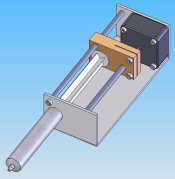
Here is a CAD drawing of my idea for a leadscrew driven syringe.
I think that the basic design is adaptable to virtually any size syringe.
It's based on standard size steppers, syringes and threaded rod.

I think the most expensive part would be the baseplate, but it's design is such that could easily (and fairly cheaply) be lasercut and CNC bent.

That aside, the rest could be built with basic tools - a drill press, a saw, a tap and die set and screwdrivers.

The leadscrew nut block could be machined for greater accuracy, but I doubt that this would be necessary. The backlash adjustment on that part may not even be needed in the actual event, as it's not going to be frequently reversing.

It's a bit oversize on the length, to allow the syringe to be removed for filling, exchange when it wears, or to change chemistry.

Any thoughts?
 

Attachments

  • syringe pump.jpg
    syringe pump.jpg
    133.7 KB · Views: 143
Looks good to me, but you may need a clip to hold the plunger so that you can fill the syringe when mounted by running it in reverse. Otherwise, how would you fill it and then place a filled syringe in the mount?

PE
 
Ah... yes :tongue:
missed that one.

I was aiming for as little plumbing as humanly possible - I was intending to fill the syringe off the machine.

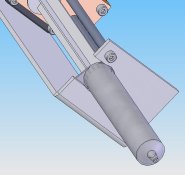
What do you think to adding a quick release for the syringe?
Somewhat like this:

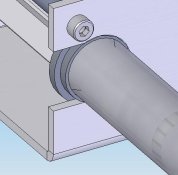
I'd need to add a stepped bush or collar that slips over the syringe to stop it wobbling all over the place.
 

Attachments

  • syringe pump with cutout.jpg
    syringe pump with cutout.jpg
    134.5 KB · Views: 120
Added the syringe collar:
 

Attachments

  • syringe pump with cutout and bush.jpg
    syringe pump with cutout and bush.jpg
    90.5 KB · Views: 110
Ben;

The mod looks perfect to me.

Now, the outlet can be on-center or off-center. If intended for upright delivery, either is ok, but if intended for horizontal delivery, the outlet must be on the bottom side of the syringe to allow filling.

Do you agree? If so, this will take a custom syringe as seen in the web site referred to above.

PE
 
Guys;

I just saw a device called a syringe rack. It was being shown on TV and is a device used by chefs to make items that have to be injected into ice water, hot water or hot oil. The rack that I saw held 12 syringes and was operated manually by a block of wood.

Looks neat, inexpensive and doable.

PE
 
Guys;

I just saw a device called a syringe rack. It was being shown on TV and is a device used by chefs to make items that have to be injected into ice water, hot water or hot oil. The rack that I saw held 12 syringes and was operated manually by a block of wood.

Looks neat, inexpensive and doable.

PE

Is this the George Foreman emulsion maker - available only through this special TV offer:D .

(Sorry, I just couldn't resist)

By the way, this and the other thread about automated emulsion making are fascinating, even if you are like me, and therefore absolutely unlikely to ever try any of this yourself.

Matt
 
Ben;

The mod looks perfect to me.

Now, the outlet can be on-center or off-center. If intended for upright delivery, either is ok, but if intended for horizontal delivery, the outlet must be on the bottom side of the syringe to allow filling.

Do you agree? If so, this will take a custom syringe as seen in the web site referred to above.

PE

Thanks :smile:
I just drew the syringe as a standard concentric type as it was easier, but I believe I can get hold of off centre syringes, if hotizontal mounting is the order of the day, but I'm working on a concept sketch of a system where 4 of these are attached vertically to a square bar.
This arrangement could then be attached to an ordinary clamp stand over a hotplate stirrer, or fit onto the lid of a machine.

I'll have another play later on. It's HIE and velvia-with-a-polariser weather now though... I'm going out
 
How about some draft requirement specs for the system?

Wow ! I have found this thread very interesting indeed for quite a few reasons.
Firstly I am an Electrical Engineer and Computer Programmer. Secondly, one of the many things I do for a living is to develop automation and control systems using (amongst other things) PCs and Data Acquisition systems. The final and obvious reason is that I am an APUGger.

I like the idea of designing an "open source" mechanical, fluidic, electrical and software system. It could even be beneficial to begin drafting up some requirement specifications for such a system - one that can be edited by anybody interested in contibuting.

PE, do you have any draft or working drawings/sketches that show a possible system as a whole ? (or a system which is sufficiently 'similar') ?

regards
Peter
 
Peter;

I could do that from memory, but I'm considering the ramifications of postng something like that due to the fact that I have too much information on confidential items. I have to edit my memory so that I can satisfy you and not disclose too much. We are treading pretty close here.

I may diagram one single delivery system and leave out details to obscure some of the fine points.

PE
 
Photrio.com contains affiliate links to products. We may receive a commission for purchases made through these links.
To read our full affiliate disclosure statement please click Here.

PHOTRIO PARTNERS EQUALLY FUNDING OUR COMMUNITY:


Ilford ADOX Freestyle Photographic Stearman Press Weldon Color Lab Blue Moon Camera & Machine
Top Bottom