• Welcome to Photrio!
    Registration is fast and free. Join today to unlock search, see fewer ads, and access all forum features.
    Click here to sign up

Spectral Dye Density Curves - measurements and interpretation

Temporary Jewels

H
Temporary Jewels

  • 1
  • 0
  • 24
Horicon Marsh-5

A
Horicon Marsh-5

  • 2
  • 0
  • 84

Recent Classifieds

Forum statistics

Threads
201,255
Messages
2,821,261
Members
100,622
Latest member
zerzig
Recent bookmarks
0

Romanko

Member
Joined
Sep 3, 2021
Messages
890
Location
Sydney, Australia
Format
Medium Format
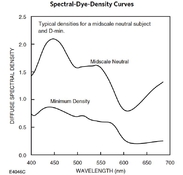
Datasheets of Kodak color negative films include Spectral-Dye-Density curves (see below for Kodak Ektar 100). Can someone please explain how these curves are measured and more importantly how to interpret them? If Kodak decided to include these curves in all their datasheets they must convey some important information about the film.

spectral-dye-density-curve.jpg
 

koraks

Moderator
Moderator
Allowing Ads
Joined
Nov 29, 2018
Messages
26,143
Location
Europe
Format
Multi Format
how these curves are measured

I don't know. That is to say, in general terms I could take a guess at it, but this thread will show you how the underlying physics are kind of involved, since it's a very similar issue: https://www.photrio.com/forum/threads/spectral-sensitivity-and-its-possible-consequences.206815 Fireworks start at around here: https://www.photrio.com/forum/threa...its-possible-consequences.206815/post-2796097
how to interpret them

Still tricky because of the above. However, what I personally use them for is to figure out how a light source and/or a sensitive element (photo paper, a digital sensor) matches with the color negative. The dye peaks are discernable in these plots, so we can infer some things from it (to a limited extent!) in terms of the risk of crossover in the imaging chain. For me, a plot like this gives a starting point for a 'back of the envelope' analysis. This is the kind of stuff I mean: https://tinker.koraks.nl/photography/the-flipside-a-closer-look-at-printing-color-negatives/

I don't get all that much more from it, and I think that's also about as much as Kodak intends us to do with it. Note that Kodak gives somewhat more detailed information for motion picture film; e.g. from the Vision3 250D datasheet:
1716538625428.png

Note how they give the actual dye peaks in this plot (and a broader spectrum), which I think is probably intended for the exact kind of analysis that I hinted at above - particularly digitization.

I also suspect that Kodak's intent is that if you need more detailed data, e.g. because you're working on a new scanning system, you're supposed to contact them with specific questions. I consider the plots in the datasheet as a kind of free 'teaser' to get you started.
 
OP
OP

Romanko

Member
Joined
Sep 3, 2021
Messages
890
Location
Sydney, Australia
Format
Medium Format
this thread will show you how the underlying physics are kind of involved, since it's a very similar issue:

Thank you, @koraks. I saw this thread but haven't read the recent posts yet. I tried a naive approach and multiplied (linear) sensitivity curves for the red, green and blue channels by the standard D65 illuminant curve and summed them together. The resulting curve looks nothing like that on the figure in my first post. I tried both linear and logarithmic scaling.
I don't remember seeing such plots in any of the textbooks I read so far. It feels like I am missing something important here.
 

koraks

Moderator
Moderator
Allowing Ads
Joined
Nov 29, 2018
Messages
26,143
Location
Europe
Format
Multi Format
I tried a naive approach and multiplied (linear) sensitivity curves for the red, green and blue channels by the standard D65 illuminant curve and summed them together.

I'm not sure what you've done here and to which curves, but if this is about spectral sensitivity, please keep in mind it's a different topic than spectral dye density. I trust you're aware of this.
 
OP
OP

Romanko

Member
Joined
Sep 3, 2021
Messages
890
Location
Sydney, Australia
Format
Medium Format
I'm not sure what you've done here and to which curves
What I tried is obviously wrong but here it is.
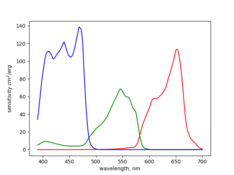
Spectral sensitivity curves for Ektar 100 digitized from the data sheet and converted to linear scale:
spectral_sensitivity_curves.png
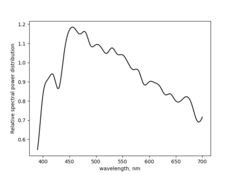
I multiplied each curve by the spectral power distribution of standard illuminant D65

Spectral_Power_Distribution_standard_illuminant_D65.png

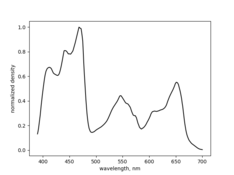
and added the three curves:

simulated_spectral_dye_density_curve_(linear).png
 

koraks

Moderator
Moderator
Allowing Ads
Joined
Nov 29, 2018
Messages
26,143
Location
Europe
Format
Multi Format
Regardless of the question whether it was 'wrong' what you did - I'm wondering what you tried to learn by doing it?
Also, what does it have to do with spectral dye densities?
 
OP
OP

Romanko

Member
Joined
Sep 3, 2021
Messages
890
Location
Sydney, Australia
Format
Medium Format
I am simply trying to understand the data sheets.

Also, what does it have to do with spectral dye densities?
By definition, the sensitivity of a film layer is measured as the inverse of the exposure required to reach a certain dye density. My assumption was that the dye density curve could be calculated from the three sensitivity curves and the spectral power density of the illuminant. This did not work.

I read the thread that you mentioned. It helped with understanding the difference in the spectral sensitivity data for black-and-white films provided by Kodak and Ilford. It was useful but did not quite answer the question of how the spectral-dye-density curve is measured and how one could interpret it.
 

koraks

Moderator
Moderator
Allowing Ads
Joined
Nov 29, 2018
Messages
26,143
Location
Europe
Format
Multi Format
I think the main conclusion you'll end up drawing is that the datasheets are insufficiently specific to be interpreted to any level of detail. What you can take away from them, is mostly at the level of some generic/superficial patterns. These are generally sufficient to effectively put the material to use.
 

DREW WILEY

Member
Allowing Ads
Joined
Jul 14, 2011
Messages
14,786
Format
8x10 Format
I pay a lot of attention to how steep the three respective hills are, and to what amount they're fully independent, versus how much they overlap lower down. That tells me a lot about how specific negative films differ. I the case of Ektar you get rather cleanly separated steep peaks, which indicates a rather contrasty film with crisply defined hues, which is, of course, exactly what Ektar is.

By comparison, most color neg films have broader mountains with a fair amount of deliberate crossover lower down, for sake of less contrasty complex skintone reproduction.

But you can learn the same thing from just a little experimentation with these various films.

But I've never paid attention to any midscale neutral plots. Perhaps those were once beneficial for color analyzer settings. Dunno. I do everything via simple test strips instead.

 
Last edited:
OP
OP

Romanko

Member
Joined
Sep 3, 2021
Messages
890
Location
Sydney, Australia
Format
Medium Format
Special-Dye-Density Curve: A graph 1) of the total density of the three dye layers measured as a function of wavelengths, and 2) of the visual neutral densities of the combined layers similarly measured.

 
Photrio.com contains affiliate links to products. We may receive a commission for purchases made through these links.
To read our full affiliate disclosure statement please click Here.

PHOTRIO PARTNERS EQUALLY FUNDING OUR COMMUNITY:


Ilford ADOX Freestyle Photographic Stearman Press Weldon Color Lab Blue Moon Camera & Machine
Top Bottom