
-
Welcome to Photrio!Registration is fast and free. Join today to unlock search, see fewer ads, and access all forum features.Click here to sign up
- Home
- Forums
- Analog Workflow Forums (100% Analog/Traditional)
- Analog Equipment
- 35mm Cameras and Accessories
You are using an out of date browser. It may not display this or other websites correctly.
You should upgrade or use an alternative browser.
You should upgrade or use an alternative browser.
Space cameras - 35mm
-
A
- Thread starter frank
- Start date


Recent Classifieds
-
For Sale Contax 46mm UV Filter, Cased, Boxed, Like New
- Started by davela
-
For Sale Beautiful Contax G2 Leather Case
- Started by davela
-
For Sale FUJI GX680III with 125mm f5.6 Fujinon and IIIN 120 back + spare 120 spool
- Started by Simon Benton
-
Sold Saunders VT-1400 11x14 Easel
- Started by Roger Thoms
-
For Sale Canon F1n with Power Winder, 50/1.4 S.S.C, and some extras [EU]
- Started by Laurent
Forum statistics
Here are a couple of resources -> Nikon cameras and NASA cameras & Nikon F3 NASA: Space Nikon
- Joined
- Aug 3, 2010
- Messages
- 1,101
- Format
- Multi Format
Kiev 6 Space Camera - http://ussrphoto.com/wiki/default.asp?WikiCatID=17&ParentID=1&ContentID=121&Item=Kiev+6+Space+Camera

Leningrad - Space version - http://ussrphoto.com/wiki/default.a...&ContentID=143&Item=Leningrad+-+Space+version
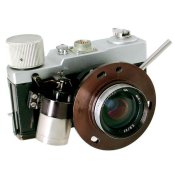
and few more I don't see online reference for them, only in books.
Leningrad - Space version - http://ussrphoto.com/wiki/default.a...&ContentID=143&Item=Leningrad+-+Space+version
and few more I don't see online reference for them, only in books.
http://en.m.wikipedia.org/wiki/Alan_Shepard
had a small 35mm rangefinder on his initial flight.
Think a Minolta but my memory from then patchwork.
had a small 35mm rangefinder on his initial flight.
Think a Minolta but my memory from then patchwork.

- Joined
- Jun 16, 2005
- Messages
- 1,074
- Format
- 4x5 Format
Kodak designed and built the "APOLLO LUNAR SURFACE CLOSE-UP CAMERA". It was a stereo camera with electronic flash. It used 35mm Ektachrome MS Film in a special metal magazine.
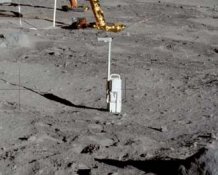
My first full-time job at Kodak was working on this. I graduated from RIT in March 1969 and started work immediately. In July the camera was carried to the Moon, used, film removed and the camera left on the Lunar Surface. I made sure that I handled each of the cameras delivered to NASA in order to make sure I handled the ones that were going to be left on the Lunar Surface. I was just a "kid" at the time.
Bob Shanebrook
www.makingKODAKfilm.com
My first full-time job at Kodak was working on this. I graduated from RIT in March 1969 and started work immediately. In July the camera was carried to the Moon, used, film removed and the camera left on the Lunar Surface. I made sure that I handled each of the cameras delivered to NASA in order to make sure I handled the ones that were going to be left on the Lunar Surface. I was just a "kid" at the time.
Bob Shanebrook
www.makingKODAKfilm.com
Kodak designed and built the "APOLLO LUNAR SURFACE CLOSE-UP CAMERA". It was a stereo camera with electronic flash. It used 35mm Ektachrome MS Film in a special metal magazine.
View attachment 95481
My first full-time job at Kodak was working on this. I graduated from RIT in March 1969 and started work immediately. In July the camera was carried to the Moon, used, film removed and the camera left on the Lunar Surface. I made sure that I handled each of the cameras delivered to NASA in order to make sure I handled the ones that were going to be left on the Lunar Surface. I was just a "kid" at the time.
Bob Shanebrook
www.makingKODAKfilm.com
That's pretty darned kewl. I hope you left a few very clear fingerprints somewhere inside the cameras so your fingerprints are on the moon.

OP
OP

That's pretty darned kewl.
Beat me to it. Just about to say he same.
ESA Spacelab Mission D1 1985
Linhof Aerotechnika
HaBla 500 EL/ m
F3
OM-1
Linhof Aerotechnika
HaBla 500 EL/ m
F3
OM-1
I have picture in the photographic encyclopedia from the 60s with John Glen and Ansco 35mm motor that NASA modified to be used with the gloves on his space suite.

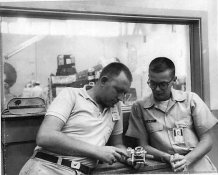
Here is Red (chief NASA camera repairman) and myself with one of the cameras being evaluated for the Glenn launch. Grissom's capsule is behind me in the white room (where I went later), and the next two capsules are unassigned. (This is a 4x5 Polaroid. I washed the negative at a water cooler while Gus Grissom stood by and watched)
So, there were dozens of cameras, 35mm and 120 that were made, tested and discarded. Only one fit the criteria and that one left behind many interesting stories.
PE
So, there were dozens of cameras, 35mm and 120 that were made, tested and discarded. Only one fit the criteria and that one left behind many interesting stories.
PE
Attachments
PE... That is so effing kewl!!
So, there were dozens of cameras, 35mm and 120 that were made, tested and discarded. Only one fit the criteria and that one left behind many interesting stories.
What were those criteria (aside of ergonomics)?
Weight, capacity of film, ease of use (I guess this is partly ergonomics), does it break down easily?
I did not have anything to do with the choice. I was part of a unit that subcontracted this with NASA making the choice and our group just looking in at the ongoing work and paying the bills. But I did work with Red and get to hold the camera that he was working on. He also gave me some discarded pieces to examine, with reasons for rejection. I forget them all, but I still have the pieces.
PE
I did not have anything to do with the choice. I was part of a unit that subcontracted this with NASA making the choice and our group just looking in at the ongoing work and paying the bills. But I did work with Red and get to hold the camera that he was working on. He also gave me some discarded pieces to examine, with reasons for rejection. I forget them all, but I still have the pieces.
PE

- APUGuser19
- Deleted

Interesting;I had one of these Practicas in 1972.It didn't survive a month in my hands(the shutter stopped working after about 500 actuation)maybe just bad luck but, I went to Nikon FMs after that and never looked back;the lens wasn't all that bad though.-) Practica EE2
Dead Link Removed
-) Ansco
-) Contarex
- AgX
- Deleted
I didn't care what camera they used.
I'm going to take a guess here before PE answers the question posed in post #16. I contend that the Hasselblads were chosen for the Apollo landings for reason of largest possible negative coupled with most exposures per load. Actually, the Hasselblad is a very good camera. As one who seems to unwittingly have become self-specialized in working on them, they do have points of engineering that cause question, but there are other areas that are brilliantly simplistic. But for short bursts of time between examinations/adjustments, they are as dependable an an anvil. For the Apollo missions, they only had to work perfectly for 10 days or so at the time. And to be sure, there was no comparable camera in existence on this planet at the time for use on the flight mission.
All good comments.
PE
So I guess ten days use is why NASA treated them as disposable cameras... leaving them on the moon. Hey, I just had a thought. I wonder what one of those cameras would be worth if brought back by some future mission, if there ever is one, keeping all the moon dust on it.

So I guess ten days use is why NASA treated them as disposable cameras... leaving them on the moon. Hey, I just had a thought. I wonder what one of those cameras would be worth if brought back by some future mission, if there ever is one and keeping all the moon dust on it.
There has been some action on treaties to protect the lunar landing sites - I recall china or russia or someone planning an unmanned landing in the last few years, and the US raising a stink about nothing being close to the Apollo sites. If something was ever retrieved from a landing site, it would probably be considered "stolen".
Besides the manned landing sites, you have the various unmanned probes, and - what I'd love to have a look at - several sites where Apollo SIVB 3rd stages were intentionally crashed into the moon to trigger seismic sensors left by earlier manned missions. The Japanese probe that photographed the Apollo sites also photographed a 3rd stage site - from that altitude it just looked like a bright crater though. Wonder how may parts survived?
Off topic but geeky as hell for Apollo nerds... the Apollo 12 SIVB's amazing journey since 1972.
I've seen pictures of one of the OM models outfitted with a pistol grip for use on NASA missions.
I've seen pictures of one of the OM models outfitted with a pistol grip for use on NASA missions.
OM4 used in the space shuttle http://www.zuiko.com/index_040.htm
| Photrio.com contains affiliate links to products. We may receive a commission for purchases made through these links. To read our full affiliate disclosure statement please click Here. |
PHOTRIO PARTNERS EQUALLY FUNDING OUR COMMUNITY:  |