
• Welcome to Photrio!
    Registration is fast and free. Join today to unlock search, see fewer ads, and access all forum features.
    Click here to sign up

Some experiments with Kentmere 400 (pushed to 800 and 1600), developed in FLIC Black, White and Green

Viaduct.jpg

A
Viaduct.jpg

  • 3
  • 1
  • 45
Durham walk.jpg

A
Durham walk.jpg

  • 0
  • 0
  • 32

Recent Classifieds

Forum statistics

Threads
202,539
Messages
2,842,069
Members
101,369
Latest member
hluvmiku
Recent bookmarks
0

oneeyedpainter

Member
Allowing Ads
Joined
Mar 1, 2026
Messages
11
Location
London
Format
Analog
Hello all,

I just wanted to share some satisfactory results with pushing a few rolls of Kentmere 400 to ISO 800 and ISO 1600. The "push" was mainly due to the necessity of working with interior low light for a few family occasions, but got the chance of shooting some frames outside as well, just to check how they would look. I used the Flic Black, White and Green developer (1+49), after having read of some success with K400 in other threads here.

Both Flic and the Massive Dev Chart leave us wondering what reasonable developing times should be when pushing Kentmere 400. I know the Film Developing Cookbook suggests to multiply the developing time by 1.25 for each stop of push, but I have the (wrong?) impression that the Flic BWG is not a particularly energetic developer (as several other phenidone-ascorbate-based developers confirm), so I opted for a 1.35x factor instead. Hence, the +1 push was developed for 22min (Agitation 1min + 15s/min), while the +2 push was developed for 30 minutes (Agitation 1min + 15s/min). I found that both developing times worked faily well. I reported below ad few samples, mainly of harsh light/constrast conditions, where grain would be more visible under pushing.

I would like to hear about your experience with Flic BWG and pushing Kentmere 400. I know, the grain is there, but I frankly like the results, and might end up experimenting with this combination more in the future.

See you

OneEyedPainter

PICT0132_crop.JPG

(Kentmere 400 - ISO 400 (box speed) - BWG 16.25m AG: 1m + 15s/min)


PICT0165_crop.JPG

(Kentmere 400 - pushed to ISO 800 - BWG 22m AG: 1m + 15s/min)


PICT0757_crop.JPG

(Kentmere 400 - pushed to ISO 1600 - BWG 30m AG: 1m + 15s/min)

PICT0796_crop.JPG

(Kentmere 400 - Pushed to ISO 1600 - BWG 30m AG: 1m + 15s/min)

PICT0751_crop.JPG

(Kentmere 400 - Pushed to ISO 1600 - BWG 30m AG: 1m + 15s/min)
 
I've pushed Kentmere to 800 and 1600, up to 8X10 to compare with Tmax 400, grain was pretty good, at 800 I could see a 11X14, I used Clayton F76+ for the 800 push and Acufine for the 1600 push. Although Tmax 400 and 3200 would be my first choice Kentmere is doable. On the other hand Foma 400 not so much.
 
Welcome to Photrio.
A good rule of thumb: don't take photos of backlit black cats if you want to test what happens when you reduce exposure and increase development (known colloquially as "pushing" film) :smile:
I'll let the cat owners chime in on whether a white cat or Cheshire cat will make a good test subject.:whistling:
 
Welcome to Photrio.
A good rule of thumb: don't take photos of backlit black cats if you want to test what happens when you reduce exposure and increase development (known colloquially as "pushing" film) :smile:
I'll let the cat owners chime in on whether a white cat or Cheshire cat will make a good test subject.:whistling:
:D I had the Cheshire cat on the 37th shot of that very same roll, alas, the scissors slipped when I snapped the roll from the cartridge, and there you go.... :wink:
 
Are these scanned with an Epson? I mostly stopped using Flic Film Black White & Green as I disliked the "sandy" quality of the grain. But maybe it's less of a problem on a flatbed scanner.
 
Are these scanned with an Epson? I mostly stopped using Flic Film Black White & Green as I disliked the "sandy" quality of the grain. But maybe it's less of a problem on a flatbed scanner.

Nope, no Epson scanner here.
 
Hello all,

I just wanted to share some satisfactory results with pushing a few rolls of Kentmere 400 to ISO 800 and ISO 1600. The "push" was mainly due to the necessity of working with interior low light for a few family occasions, but got the chance of shooting some frames outside as well, just to check how they would look. I used the Flic Black, White and Green developer (1+49), after having read of some success with K400 in other threads here.

Both Flic and the Massive Dev Chart leave us wondering what reasonable developing times should be when pushing Kentmere 400. I know the Film Developing Cookbook suggests to multiply the developing time by 1.25 for each stop of push, but I have the (wrong?) impression that the Flic BWG is not a particularly energetic developer (as several other phenidone-ascorbate-based developers confirm), so I opted for a 1.35x factor instead. Hence, the +1 push was developed for 22min (Agitation 1min + 15s/min), while the +2 push was developed for 30 minutes (Agitation 1min + 15s/min). I found that both developing times worked faily well. I reported below ad few samples, mainly of harsh light/constrast conditions, where grain would be more visible under pushing.

I would like to hear about your experience with Flic BWG and pushing Kentmere 400. I know, the grain is there, but I frankly like the results, and might end up experimenting with this combination more in the future.

See you

OneEyedPainter

View attachment 419330
(Kentmere 400 - ISO 400 (box speed) - BWG 16.25m AG: 1m + 15s/min)


View attachment 419331
(Kentmere 400 - pushed to ISO 800 - BWG 22m AG: 1m + 15s/min)


View attachment 419332
(Kentmere 400 - pushed to ISO 1600 - BWG 30m AG: 1m + 15s/min)

View attachment 419333
(Kentmere 400 - Pushed to ISO 1600 - BWG 30m AG: 1m + 15s/min)

View attachment 419334
(Kentmere 400 - Pushed to ISO 1600 - BWG 30m AG: 1m + 15s/min)

I'm amazed by the results; thanks for sharing.
 
That makes sense. Most scanners cap out at around 2400 true dpi and that smooths the appearance of grain.
 
That makes sense. Most scanners cap out at around 2400 true dpi and that smooths the appearance of grain.

Thanks @loccdor

That is true. Although I was taught many years ago that any discussion about film grain should also include a clear note to the enlarger magnification ratio used to print it :wink:

I am not printing any 35mm film on 16"x12" (ever), hence my assessment of those results was "satisfactory" based on the typical use I would make of a digital scan of them :smile: The grain is there, nobody can deny it, but the results are definitely much better than I expected from a cheap film pushed with a cheap developer, to be viewed at normal screen resolution.

YMMV and I appreciate that.
 
Yes, just analyzing. Thanks for sharing the images. My favorite is the flower.
 
Yes @loccdor I know, and I appreciate your comment and your analysis. This is exactly why I posted the results here :smile:

Just as a scientific exercise, please find below 1:1 versions of (portions of) the last three pictures, those pushed to 1600 ISO, in the same order as in the OP. No interlacing or smoothing, just pure 1:1 mapping of pixels on the screen. Hope they do not get resized by the import....

The flower was a surprise for me as well: it was shot with an old Yaschica MC 75-200mm zoom at fake-macro (1:4) ratio, focal length 200m, f:11, I guess at 1/250 or 1/500 as it was ovcercast. I bought the lens off ebay for 25 quids (LOL), clean, functioning and all. I honestly expected a much softer touch from it, especially at 200mm, which would have been amplified even further by the pushing. That is why I am impressed by how it came out, after all.

screen_20260302_112256.png


screen_20260302_112355.png


screen_20260302_112137.png
 
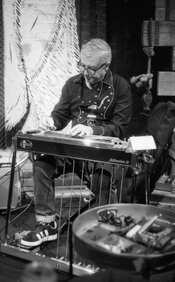
I've moved to Kentmere 400 for my gig photography, pushed to 3200 in Ilford Microphen. I scan using an ancient Epson V-series flatbed. These I lifted from my social media as I am currently at work without access to the original files....but they give an idea of what Kentmere 400 can do pushed to 3200
 

Attachments

  • k7.jpg
    k7.jpg
    414.7 KB · Views: 4
  • k8.jpg
    k8.jpg
    824.4 KB · Views: 4
  • k6.jpg
    k6.jpg
    607.8 KB · Views: 3
  • k5.jpg
    k5.jpg
    696.2 KB · Views: 3
  • k4.jpg
    k4.jpg
    616.2 KB · Views: 3
  • k3.jpg
    k3.jpg
    727.1 KB · Views: 3
  • k2.jpg
    k2.jpg
    616.1 KB · Views: 3
  • k1.jpg
    k1.jpg
    851.2 KB · Views: 4
For comparison, here's Tri-X in B/W&G. I didn't find my Tri-X results as objectionable as some other films, but still grainier than 510-pyro or HC-110. The crop is a 1mm x 1mm area.

54955107054_6c89de8454_k(1).jpg


54955107054_5a982860bb_o.jpg
 
I've moved to Kentmere 400 for my gig photography, pushed to 3200 in Ilford Microphen. I scan using an ancient Epson V-series flatbed. These I lifted from my social media as I am currently at work without access to the original files....but they give an idea of what Kentmere 400 can do pushed to 3200

Thanks for sharing those @Agulliver , much appreciated! You results are very good, and it looks like Microphen did a truly decent job there. I used Microphen a lot during my previous film life, mostly with FP4+ and Agfapan APX 400, but I am intrigued to see how far one can stretch ascorbate-phenidone developers, which I had never tried before (I had used exclusively MQ or PQ ones).

I am now really tempted to try and see how BWG would behave on Kentmere 400 pushed to 3200 ISO.... :smile:
 
I've moved to Kentmere 400 for my gig photography, pushed to 3200 in Ilford Microphen. I scan using an ancient Epson V-series flatbed. These I lifted from my social media as I am currently at work without access to the original files....but they give an idea of what Kentmere 400 can do pushed to 3200

BTW, the last two shots (k1.jpg and k2.jpg, the two saxophonists) are really amazing.
 
BTW, the last two shots (k1.jpg and k2.jpg, the two saxophonists) are really amazing.

Thank you very much. It's a tricky lighting situation because the back wall is backit in red, one of the spotlights shines directly down (it's known as "the transporter") and use of the regular spots is inconsistent. They only really started using the spots because of my regular presence!

I shot an album cover there last year, purely by accident because I wasn't trying to do so. All the photos on the front cover were B&W film, and about a third of the inner sleeve were colour film - the rest of the inner being digital.

I find that chief difference between K400 and more expensive options such as Tri-X, Delta 400 and HP5+ is the antihalation. There's a little more halation with K400. But I don't mind in this case, it perhaps adds something to the images. In other settings it might bother the photographer? I've tried Fomapan 400 at this club too and while it can be pushed to 1600, it becomes very contrasty. Delta 3200 I find too mushy in 35mm but I do shoot it in medium format. Now that I have a Super Ikonta with an f2.8 lens I will try K400 in 120 at this club soon.

I also used something called "Exeter-Pan" last year which may be expired but frozen Ilford P400 surveillance film. It performed somewhat similar to K400 but the last 100 foot roll I bought exhibited slight fogging (possibly due to age) so I've gone back to K400 as the best value for money in my circumstances.
 
Photrio.com contains affiliate links to products. We may receive a commission for purchases made through these links.
To read our full affiliate disclosure statement please click Here.

PHOTRIO PARTNERS EQUALLY FUNDING OUR COMMUNITY:


Ilford ADOX Freestyle Photographic Stearman Press Weldon Color Lab Blue Moon Camera & Machine
Top Bottom