
• Welcome to Photrio!
    Registration is fast and free. Join today to unlock search, see fewer ads, and access all forum features.
    Click here to sign up

Skin Tones in pre 1960 Black and White

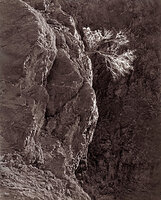
Bush on Canyon Wall

A
Bush on Canyon Wall

  • 0
  • 0
  • 0
double portrait

A
double portrait

  • 1
  • 0
  • 20

Forum statistics

Threads
203,257
Messages
2,851,997
Members
101,747
Latest member
Tallphotographer
Recent bookmarks
0
Could we be working too hard on this?

Finally getting the examples - they somehow were invisible in your posting, and appeared only in the input box when I tried to reply - what I see is distinctly unremarkable. Looks like underexposure, especially with an uncoated lens, with a stretching of the contrast in printing to achieve a full scale.

One thing that - can it be nobody sees that in one of the examples, the subjects are asian, probably dark to begin with? And, it's pretty certain that HCB didn't always expose perfectly.

When I started in photography, I had only WWII surplus film, and I liked my Contax II with an uncoated Sonnar. Believe me, I see nothing at all unusual about what you are showing. I'm pretty confident that I could duplicate it with contemporary films using an old lens and exposing against my better judgment.

As for halation, one of my favorite films was 2475 recording film, of which I shot many hundreds of rolls. It had no halation coating at all. I can say with absolute confidence that halation isn't what I'm seeing.

Maybe but how can I get the highlight effect to happen so readily on type 55 polaroid and cannot seem to get it on my other regular films? Believe me I have tried in the exact same shots just switched backs. And developed the living shit out of them in some cases.

RB
 
Single coated - or non-coated lens will give small, pure highlights, spread out highs, lots of detail in medium and lower values and very few pure black areas.
The negative will look dramatically different from a negative shot with a modern multi-coated lens.
The image on my home page was shot with a 105 year old non-coated Cooke lens.


Per Volquartz

Dead Link Removed
 
Single coated - or non-coated lens will give small, pure highlights, spread out highs, lots of detail in medium and lower values and very few pure black areas.
The negative will look dramatically different from a negative shot with a modern multi-coated lens.
The image on my home page was shot with a 105 year old non-coated Cooke lens.


Per Volquartz

Dead Link Removed

Okay - understood. I have a lot of lenses from the 1930's and 1940's but... That still doesn't answer why this happens with type 55 and brand new zeiss CFi glass as well but not other films - at least I can't seem to get it to happen.

RB
 
Polariod is pretty low resolution compared to regular films. And it also loses sharpness through diffusion of the silver as it transfers from the neg to the print. The highlights may show this effect more as there is more to diffuse.

You know, a lot of people had more tanned skin 60 years ago than people today, at least people that worked outdoors. Even the kids played outside more back then than now...
 
I think too many separate issues are at play here, and your examples don't have all that much in common to my eye. You need to find out, with nore specificity what it is that you want. You'll just have to experiment and be patient. Lenses, film, dev, lighting, spectral sensitivity... lots and lots of variables.

Why don't you just keep an eye out for a print that you like in the apug gallery and when you see it, inquire about the details.

And I agree with bowzart, I see no halation.

P.S. try fuji fp100b.
 
Anyway, have you seen this lovely ad from around 1930? It promised "beauty heretofore impossible" through the expanded spectral sensitivity of pan film...

panortho.jpg

Keith, this is a very interesting add. I think the portrait on the left is more flattering. I'm assuming the model has blue eyes, and assuming the photo on the left is ortho film. I love the spectral sensitivity of the ortho film (blue sensitive). It's so different from todays films. I guess at the time, the spectral sensitivity of panchromatic films was different and "better."

I'm surprised RB didn't respond to this post. This may the answer to his question.
 
Maybe Flashbulbs instead of xenon flash might have added to the effect. Maybe it is an artefact of the type 55 film, silver diffusion et al., but I'll bet that the somewhat diffuse light from a flashbulb helps give this effect, combined with what everyone else was saying about ortho film, dark, oily skin, etc. etc...
 
Yeah, agree with others here that it has nothing to do with halation. And even if it did, it's really not a very practical way to go about replicating it when there are easier ways. Regardless, type 55, b/c of it's colorless base, and tonality (especially how the highlights and shadows fell off...abruptly but tastefully), printed unlike any film I've used, and had a unique look. But it's gone, so...

With that, I'd probably start with lighting. Talking about soft but direct sources. This is the most important part here, the light, and also the most difficult to understand and control. TXP is a good start, b/c it has an interesting old-fashion upswept curve that will compress the mids. But I think Tri-x in D-76 pushed a stop in the right light can more easily give those glowy/flat/spread-out looking highlights, imo. And finally a good single coated lens wide open. Or it doesn't even have to be single coated, but I know a lot of old german glass that will easily get the highlights to soften and bleed like that.
 
I'm with Bowzart on this, I think it is simple under-exposure compared to how we expose B&W film today.

Today we have multi-coated lenses that dump shadows, so we add exposure. Then we add even more exposure "just to be safe." Pretty soon we have negatives that are "pretty thick" and have a lot of shadow detail.

Try an older lens, shoot at box speed and develop gently.

I used to look through old newspaper photo archives, you would be surprised at how "thin" some of the negatives look, yet they yielded beautiful prints.
 
Keith, this is a very interesting add. I think the portrait on the left is more flattering.

Indeed, I am not sure the ad made their case as clearly as they hoped! I think we are supposed to notice that the older film maps all the colours of her rainbow ensemble into very similar b&w tones. But the face... there are some features that I like more on the right and some more on the left. I think I do prefer the deeper eyes.
 
I shot the same image on the same day at the same time with Plus-X and developed to a similar CI - no dice.

Can you post side-by-side images for comparison with complete descriptions of what was the same/different?
 
Okay - understood. I have a lot of lenses from the 1930's and 1940's but... That still doesn't answer why this happens with type 55 and brand new zeiss CFi glass as well but not other films - at least I can't seem to get it to happen.

RB

Actually, I think it may explain it very well. In the case of the type55/newZeiss combination, the highlight distribution is due to the film, and in case of the panfilm/1930lens combination, it's coming from the lens. Similar effect, different root cause.
 
Whoo hoooo - are you saying that the effect I am noticing IS halation???

Not in the least. I merely point out that if you would like to see what halation does to a modern film/lens/processing combination, it might be possible to introduce it without making film from scratch. I had in mind to do this as a educational exercise, with all of the caveats about what the washing and drying processes might do to the film other than remove the dye. I also considered using liquid emulsion on blank film base, but this changes too many things at once.

Many years ago, I tried using Kodak Fine Grain Positive as camera stock (untinted base, thick blue-sensitive emulsion about equivalent to the Kodabromide paper of the day) and I got images eerily reminiscent of the wet-plate era. This was with a Nikkor-H lens from the 1950s, so I had a low-technology lens (by today's standards), large aperture (the emulsion was paper-speed), blue sensitivity, and no antihalation base. No wonder the pictures looked different. :smile:
 
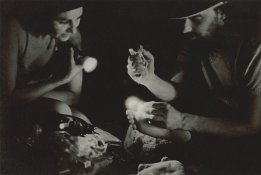
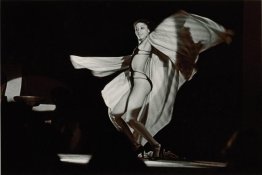
Well, just to offer a bit of perspective, I'll present a couple of images made under very harsh lighting conditions on 2475 recording film.

The first was made solely with the light of the included flashlight in a cave on a dark night. The lens was a 35mm Canadian made Leitz Summicron. This one shows obvious halation. Ain't it cool?

The second was made at a fashion show with the light provided by a followspot. The lens was most likely one of the old silver metallic barreled Canon 85mm LTM f/1.9's. I don't see any halation here. Of course, there could be some, but if so, it is slight and compensated by other factors.

The difference has to do with the quantity of light that actually reaches the film BASE. Films without anti halation coatings don't necessarily show noticeable halation. They will if the quantity of light is sufficient.
 

Attachments

  • The-Toe.jpg
    The-Toe.jpg
    72.4 KB · Views: 171
  • wearable art.jpg
    wearable art.jpg
    32.7 KB · Views: 173
To me all three of those shots (especially the first two) look like they were developed in 777.

Yes, I know there are no magic bullets in film processing, but in my experience 777 is one of the very, very few developers that imparts a certain look to negs and a lot it has to do with the way the highlights look.

Supposedly HCB was a fan of 777 and used it when available.

There is an article here about 777, but apparently the wrong formula is listed for true 777.

http://unblinkingeye.com/Articles/Harvey/harvey.html

Ignore the formula, but take a look at the pictures:

http://unblinkingeye.com/Articles/Harvey/P01/p01.html

http://unblinkingeye.com/Articles/Harvey/P02/p02.html

Look familiar?

At the moment only one company makes REAL 777. Bluegrass or something in Kentucky, USA.

You can get it through this site:

http://frugalphotographer.com/

direct link

http://tinyurl.com/acn8e

I know people who have bought this developer and it's the real thing.

http://400tx.blogspot.com/search?q=777


777 does impart a certain look, especially with Tri-X 400.
Use an older Leica or Nikkor lens and you're definitely in for some time traveling.
 
Just buy a Rodenstock Imagon or Fujinon SF so you can see the effect real time through the camera. Or you could just duplicate the effect in PS. Yes, I'm bad for suggesting the latter. :smile:
 
I'm with Harry Lime on this one. There are stories about the Magnum photographers gathering in the offices to test new films in or attend to the seasoning of a new batch of Harvey's Panthermic 777, which was the developer of choice for most of them, including Cartier-Bresson. It was used dip & dunk in large tanks AFAIK (but I wasn't there).

It's still available from:

http://www.bluegrasspackaging.com/
Bluegrass Packaging Industries, Inc.
3651 Collins Lane
Louisville KY 40245
502-425-6442

I'd try it with more of an old style emulsion for the same gradation as the older photos. Perhaps one of the Efke/Adox films, or even the more recently reformulated Tri-X or Plus-X films.

Lee
 
Know what you are talking about. I have portraits of my kids done in the 1970`s. I can print them and they look the same. Yet I can not duplicate the look, same studio lights, same camera, same film and developer. Just can`t get the same look
 
I'm not convinced about the 777 theory. There are just far too many unknown variables. How can we be certain that the result is from one thing rather than another? I don't think we can - unless someone takes on the responsibility of replicating it. That would mean to test each of the proposed theories and evaluating them.

Photography has always presented the mind with a multitude of opportunities for speculation. It's very seductive. And of all the seductive possibilities, 777 seems to be singular in its ability to trap the imagination.

By the way, 666 is the very high temperature (infernal) version of panthermic.
 
By the way, 666 is the very high temperature (infernal) version of panthermic.

Yep. And the only known formula based on burning brimstone...
 
Do you see anything familiar in my first experiments with Fomapan 100?
http://not.bloodylikely.org/photos/filterByKeyword/keywords(Fomapan100)/
The first roll (photos without -3ag- in the names) was with a Leica IIIa and a Summaron? 50/2 lens. Most were underexposed and probably developed ok.

The second roll (named *ag3*) was with a Canon EOS 3 50/1.4, and mostly correctly exposed, but quite over-developed

The second roll showed characteristically blown highlights that I found online with many fomapan 100 photos. This is probably because fomapan 100 needs quite a bit less development than other films and has a characteristic look when it's over-developed.

My guess is that the look you're seeking is due to the film used, and that you should search for examples where the film type is known
 
Heres my two cents worth. It appears that al have touched on at least one or two points that would achieve the look the OP is trying to attain. If we look at ALL the factors involved in "pre 1960" photography, we will find orthochromic film and first generation panchromic film, both with reasonably slow emulsions, using longer exposures. Lighting was most probably(in studios) photoflood (incandesent), so to, available light being tungsten. Now, we get to developers. Most are in agreement that "777" was most likely the developer of choice. Lastly, we look at what paper choices we are left to choose from. Would we use a fiber base, slow emulsion (graded ?) paper with any sort of textured surface, reminesent of Ektalure, or Portralure from Kodak? I'm sure there other papers out there that I cant remember offhand, possibly from Berger and Slavich, and Agfa, that gave the "look". My wife just reminded me of one more factor, uncoated lenses, that produce that "soft" look, giving a slight halo effect, that she loves on portraits.
Lets all take up the challenge, and use ALL these factors, and find the "look" the OP is seeking.

Rick
 
Photrio.com contains affiliate links to products. We may receive a commission for purchases made through these links.
To read our full affiliate disclosure statement please click Here.

PHOTRIO PARTNERS EQUALLY FUNDING OUR COMMUNITY:


Ilford ADOX Freestyle Photographic Stearman Press Weldon Color Lab Blue Moon Camera & Machine
Top Bottom