
• Welcome to Photrio!
    Registration is fast and free. Join today to unlock search, see fewer ads, and access all forum features.
    Click here to sign up

Show your tools!

Autumn

D
Autumn

  • 0
  • 0
  • 8
Sol Infinitus

A
Sol Infinitus

  • 5
  • 0
  • 31

Recent Classifieds

Forum statistics

Threads
203,390
Messages
2,853,900
Members
101,815
Latest member
DorianG
Recent bookmarks
0
So far I have repaired Minox A, Mamiya super 16 and Edixa 16 cameras. That's why I use these tools:View attachment 358873
The tool on the far left is a homemade tool made from a scalpel.

Then of course I have consumables for cleaning and lubricating.
- Mineral spirits for cleaning the internal parts and removing resin from the escapement
- Isopropanol for cleaning glass surfaces
- Acetone for degreasing the shutter blades
- NYOIL sealing oil for the bearing points of the gears and levers.
- GunCer weapon grease (Ballistol) for slow-running sliding pairs with emergency running properties, e.g. B. Lever and housing parts. Because of its very good adhesion, even at high temperatures, it is also suitable for use near lenses and shutters, as the risk of migration into grease-free zones is low.

This is a nice collection 🄰
 
Came in the mail today - the most expensive pair of tweezers of my life.
Pinzette.jpg
 
IMG_9256.jpeg


For the Weston meters.

ASA convert: guides me to cut (with an X-Acto knife) a small piece of pie the width of 1/3 stop from the exposure index window. I slide the wedge over and epoxy to a thin brass shim underneath. That makes the 1/3 stop difference between 80 and 100.

Typical wrenches.

Spring balance adjusting tube. Game changer. The balance is so easy with the tool. Start by zeroing with meter horizontal. Then hold meter vertical and if the needle is below zero, loosen the right-hand balance (to make it heavier). Then hold horizontal and balance by adjusting the left-hand balance. It’s so intuitive. With a little back and forth you can make it zero on three axes.

The weston V needs a flush socket so I just ground one down. They often glue those nuts so a drop of acetone helps.
 
View attachment 358878

For the Weston meters.

ASA convert: guides me to cut (with an X-Acto knife) a small piece of pie the width of 1/3 stop from the exposure index window. I slide the wedge over and epoxy to a thin brass shim underneath. That makes the 1/3 stop difference between 80 and 100.

Typical wrenches.

Spring balance adjusting tube. Game changer. The balance is so easy with the tool. Start by zeroing with meter horizontal. Then hold meter vertical and if the needle is below zero, loosen the right-hand balance (to make it heavier). Then hold horizontal and balance by adjusting the left-hand balance. It’s so intuitive. With a little back and forth you can make it zero on three axes.

The weston V needs a flush socket so I just ground one down. They often glue those nuts so a drop of acetone helps.

Not used for the first time as can be seen šŸ‘
 
I just got a pair of cheap ones and the first thing I encountered was a magnet.

Tell me more about that pair.

I hate it when the tiny part that I've pushed into place with the tweezers gets stuck to the tweezers when I open it and pull it away. So my tweezers have to be antimagnetic.

But I love it when my screwdrivers are magnetic. Then I insert the tiny screws into the hole using the screwdriver.
 
Knipex manufactures exclusively in Germany, at its founding location in Wuppertal.

I am glad that I was wrong. I thought I ran across some Knipex tools that I saw marked made in China. I as so disappointed.
 
Are there any mini pump style suction cups to be had?
I've seen some silly struggles on youtube regarding ground glass and some lens cells.

Think of the big 8" shower and window glass models and now shrink the cup down to 1 or 2 inches. That's what I have in mind.
 
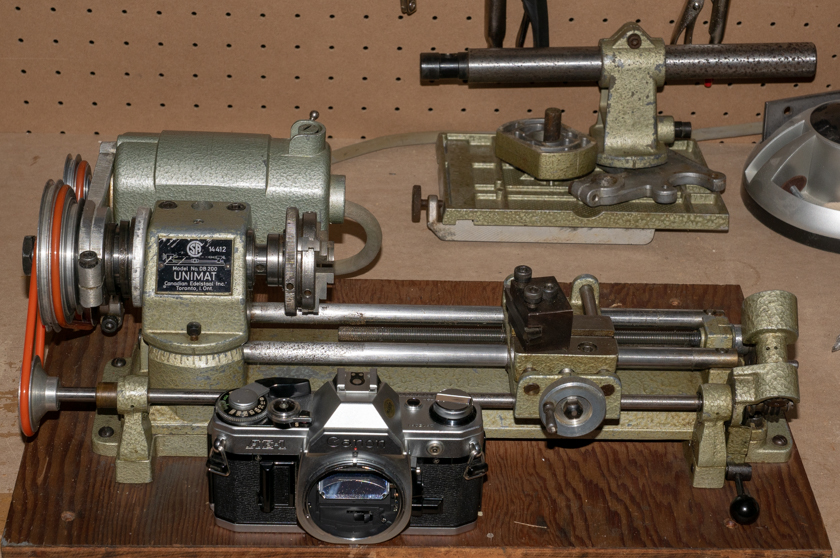
How can you acquire the knowledge of tool making for DIY and learn how to use such machines? Here, it is almost a separate apprenticeship.

It is fairly easy to learn how to use a Lathe or Milling machine ... it is harder to acquire one of these. I learned this skill when I was a teenager in school in a 1/3 year class ... and today with so many video tutorials it is quite trivial to learn the basics enough to create a camera part or repair tool ... example: Blondihacks

I have been in many situations where a camera part is broken or missing and getting a parts camera was no feasible. Using a lathe/mill is great for making custom tools like they did for the old factory service technicians (many of these custom tools are detailed in the Service Manuals).
 
Last edited:
How's about a virtual mini spanner? Designed to fit a ratcheting screwdriver. I resize the working end as needed, print with ordinary PLA fiber, and for the pins, I use piano wire. Because the part is so small, an entry-level 3D printer works fine, and print times are short.
Mini Spanner-3.jpg
 
Is there any tools that could repair the dents?

I am using the plastic (nylon) headed hammer with small anvil in jeweler's tiny size to do the repairs. Are the they the right tools?

Back in the 60s Original UK owned Rolls Royce (Crewe UK) used a small lead roller similar to a lawn roller to iron out a dent on car doors..(Used on the inside of course!!)🤣
 
Photrio.com contains affiliate links to products. We may receive a commission for purchases made through these links.
To read our full affiliate disclosure statement please click Here.

PHOTRIO PARTNERS EQUALLY FUNDING OUR COMMUNITY:


Ilford ADOX Freestyle Photographic Stearman Press Weldon Color Lab Blue Moon Camera & Machine
Top Bottom