• Welcome to Photrio!
    Registration is fast and free. Join today to unlock search, see fewer ads, and access all forum features.
    Click here to sign up

Show your mounted/framed photographs on the wall...

Recent Classifieds

Forum statistics

Threads
202,690
Messages
2,844,308
Members
101,472
Latest member
zzzzzz
Recent bookmarks
0
Leica CL, 1934 Elmar 3.5cm f 3.5, Agfapan 25. 11x14" darkroom print

52625482968_5c11c18d3c_c.jpg
Flickr
It looks like you do your own dry mounting, matting, and framing. There is obvious care taken in how the dry mounted print sits in the window, and there are no over cuts in the mats window. Nicely done, very clean.

I got somebody to dry mount and mat a print for me...once...then I learned how to do it.
 
Thank you. I haven't reached the 10k hours with cutting window mats yet and am still discovering measuring tricks along the way. I have to admit, I find the printing easier than the mounting!
 
Thank you. I haven't reached the 10k hours with cutting window mats yet and am still discovering measuring tricks along the way. I have to admit, I find the printing easier than the mounting!
I hear you. It's like subduing some mythic multi-headed beast.
 
8"x20" contact print from enlarged 4"x10" negative (Bergger 200 in Pyrocat)...print on Ilford Warmtone FB
IMG_6839 2.JPG
67202554405__C2E5A459-0A77-4873-80B9-F46D84AF6BD6 2.jpg
 
8"x20" contact print from enlarged 4"x10" negative (Bergger 200 in Pyrocat)...print on Ilford Warmtone FB

Greg, did you use an inkjet to make the enlarged negative? I do that with alt processes (Kallitypes) and am wondering how well the process translates to contact-printing on silver gelatin.
 
Greg, did you use an inkjet to make the enlarged negative? I do that with alt processes (Kallitypes) and am wondering how well the process translates to contact-printing on silver gelatin.

Sanders, that image is one of 3 I had negatives made by Bob Carnie. I sent him file scans..... BUT one negative was perfect, one had banding issues on his printed negative and the 3rd one (from a scan of a 5x7" neg) had such banding issues as to not be usable. He re-did one and it had similar problems. An expensive failed experiment.....
If i need something similar for a client in the future i admit, i'll just look for someone to a high quality digital print.....but i prefer printing in my own darkroom.
 
A few, but poorly captured on the iPhone, they appear washed out.
1673812301456.png


1673812325816.png


1673812384125.png


1673812401911.png


1673812420090.png


1673812437546.png


1673812458627.png
 
Sanders, that image is one of 3 I had negatives made by Bob Carnie. I sent him file scans..... BUT one negative was perfect, one had banding issues on his printed negative and the 3rd one (from a scan of a 5x7" neg) had such banding issues as to not be usable. He re-did one and it had similar problems. An expensive failed experiment.....
If i need something similar for a client in the future i admit, i'll just look for someone to a high quality digital print.....but i prefer printing in my own darkroom.

I am sorry to hear that. I've had to deal with banding only once, and that was due to a clogged inkjet print head. I know banding can occur with 8-bit files, but if you're scanning a large negative and working with 16-bit files, you should have been able to get a printable negative.

For the enlarged negative that worked for you: How did the contact print you made with it compare to what you ordinarily print with a regular negative? I am curious as to how well a digital negative contact-prints on silver gelatin papers. Any thoughts?
 
I am sorry to hear that. I've had to deal with banding only once, and that was due to a clogged inkjet print head. I know banding can occur with 8-bit files, but if you're scanning a large negative and working with 16-bit files, you should have been able to get a printable negative.

For the enlarged negative that worked for you: How did the contact print you made with it compare to what you ordinarily print with a regular negative? I am curious as to how well a digital negative contact-prints on silver gelatin papers. Any thoughts?

The contact print worked out really well. As you can imagine, the scanned file from the 4"x10"
negative had lots of detail. The print on Ilford Warmtone is pretty much as good as you'd get from a regular negative.
 
Another one, a Kenyan lady in her Sunday best. Nikkor 105mm this is full frame with bleed that can be seen in places, I was a bit too close.

Wall_Hanging_Nancy_Nuncee.jpg
 
20230424_155153b.jpg


In the process of hanging at a local gallery a couple of weeks ago - these are prints on aluminum - I should go back an snap a pic of the final presentation with labels etc, huh. There's been a larger print in the front window, too.
 
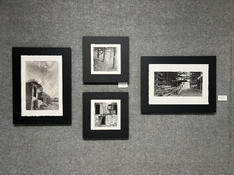
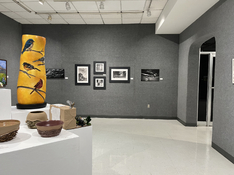
I have four kallitypes up on the wall in the Weizenblatt Art Gallery at Mars Hill University this summer. I hinged them each onto half-inch gator board -- very simple. Here are a couple of snaps from the installation:
 

Attachments

  • Weizenblatt01.jpg
    Weizenblatt01.jpg
    938.9 KB · Views: 191
  • Weizenblatt02.jpg
    Weizenblatt02.jpg
    620.3 KB · Views: 206
I have four kallitypes up on the wall in the Weizenblatt Art Gallery at Mars Hill University this summer. I hinged them each onto half-inch gator board -- very simple. Here are a couple of snaps from the installation:

Very nice.
 
I have four kallitypes up on the wall in the Weizenblatt Art Gallery at Mars Hill University this summer. I hinged them each onto half-inch gator board -- very simple. Here are a couple of snaps from the installation:
I like these a lot, and the gator board is a nice compliment too.
 
I like these a lot, and the gator board is a nice compliment too.

Thanks! To me, the beauty of a kallitype (of any photo really) is that it is a work on paper. For me, gluing the paper flat on a base and putting it behind glass destroys the photograph as a work on paper. I like this way of simply hinging the paper to board so that the viewer can see the paper for what it is.
 
Very nice presentation; excellent images and beautiful kallitype printing. I am intrigued with your mounting process, I should try that. Have dry mounted some of my cyanotypes on back matt board and framed under glass. However I agree they seem to lose something behind glass.
 
While I have plenty of my traditional wet-printed photographs dry mounted, matted, and framed behind glass, I personally find glass to create a barrier for the viewer, especially when reflections are a problem. I had a small exhibition at the university a few years ago of a mixture of cyanotypes, Van Dykes, and silver-gelatin prints where I just placed them loose on a table and encourage viewers to pick the up to look at them. Yes, this creates some wear and tear but I wanted the viewers to have the opportunity to interact with them as much as to just view them.

Over the past dozen years or so, I produce more drawings and alt-process photos than conventional photographs and my preferred method for displaying them is to hang them with two small binder clips on the wall. I want the lack of pure flatness of the paper to be part of the work. However, some of my stuff has gone up on a year-long exhibition and I was told that the work really needed to be framed and covered with glass or acrylic to protect it from, well, handling. OK, I did that.

I have a new series of drawings, all based on my original photographs, and after a discussion with one of the art professors who sells quite a bit of work, I learned that, in her opinion, work that is framed under glass will more likely sell as this is what the buying public expects. I am framing this series, under glass but using spacers to keep the glass away from the paper and mounting the paper to the backing board using the t-hinge method, allowing it to float a bit.

 
While I have plenty of my traditional wet-printed photographs dry mounted, matted, and framed behind glass, I personally find glass to create a barrier for the viewer, especially when reflections are a problem. I had a small exhibition at the university a few years ago of a mixture of cyanotypes, Van Dykes, and silver-gelatin prints where I just placed them loose on a table and encourage viewers to pick the up to look at them. Yes, this creates some wear and tear but I wanted the viewers to have the opportunity to interact with them as much as to just view them.

Over the past dozen years or so, I produce more drawings and alt-process photos than conventional photographs and my preferred method for displaying them is to hang them with two small binder clips on the wall. I want the lack of pure flatness of the paper to be part of the work. However, some of my stuff has gone up on a year-long exhibition and I was told that the work really needed to be framed and covered with glass or acrylic to protect it from, well, handling. OK, I did that.

I have a new series of drawings, all based on my original photographs, and after a discussion with one of the art professors who sells quite a bit of work, I learned that, in her opinion, work that is framed under glass will more likely sell as this is what the buying public expects. I am framing this series, under glass but using spacers to keep the glass away from the paper and mounting the paper to the backing board using the t-hinge method, allowing it to float a bit.

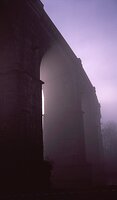
There are several choices of glass and plexiglass:
Anti glare​
UV​
Museum Quality​
Various combinations of the above three​
Plastic is preferred in Southern California because of earthquakes.
 
I have four kallitypes up on the wall in the Weizenblatt Art Gallery at Mars Hill University this summer. I hinged them each onto half-inch gator board -- very simple. Here are a couple of snaps from the installation:

Thanks for the inspiration, Sanders—that’s definitely the approach that I’d try on my walls…and it also seems to lend itself to triptych/polytych works as well. For whatever reason, I find I “read” alt prints totally differently than bog standard silver gelatin…being somewhat akin to glyphs rather than realistic paintings. ( Vincent’s approach appeals to me for the same reason.:smile:)
 
While I have plenty of my traditional wet-printed photographs dry mounted, matted, and framed behind glass, I personally find glass to create a barrier for the viewer. ... I want the lack of pure flatness of the paper to be part of the work.

Exactly! The beauty of works on paper is ... the paper.

in her opinion, work that is framed under glass will more likely sell as this is what the buying public expects.

That is unfortunate.
 
Photrio.com contains affiliate links to products. We may receive a commission for purchases made through these links.
To read our full affiliate disclosure statement please click Here.

PHOTRIO PARTNERS EQUALLY FUNDING OUR COMMUNITY:


Ilford ADOX Freestyle Photographic Stearman Press Weldon Color Lab Blue Moon Camera & Machine
Top Bottom