
• Welcome to Photrio!
    Registration is fast and free. Join today to unlock search, see fewer ads, and access all forum features.
    Click here to sign up

Sheet film - FOMA vs Ilford

Somewhere...

D
Somewhere...

  • 2
  • 1
  • 69
Iriana

H
Iriana

  • 6
  • 1
  • 129

Forum statistics

Threads
202,742
Messages
2,844,956
Members
101,494
Latest member
FlyingDutchman
Recent bookmarks
0
Not that it makes a significant difference, but ISO CI/ G-Bar usually equates to about a 0.65 gamma. Higher flare situations (uncoated lenses, cold cathode heads etc) could lead to recommended/ design gamma being in the 0.75-0.8 range on some older emulsions.

And you've successfully avoided the apparent error on the Foma 200 data sheet - the D-76 gammas have seemingly been transposed up by 0.2...

Good information, thanks. Point being Foma 200 needs 0.3 stops more exposure (or less than that). Foma 400 needs 0.75 stops more which explains partly why people think it is "muddy" when exposing at box speed.
 
......It's actually not fully red sensitive - you throw a Red 25 in front of it and you've got to boost your exposure by at least an extra stop or even two above the regular filter factor to get something approaching a normally exposed negative........


Foma400.jpeg
 
Foma 200 easily needs an entire full stop extra to do what it claims. And if you need a long exposure, time it with a Carbon 14 clock.
 
Amusing ?
What matters is to get information in the shadows. Then while printing you can do whatever you want. You represent them. Or not.
In theses two examples there is no need to show information in these shadows and make a muddy grey print without any punch.
Max black makes the print.
So please amuse me and show me some prints of yours.

Shadow detail...the thing only a photographer could love, or even give a rat's ass about.
 
Good information, thanks. Point being Foma 200 needs 0.3 stops more exposure (or less than that). Foma 400 needs 0.75 stops more which explains partly why people think it is "muddy" when exposing at box speed.

I'm not quite sure if it's Microphen or LQN that Foma seem to use to define box speed from, but it looks like 100 & 200 use a 0.65-0.75 aim gamma and 400 uses a 0.7-0.8 aim gamma - which with Microphen should put you within a 0.3 stop range of box speed. Why the difference in aim gammas, I don't know. I have noticed that Foma 400 seems more prone to internal reflections/ halation - and that internal flare might raise the effective speed somewhat. The tests in the data sheet will likely have been done in a flare free environment. Usually if a film delivers 'muddy' results, it's mostly not a result of underexposure & extended development, but overexposure and too lengthy development.
 
Usually if a film delivers 'muddy' results, it's mostly not a result of underexposure & extended development, but overexposure and too lengthy development.

As underexpose cuts down shadow details, I think that looks muddy too? If you do it heavily then the shadows aren't "muddy" because you don't have any details in the shadows?

Can you describe why overexposure+extended development causes muddyness? Overexposure creates more shadow details?
 
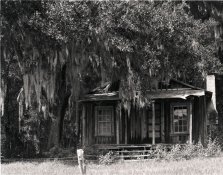
So a lot of subjective terms such as "muddy" or "blocked" are being thrown around. I'd like an opinion on this photo, which is essentially, straight out of the scanner. Basic inversion was performed, and out of consideration, it's resized to fit HD monitors. It was a fairly bright day, with heavy shade. I'm curious as to whether people think it was over- or under-exposed.

Image003_orig.jpg

It's Arista .EDU Ultra 400, scanned on an Epson v800 with Silverfast, using the NegaFix module, and the histogram set to the full range of the image.
 
As underexpose cuts down shadow details, I think that looks muddy too? If you do it heavily then the shadows aren't "muddy" because you don't have any details in the shadows?

If you mean in the way that people try to desperately retrieve the last bits of information held by the toe of the neg by printing on a softer grade than the overall gradient of the film demands for good highlight reproduction, then yes, you can get a grey, flat print. I would however generally say that 'muddiness' tends to be used in reference to the reproduction of highlights, rather than trying to reduce contrast in an attempt to lift shadows to retrieve detail falling into the toe of the film.

Can you describe why overexposure+extended development causes muddyness? Overexposure creates more shadow details?

Because you're driving more of the information on the neg up into the increasingly compressed shoulder of the film, thus when you try to print it, it no longer has the gradation you might want at a more moderate contrast grade. Raise the contrast to get better separation up the scale and even though you have given your shadows more exposure, the raised paper grade will crush them because of the curve relationships.


It is also important to note that all of these exposure/ process relationships have important uses as creative tools - the 'correct' neg should only ever be treated a starting point - too many people spend far too long failing to get to that point, thus never understand/ learn to use the broader interpretative possibilities of the medium.
 
So a lot of subjective terms such as "muddy" or "blocked" are being thrown around. I'd like an opinion on this photo, which is essentially, straight out of the scanner. Basic inversion was performed, and out of consideration, it's resized to fit HD monitors. It was a fairly bright day, with heavy shade. I'm curious as to whether people think it was over- or under-exposed.

View attachment 267203

It's Arista .EDU Ultra 400, scanned on an Epson v800 with Silverfast, using the NegaFix module, and the histogram set to the full range of the image.

This looks good on my phone. The chimney and foreground are maybe a little hot but certainly within reason.
 
This looks good on my phone. The chimney and foreground are maybe a little hot but certainly within reason.

It was a very bright day. I'm pretty sure my EV readings were between 15 and 8, and I went with approximately EV 11.5.
 
I'm pretty sure my EV readings were between 15 and 8, and I went with approximately EV 11.5.

That would tally with placing the deepest shadows with detail on the IRE 10 shadow index at an EV of about 9 - do also bear in mind that because of the linearity of scan sensors, you may get a little more useable shadow detail than you could readily access in the darkroom. Camera flare (plus possible internal halation/ flare on the film) & de facto bounce fill on the subject can also help to lift shadow values more than might be expected. What EI did you use for basing your exposure on?
 
Last edited:
That would tally with placing the deepest shadows with detail on the IRE 10 shadow index at an EV of about 9 - do also bear in mind that because of the linearity of scan sensors, you may get a little more useable shadow detail than you could readily access in the darkroom. Camera flare (plus possible internal halation/ flare on the film) & de facto bounce fill on the subject can also help to lift shadow values more than might be expected. What EI did you use for basing your exposure on?

400. Taken with a Caltar-S II 210 f/5.6 lens (which I believe is multicoated). I've tried shooting Foma 400 at 320 or 200 before, and in scenes like this one in particular, the highlights suffer.

That may be entirely because I scan with an Epson, although I managed a similar tonal range with my DSLR.
 
400. Taken with a Caltar-S II 210 f/5.6 lens (which I believe is multicoated). I've tried shooting Foma 400 at 320 or 200 before, and in scenes like this one in particular, the highlights suffer.

That may be entirely because I scan with an Epson, although I managed a similar tonal range with my DSLR.

Do you tightly mask off the extra coverage of the 210 with a compendium, or just leave as is? I've learnt the hard way to be extra careful of all sorts of things that can cause in-camera flare when using a 210 (with 8x10/ near 8x10 coverage) on 4x5 - it'll happily flare the shadows open a bit. Not a bad thing necessarily. I quite like some of the older Kodak Ektar lenses for their slightly higher flare levels.

I'll need to do some further sensitometric tests on Foma 400 - I also noticed that the highlights tended to roll-off pretty quickly with overexposure on the small amount I used - along with a stronger tendency to halation on high contrast edges - potentially caused by the higher turbidity of the emulsion used.
 
Do you tightly mask off the extra coverage of the 210 with a compendium, or just leave as is? I've learnt the hard way to be extra careful of all sorts of things that can cause in-camera flare when using a 210 (with 8x10/ near 8x10 coverage) on 4x5 - it'll happily flare the shadows open a bit. Not a bad thing necessarily. I quite like some of the older Kodak Ektar lenses for their slightly higher flare levels.

Not particularly-- To be honest, while I'd considered flare from shooting with the sun in front of me, I hadn't really thought about the excessive coverage inside the camera. I don't think it's been a problem yet, but that may be a result of the relatively modern nature of my particular camera (Chamonix). Or it may be blind dumb luck. :smile:

The one lens I'm truly paranoid about flare with, is my ICA vintage "Maximar" 12cm f/5.4 lens. The only coating it's ever had is dust, I suspect.
 
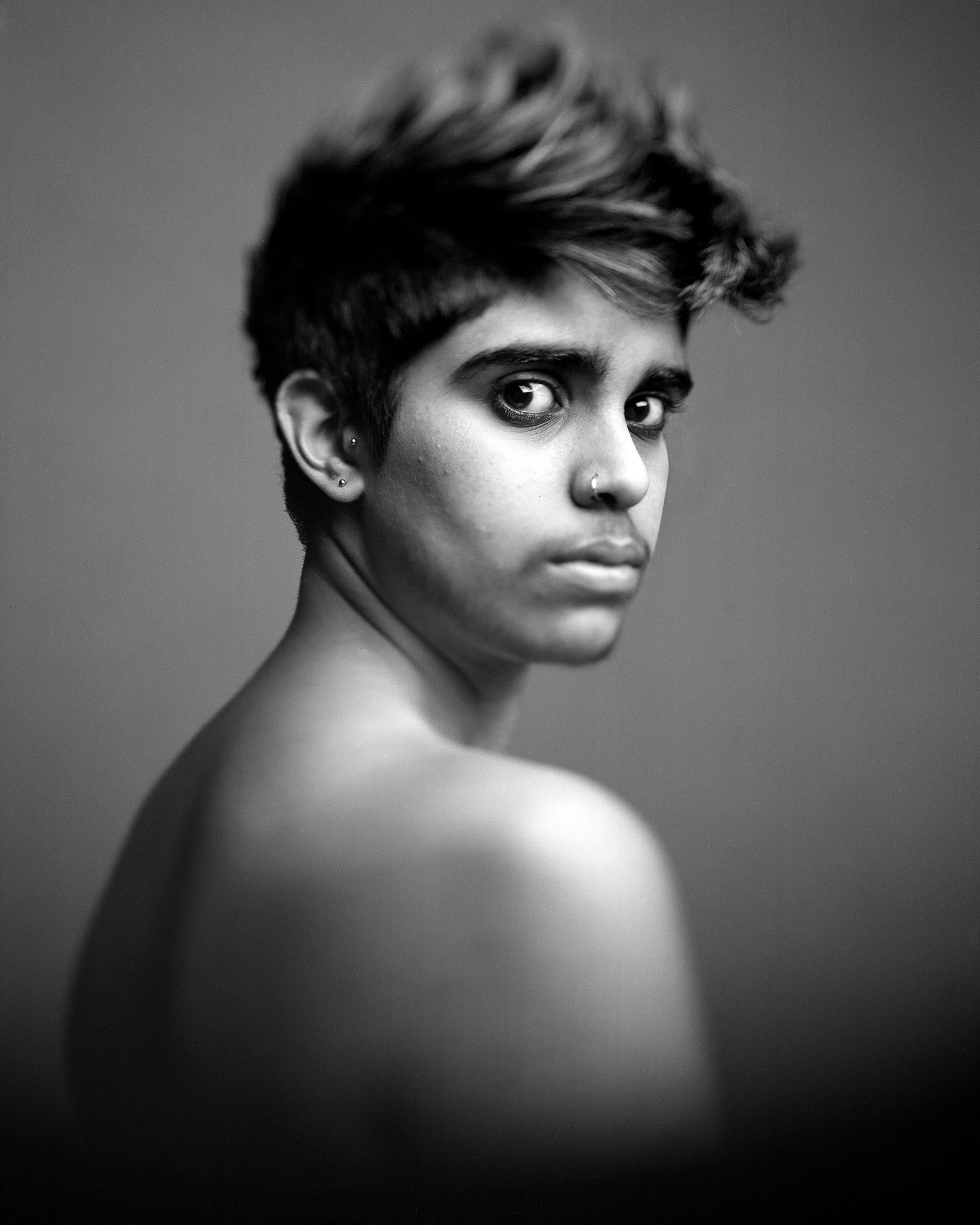
Coming late to the party, but I use almost exclusively Foma 100 sheets for portraiture because I can afford them and I'm quite happy with the results.
I meter at 50 iso and develop in Kodak HC110.

SABAH.jpg


You can see more examples here
 
I typically shoot HP5 and FP4 in medium format. How does the FOMA compare? Don't want to be a cheap skate but if it's half the cost that's a big savings. Are there any quality control issues with FOMA?

Foma sheet film is fairly priced, "per surface" price is similar to roll film, other manufacturers have a different pricing policy penalizing sheet film.

One can get totally Pro results with Foma sheet film, these are the points I feel interesting for its usage:

> When wet, Foma emulsion is well softer than the Kodak/Ilford ones, so extra care has to be played in the processing to not have scratches.

> Box speed is a little optimistic, as datasheet suggests it was calculated for an speed increasing developer and to a higher than regular Contrast Index. In practice use a bit lower EI that you would use for the same Kodak/Ilford box speed, 1/3 to 1/2 stop correction would be sound.

> Extreme highlights (say beyond +4 stops) in Foma Films are more shouldered than Kodak/ilford usually. This is not good or bad, it can be benefical to print highlight detail easier in the darkroom, or it may blow detail in the extreme highlights, still all can be modified in the processing with some compensation or compression. Foma films have a more classic behaviour (more shouldered in the extreme highlights), not specifically bad, but it may require adjusting processing after a transition from ilford/kodak, I'd suggest to practice with 35mm roll film and spot metering shadows and highlights to find the useful latitude at both sides, and later investigating how processing influences.

Personally I'm mostly using Kodak/ilford, but I'm starting to shot some Foma sheet film because IMO it has a fair pricing.
 
When wet, Foma emulsion is well softer than the Kodak/Ilford ones, so extra care has to be played in the processing to not have scratches.

This is totally true. Foma is famous of its scratchability (?). But what comes to handling of sheet films; I think any brand needs a extra care. While you might throw your films around in 135 and 120 formats - sheet films are so "precious" that if you scratch Foma you are probably doing it wrong anyways. The amount of energy & time that goes to single sheet film isn't worth taking any change of mis-handling on any film brand.

In 135 format: if it ain't have scratches, it ain't Foma :D
 
But what comes to handling of sheet films; I think any brand needs a extra care.

I never had scratches with LF HP5 or TMX, but at the first sheet format Foma batch I got quite severe scratches, I process sheets mostly in trays. Solution was playing extra care in the sheet handling when moving sheets from one tray to the other to not touch at all the emulsion side, always with the emulsion facing up in the trays avoiding stacking the sheets in the wash, and performing a final wash with distilled (that I anyway always do) to allow a very gentle squeeze.

No doubt gelatin hardening is quite more advanced in kodak/ilford products, but at 2€ per 8x10" Foma sheet this is quite a competitive price, Kodak Tri-X price is 17.9€ per sheet right now in the EU.

Another interesting fact is that LF Foma materials have half the "per surface" price than roll film, while in the kodak case the LF materials have twice the price than the similar stuff made in rolls, pointing to a very different pricing policy, rich photographers won't care but in non premium high-income countries...

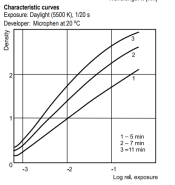
upload_2021-2-24_10-6-28.png

The curves in the datasheet point that we can obtain quite a linear (8 stops) behaviour if pulling to 5min (with microphen...) while shouldering way sooner if pushing, so IMO one has to experiment with development to control this material, as IMO it reacts more to the development kind than other materials, specially in the highlights.
 
There is a reason that Foma is 1/2 the price of other films. Your mileage may vary.
 
  • 138S
  • 138S
  • Deleted
So a lot of subjective terms such as "muddy" or "blocked" are being thrown around. I'd like an opinion on this photo, which is essentially, straight out of the scanner. Basic inversion was performed, and out of consideration, it's resized to fit HD monitors. It was a fairly bright day, with heavy shade. I'm curious as to whether people think it was over- or under-exposed.

View attachment 267203

It's Arista .EDU Ultra 400, scanned on an Epson v800 with Silverfast, using the NegaFix module, and the histogram set to the full range of the image.

This is a really nice example of how this film's limitations can be...limited. I think many large format "landscapes" would suffer with this film, so well done.
 
So a lot of subjective terms such as "muddy" or "blocked" are being thrown around. I'd like an opinion on this photo, which is essentially, straight out of the scanner. Basic inversion was performed, and out of consideration, it's resized to fit HD monitors. It was a fairly bright day, with heavy shade. I'm curious as to whether people think it was over- or under-exposed.
View attachment 267203
It's Arista .EDU Ultra 400, scanned on an Epson v800 with Silverfast, using the NegaFix module, and the histogram set to the full range of the image.

To show an scanned image to be technically judged, better is to place an Stouffer T2115 desnsity wedge so the film and the wedge are scanned alongside, also spot metering readings in key places should be mentioned.

Anyway it looks to me that this image would have required quite more exposure and shortened development.

Foma (Arista) datasheets (suposedly for commercial reasons) tend to stamp optimistic box speeds, specially for the 200/400 box speeds, having calibrated speed with an speed increasing developer also pushed... mentioning a higher than standard Contrast Index.

Also if one wants to emulate the look of a film with another film then he has to find the right color filtration, as each film has its particular own spectral sensitivity. This is totally evident for Ortho vs Orthopan vs Panchromatic vs Extended_Red films, but there are other nuances.

IMO using Fomapan 400 as datasheet instructs will deliver a "creative" pushed look, instead I would use it at less than the half of the box speed with a way more moderated development, to deliver a quite standard behaviour.
 
Fotoimpex's Microphen description has following information

"Microphen is exactly the opposite of Perceptol. This developer can easily push films up to 3 stops (with a developer temp. of 30 degrees), but the contrast and grain are basically uncontrollable. The contrast increases almost linearly with the developing time, and even the lowest-contrast Fomapan negative has no chance of avoiding a sharp contrast curve. HP5 can be pushed up to 1600 ASA and the Adox CHS films can be pushed even up to 4 Stops. Even Tmax and Delta films can be pushed past their ratings and still show the middle gray-tones.
A film pushed 4 stops with this developer has a very unique look - almost like a lith print. Black tones blend together and the middle tones and highlights and compressed together. The ADOX CHS 100 looks even better, but with somewhat markedly accentuated grain."
https://www.fotoimpex.com/chemistry/ilford-microphen-to-mix-1000-ml.html

That is controversial to the 8 stop linearity.. Or is Fotoimpex talking about only pushing in that description?
 
Fotoimpex's Microphen description has following information

"Microphen is exactly the opposite of Perceptol. This developer can easily push films up to 3 stops (with a developer temp. of 30 degrees), but the contrast and grain are basically uncontrollable. The contrast increases almost linearly with the developing time, and even the lowest-contrast Fomapan negative has no chance of avoiding a sharp contrast curve. HP5 can be pushed up to 1600 ASA and the Adox CHS films can be pushed even up to 4 Stops. Even Tmax and Delta films can be pushed past their ratings and still show the middle gray-tones.
A film pushed 4 stops with this developer has a very unique look - almost like a lith print. Black tones blend together and the middle tones and highlights and compressed together. The ADOX CHS 100 looks even better, but with somewhat markedly accentuated grain."
https://www.fotoimpex.com/chemistry/ilford-microphen-to-mix-1000-ml.html

That is controversial to the 8 stop linearity.. Or is Fotoimpex talking about only pushing in that description?


I think Fotoimpex tones compression comment is refering to a 4 stops push.
 
Photrio.com contains affiliate links to products. We may receive a commission for purchases made through these links.
To read our full affiliate disclosure statement please click Here.

PHOTRIO PARTNERS EQUALLY FUNDING OUR COMMUNITY:


Ilford ADOX Freestyle Photographic Stearman Press Weldon Color Lab Blue Moon Camera & Machine
Top Bottom