• Welcome to Photrio!
    Registration is fast and free. Join today to unlock search, see fewer ads, and access all forum features.
    Click here to sign up

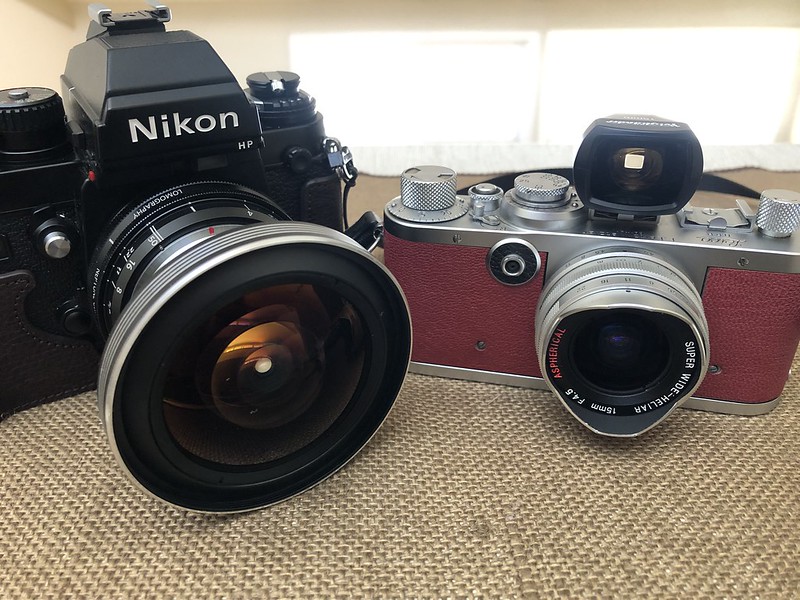
Same focal length, same speed, same film format, one lens is a zillion times bigger than the other.

Autumn

D
Autumn

  • 0
  • 0
  • 10
Sol Infinitus

A
Sol Infinitus

  • 5
  • 0
  • 32

Recent Classifieds

Forum statistics

Threads
203,390
Messages
2,853,902
Members
101,816
Latest member
Gregg128
Recent bookmarks
0
Digital camera lenses of the same focal length and speed (especially DSLR) are yet even bigger in general! Not trying to start a fight here, just a feature of using sensors.

Back to film- rangefinders have real advantages, especially moving into wide angle. Not trying to start a fight here, just a feature of not interposing a mirror :smile: .
 
I had a Nikon Df for a while, decided to try the Tamron 15-20 2.8 AF. I bought the biggest of the Peak Design straps which is about the size of a seatbelt and it felt like carrying a bowling ball around.
 
It depends on the lens design too. My Leica R 90 2 Summi was as short as a normal 50, while the 90 2.8 Elmarit was much longer. I wouldn't have expected that the faster lens would be smaller than the slower lens.

Whatever they made that Summicron from felt like lead. It was a short lens, but very heavy. In your hand it was like one solid block of glass and metal.
 
Pretty soon the 110/Minox crowd will show up and win this hand.
 
It depends on the lens design too. My Leica R 90 2 Summi was as short as a normal 50, while the 90 2.8 Elmarit was much longer. I wouldn't have expected that the faster lens would be smaller than the slower lens.

Whatever they made that Summicron from felt like lead. It was a short lens, but very heavy. In your hand it was like one solid block of glass and metal.

I was reading about this earlier, because the Mamiya Sekor 80mm f2.8 is really based on the 90mm f2.8 Elmarit design, which is a Tessar derivative. The f2 Summicron is a very different and more modern design.

1656045428531.png


1656045464991.png


1656046262856.png
 
Last edited:
"Never took" what?
I have no idea from where you have come from on this conclusion.
I came from FED-2. Small, simple and neat.
But I'm honest enough to realize what 50 USD F2 (got it for metal curtains, but it just worked with next to none CLA) and Vivitar 19mm lens (70 USD) were less hustle than IIC (350 USD) with CV CS 21/4 (300 USD + VF).
This is where majority went. Not to Leica side.

Yet, I let go Nikon and keeping Leica UWA set.
But:
 
Basic remarks:

same-focal-length-same-speed-same-film-format

-) does not mean they are same way designed (think of plain- vs. retrofocus-wideangle)

-) does not even mean that they are designed for same format
 
Them little Voigtlanders are a hell of a lens. Don't even really need the view finder, everything in front of it will be in view. The trick is getting close enough to the subject.
 
Not really.

Now compare the difference in size of rangefinder and SLR 200mm telephoto lenses of comparable speed.

why? Does this comparison exist? Anyone here have that? I welcome you to post a comparison pic of your 200mm rangefinder lens next to your 200mm slr lens.
 
The iF shutter is like a little girl fart, only way you can tell is a slight smirk.

i think that is what 1F stood for.
I shudder to think what the real meaning of my F3P in that pic is.
 
Looks like comparing apples and oranges. Isn't that Heliar a rectilinear and the other a fisheye? What are the maximum f-stops of each? And as mentioned, an SLR has to have room for the mirror. That difference is due to the viewing system -- not the lens.
 
Last edited:
The only 200 made a 35mm rangefinder that comes to mind is the 200 for Kodak Retina S, it is uncouple (if memory serves me) same lens as the Retinaflex used. All of the other 200 were used with reflex housings. The other longish lens for a rangefinder was the 150mm for the Ektar, it was coupled.
1656084775909.png
 
Digital camera lenses of the same focal length and speed (especially DSLR) are yet even bigger in general! Not trying to start a fight here, just a feature of using sensors.

Back to film- rangefinders have real advantages, especially moving into wide angle. Not trying to start a fight here, just a feature of not interposing a mirror :smile: .

Just for clarification: rangefinders have the following real advantages:
  • Lacking "what is you see is what you get" focusing
  • Lacking ability to see what the polarizer effect is through the viewfinder
  • Inability to use shorter than 21mm wide angle lenses
  • Inability to use longer than 135mm telephoto lenses
What other "advantages" are missing from the list? 😛
 
Just for clarification: rangefinders have the following real advantages:
  • Lacking "what is you see is what you get" focusing
  • Lacking ability to see what the polarizer effect is through the viewfinder
  • Inability to use shorter than 21mm wide angle lenses
  • Inability to use longer than 135mm telephoto lenses
What other "advantages" are missing from the list? 😛

Rangefinders have optical design advantages, but have some operational issues, as do TLRs for instance. All this must be considered when choosing the camera for a task. I find many of those limitations are not as limiting as people imagine, but there are times where they are an issue.

The OP post shows a 15mm wide angle lens on a Barnack Leica (viewfinder camera, but these work with rangefinder models also). Why do you say 21mm is the lower limit?
 
Just for clarification: rangefinders have the following real advantages:
  • Lacking "what is you see is what you get" focusing
  • Lacking ability to see what the polarizer effect is through the viewfinder
  • Inability to use shorter than 21mm wide angle lenses
  • Inability to use longer than 135mm telephoto lenses
What other "advantages" are missing from the list? 😛

I found one more!
  • Providing the user the experience of needing to correct for parallax much like the TLR does for 120 film
 
I found one more!
  • Providing the user the experience of needing to correct for parallax much like the TLR does for 120 film

If you find yourself frequently needing to correct for parallax when using a 15mm lens on 35mm film, I'd suggest that you are getting way to close to your subject.
 
Unfair! An SLR lens is not the same design for wide-angle, the rear element cannot protrude as much into the body. As far as DLSR lenses go, there is the added bulk and weight for such things as AF and optical stabilization.
 
Looks like comparing apples and oranges. Isn't that Heliar a rectilinear and the other a fisheye? What are the maximum f-stops of each? And as mentioned,e SLR has to have room for the mirror. That difference is to the the viewing system -- not the lens.

The SLR lens is not a fish eye. One is f4.5, the other is f4 (they claim 3.8 but this is Lomo we are talking about).
The one advantage of the SLR 15mm lens is it can double for HAL in 2001: A Space Odyssey.
 
Unfair! An SLR lens is not the same design for wide-angle, the rear element cannot protrude as much into the body. As far as DLSR lenses go, there is the added bulk and weight for such things as AF and optical stabilization.

No AF or stabilization for this SLR lens.
 
Photrio.com contains affiliate links to products. We may receive a commission for purchases made through these links.
To read our full affiliate disclosure statement please click Here.

PHOTRIO PARTNERS EQUALLY FUNDING OUR COMMUNITY:



Ilford ADOX Freestyle Photographic Stearman Press Weldon Color Lab Blue Moon Camera & Machine
Top Bottom