
• Welcome to Photrio!
    Registration is fast and free. Join today to unlock search, see fewer ads, and access all forum features.
    Click here to sign up

Rollei Infrared Hyper-Panchromatic B&W Film Development Times

Recent Classifieds

Forum statistics

Threads
201,664
Messages
2,828,193
Members
100,879
Latest member
MdeC
Recent bookmarks
1

Matt Hall

Member
Allowing Ads
Joined
Feb 9, 2022
Messages
44
Location
Santa Barbara, CA U.S.A.
Format
Multi Format
I'm looking for someone with any experience with this film and it's development time. I'm shooting 4x5 format in an astrograph camera of the night sky. I have a clock drive to negate star drift and have shot several exposures of Orion using a #29 deep red filter. I know this lets a bit of the visual spectrum through but as of yet have not been able to source a 6"x 6" gelatin #87C filter. I'm using an old Aero Ektar 305mm f/2.5 lens that has a 5" main objective diameter so I need these larger filters. Anyway, I have turned in one sheet of film to my lab this morning of the eight that I shot as a test for development time. I want an equivalent ASA of 1600 so that should require a 2 stop push. The Rollei film spec sheet calls for a base time x 1.33 (squared) which equates to about base time x 1.76. Here is the problem:

My lab has a machine processor utilizing D-76 as the developer. Their program has the Rollei film installed and calls for a standard development of 6 1/2 minutes at 22C. That equals to roughly 11.44 minutes for a 2 stop push (6.5 x 1.76). The Rollei spec sheet states that the standard development time for this film in D-76 at 22C is 10 1/2 minutes, 4 full minutes longer than the machine processor indicates. With the added push process time factor that mounts to a whopping 18.48 minutes! My lab guy says that would yield a bullet proof negative, another words, unprintable. Anyone out there have any experience that might shed some light on this difference?

Also, the film rating of ASA 400 is somewhat confusing. Is this the rating for the film if exposed using the entire visual spectrum + IR, or is this just if exposed for IR alone? Then do you need a filter factor for the IR filter on top of that?
 
Last edited:
MCB18

Subscriber
Allowing Ads
Joined
Jan 16, 2023
Messages
1,352
Location
Colorado
Format
Medium Format
This film is an aerial emulsion known as Agfa Aviphot 200, with a normal speed of around 100 to 125 ISO. The 400 rating that they give you is already pushing the film around two stops, which is why the development time is so long. By trying to expose it at 1600 you’re pushing this film around two more stops, meaning it’s a total push around four stops. While I have seen folks push Aviphot of several flavors (rebrands) to 1600, it gets very contrasting and very grainy. Not exactly sure if that’s what you’re looking for for Astro.

As far as the rating goes, the 400 rating is for visible light. And again, they’re pushing the film two stops in order to get it there. This film actually used to be a different emulsion called Aviphot 400s that was closer to ISO 400 (I believe actual speed was probably closer to 250), but that film has not been manufactured for around 10 years now, and they have silently switched over to using 200.

In my experience, shooting in just IR your film speed goes down to around EI 6-12, sometimes 25.
 
OP
OP
Matt Hall

Matt Hall

Member
Allowing Ads
Joined
Feb 9, 2022
Messages
44
Location
Santa Barbara, CA U.S.A.
Format
Multi Format
Thanks so much for clearing up the confusion. Everything you say makes sense now. It sounds like the old Fujichrome Provia 1600 I used to shoot. It was actually 400 speed film pushed to 1600 with their recommended processing time. Exactly like this Rollei stuff. Wonder what film they used to use for this lens back in the war days? They shot 9" x 9" infrared film and it seems like 12 to 25 speed film would have been way too slow for aerial work at night. The world moved to digital and I still use this old lens that now has no film made for it anymore. Bummer! There is always the 400 speed color negative stock available, but this lens is NOT panchromatic and shows some serious aberrations wide open when using the full visual spectrum. I guess I could always shoot some B&W color separation negatives using some narrow bandpass filters. Or stick with the IR stuff and just extend my exposure times considerably. More testing I guess.
 

MCB18

Subscriber
Allowing Ads
Joined
Jan 16, 2023
Messages
1,352
Location
Colorado
Format
Medium Format
Thanks so much for clearing up the confusion. Everything you say makes sense now. It sounds like the old Fujichrome Provia 1600 I used to shoot. It was actually 400 speed film pushed to 1600 with their recommended processing time. Exactly like this Rollei stuff. Wonder what film they used to use for this lens back in the war days? They shot 9" x 9" infrared film and it seems like 12 to 25 speed film would have been way too slow for aerial work at night. The world moved to digital and I still use this old lens that now has no film made for it anymore. Bummer! There is always the 400 speed color negative stock available, but this lens is NOT panchromatic and shows some serious aberrations wide open when using the full visual spectrum. I guess I could always shoot some B&W color separation negatives using some narrow bandpass filters. Or stick with the IR stuff and just extend my exposure times considerably. More testing I guess.
The lens is an aerial lens, it can shoot on 9-1/2 inch wide roll film. Comically large stuff, I cut it up into sheets.

Believe or not, you can still get this type of film! Agfa does still sell it in 9-1/2 inch rolls, although you do have to meet a minimum order requirement of something like $8000 and 2000 feet of film from my understanding. However, I’ve gotten it in smaller quantities for a couple of folks on here from Astrum in the Ukraine.

The real trick is, you need a camera to shoot the stuff, and a way to develop it. I know someone that has the camera, he says it weighs about 500 pounds! Good luck getting a tripod for that thing! And the developing rig is basically a giant tank with a couple of spools you have to wind the film back-and-forth and back-and-forth between for quite a while before the film is all developed.

I do have a couple of these rolls if you wanna see a picture of one, in case you’re curious.
 
Last edited:
OP
OP
Matt Hall

Matt Hall

Member
Allowing Ads
Joined
Feb 9, 2022
Messages
44
Location
Santa Barbara, CA U.S.A.
Format
Multi Format
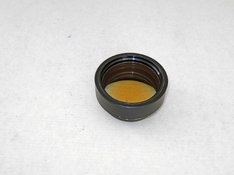
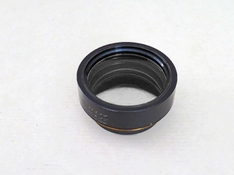
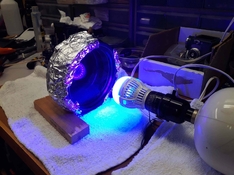
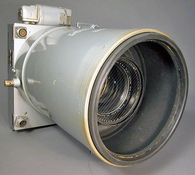
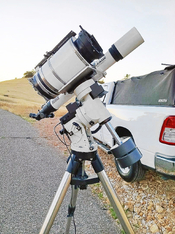
No thanks. I do not have the original camera any more. I have constructed my own astrograph camera using this lens and 4x5 film. It attaches to my German equatorial clock drive to take time exposures of the night sky with no star trails. I attached a photo of my rig setup on the local mountain a few weeks ago. Also note the before and after shots of the rear lens cell. It contains thorium which turns the glass brownish as it decays. I completely cleared it by exposure to UV for about 7 weeks. Lastly is the camera my lens came with. I had no use for it and got rid of it years ago.
 

Attachments

  • thumbnail (1).jpg
    thumbnail (1).jpg
    336.3 KB · Views: 60
  • 28b.jpg
    28b.jpg
    102.7 KB · Views: 39
  • 30a.jpg
    30a.jpg
    119 KB · Views: 44
  • 29.jpg
    29.jpg
    246.7 KB · Views: 48
  • 6.jpg
    6.jpg
    94.5 KB · Views: 57

mshchem

Subscriber
Allowing Ads
Joined
Nov 26, 2007
Messages
15,927
Location
Iowa City, Iowa USA
Format
Medium Format
No thanks. I do not have the original camera any more. I have constructed my own astrograph camera using this lens and 4x5 film. It attaches to my German equatorial clock drive to take time exposures of the night sky with no star trails. I attached a photo of my rig setup on the local mountain a few weeks ago. Also note the before and after shots of the rear lens cell. It contains thorium which turns the glass brownish as it decays. I completely cleared it by exposure to UV for about 7 weeks. Lastly is the camera my lens came with. I had no use for it and got rid of it years ago.

Holy Cow, and I think I'm crazy! 😁

Very cool!
 

Andrew O'Neill

Moderator
Moderator
Allowing Ads
Joined
Jan 16, 2004
Messages
12,860
Location
Coquitlam,BC Canada
Format
Multi Format
I have lots of experience working with infrared films, going back to Kodak HIE days. Rollei IR (actually Aviphot 200) cannot be used with an 87C filter, at least in my experience. Your best bet is to use a 720 filter. Without a filter, I rate the film at EI 200, and EI 3-6 with the 720 filter.
 

MCB18

Subscriber
Allowing Ads
Joined
Jan 16, 2023
Messages
1,352
Location
Colorado
Format
Medium Format
No thanks. I do not have the original camera any more. I have constructed my own astrograph camera using this lens and 4x5 film. It attaches to my German equatorial clock drive to take time exposures of the night sky with no star trails. I attached a photo of my rig setup on the local mountain a few weeks ago. Also note the before and after shots of the rear lens cell. It contains thorium which turns the glass brownish as it decays. I completely cleared it by exposure to UV for about 7 weeks. Lastly is the camera my lens came with. I had no use for it and got rid of it years ago.
Wow that’s pretty cool!
 
OP
OP
Matt Hall

Matt Hall

Member
Allowing Ads
Joined
Feb 9, 2022
Messages
44
Location
Santa Barbara, CA U.S.A.
Format
Multi Format
As for the type of UV bulb I used, it was the following I found on Amazon:

SANSI 5W LED Black Light Bulbs, A15 E26, 320-400nm​

I wanted something low wattage so not to introduce any heat into the lens cell. That might account for how long it took to clear.

Now for the IR filter and Rollei film combination. I had not researched the Rollei film thoroughly enough I guess. It only extends to about 750nm and the 87C doesn't start to pass anything until about 800nm, so you are absolutely correct! The 720 filter will only give me about 30nm of width for exposure which will likely dramatically reduce film speed. Perhaps I could use a #29 deep red. It starts to pass at 640nm and even though there would be a small amount of red light getting through, it would give me a faster film speed, no? I'm not too concerned with just isolating the IR. I am really trying to block most of the visible spectrum as this lens is NOT panchromatic, suffering from chromatic aberration wide open. Even this small amount of red light should give me much better control of the focal plane.
 

Todd Niccole

Member
Allowing Ads
Joined
Sep 23, 2008
Messages
69
Format
35mm
Unfortunately, you are not going to get much out of this film. My primary interest is in film is astrophotography and I tested this film along with most of the suitable films on the market starting about a decade ago. All of Rollei films including their IR have the worst reciprocity out of all the films I have tested. It won't even respond to hydrogen hypersensitization. The greatest hydrogen hypering response was from Fomapan 400 which has peak sensitivity in the far red including the h-alpha line. It's a significantly better performer out of the box than Rollei IR but still has significant low sensitivity and reciprocity. Going full spectrum in the 4x5 format you would be better off with HP5 or Tmax 400 on some brighter targets. Better yet, if you can modify the camera for medium format Fuji Acros has excellent astronomy performance out of the box.
 

reddesert

Member
Allowing Ads
Joined
Jul 22, 2019
Messages
2,599
Location
SAZ
Format
Hybrid
If you are taking photographs including the Orion nebula, I'd think you'd want a filter (and film) that is sensitive at the H-alpha 656.3nm line. The red filter would be useful while the near-IR filters like 87, 89 series would block it.

Also, if you're concerned about chromatic aberration, it's typically worst in the blue, so a minus blue filter (yellow) should take care of a lot of it. If you do use a IR filter that is opaque in the visual, or even a filter that is hard to see through (deep red), then you have the problem of accurately focusing at the taking wavelength.
 
Last edited:
Photrio.com contains affiliate links to products. We may receive a commission for purchases made through these links.
To read our full affiliate disclosure statement please click Here.

PHOTRIO PARTNERS EQUALLY FUNDING OUR COMMUNITY:


Ilford ADOX Freestyle Photographic Stearman Press Weldon Color Lab Blue Moon Camera & Machine
Top Bottom