
• Welcome to Photrio!
    Registration is fast and free. Join today to unlock search, see fewer ads, and access all forum features.
    Click here to sign up

Resolution - a few 400 speed films under the loupe

feeling grey

A
feeling grey

  • 0
  • 0
  • 20
Inconsequential

H
Inconsequential

  • 2
  • 0
  • 35

Recent Classifieds

Forum statistics

Threads
201,798
Messages
2,830,385
Members
100,961
Latest member
pisimimail
Recent bookmarks
0

Alan Johnson

Subscriber
Allowing Ads
Joined
Nov 16, 2004
Messages
3,374
There was a 4 page technical review of 400 ISO tabular grain films by Geoffrey Crawley in Amateur Photographer 10 May 2008.TMY, TMY-2, Neopan 400 all in T-max developer, 400 Delta in DDX.Some points:
All were up to 400 ISO.
The film giving nearest to an S shaped curve was 400 Delta,followed by Neopan 400, TMY,TMY-2 gave some toe followed by straight line."Ilford 400 Delta has inherently a more pictorial characteristic curve."
400 Delta gives a greater increase in shadow speed on pushing to 3200 (only 1600 for Neopan)
TMY-2 is sharper than 400 Delta=Neopan 400, all sharper than TMY."But these distinctions are quite fine"
Grain was more compact on TMY-2 than the other films.Fixing takes longer with TMY-2,this could be a sign of more silver iodide or more compacted emulsion.
 

Photo Engineer

Subscriber
Allowing Ads
Joined
Apr 19, 2005
Messages
29,018
Location
Rochester, NY
Format
Multi Format
Did Mr. Crawley include the curves that he described, or is the description only verbal (qualitative and subjective)?

You see, the terms Crawley used have a lot of possible interpretations.

PE
 

Alan Johnson

Subscriber
Allowing Ads
Joined
Nov 16, 2004
Messages
3,374
Yes,Mr Crawley did include the curves.While, after the toe, those for TMY, TMY-2 are almost straight, the curve for 400 Delta justs bends gently upwards.He just says it is the nearest to an S-curve.As you say , that does seem to be interpretation.He does mention that it is the full S-curve they give that accounts for the continuing popularity of of traditional grained films such as Tri-X and HP5.
On closer inspection, Crawley's curves are only given for about the 3 stops nearest the toe,they do not reach the shoulder S-shape region.
 
Last edited by a moderator:
Joined
Jan 21, 2003
Messages
15,715
Location
Switzerland
Format
Multi Format
I may be misinformed, but I was under the impression Neopan 400 was a traditional random grain film. To me it looks much like Tri-X but with finer grain; in prints though, I don't have any testing equipment.

- Thomas
 
Joined
Jan 21, 2003
Messages
15,715
Location
Switzerland
Format
Multi Format
That makes more sense, Alan. Thanks for clarifying.
- Thomas
 

Photo Engineer

Subscriber
Allowing Ads
Joined
Apr 19, 2005
Messages
29,018
Location
Rochester, NY
Format
Multi Format
Alan;

If he only shows the 3 stops nearest the toe, then the representative exposures may have been underexposed I think. You need to be on the middle of the scale.

Also, experiments have shown in a number of other articles that the "S" curve causes distortion of the mid scale on prints. That is why so much work went into getting the straight line. Well, that and getting longer latitude. A bow in the curve causes compression of data on either side and loss of highlights and shadows. It is also harder to get good over and under exposures or push such films.

PE
 

Alan Johnson

Subscriber
Allowing Ads
Joined
Nov 16, 2004
Messages
3,374
Interesting to read that view on the straight line curve of TMY, TMY-2.
Crawley has some comments on developers,noting the high tech films he tested are designed for developers without a solvent action on the halide crystals during processing. A solvent type such as D-76,ID-11,Microphen or Microdol tends to give a better S-curve which may be better to tame highlights at expense of sharpness but he says the best overall result for high tech emulsions is in the developers designed for them.
 
Last edited by a moderator:

sanking

Member
Allowing Ads
Joined
Mar 26, 2003
Messages
5,437
Location
Greenville,
Format
Large Format
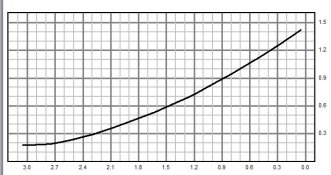
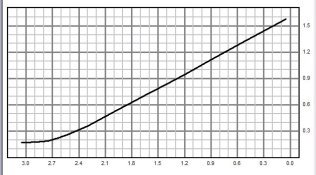
Alan makes a good point about the importance of the developer for curve type. Both developer and type of development can have a very significant impact on curve shape. I recently published an article in View Camera on two-bath development. In film testing for the article I tested Tri-X in Diafine and divided D23 with both intermittent and continuous agitation. With Diafine the curve shape as almost completely straight line, while with divided D23 the curve has a very long toe and flaring curve that is more typical of Tri-X in a traditional solvent type developer like D76.

My point is that if you really like the look you are getting with a specific combination of film/development/paper process that look may difficult to achieve with another combination without some experimentation. Of course, if you understand the relationship between curve shape of the film/developer combination and how it reacts with the curve of the paper process it should be easier to narrow down the combinations that will give the desired result.

Attached are the curves produced by Tri-X in Diafine and D23 with divided development.

Sandy King
 

Attachments

  • Tri-X-D23.jpg
    Tri-X-D23.jpg
    79.3 KB · Views: 134
  • Tri-X-Diafine.jpg
    Tri-X-Diafine.jpg
    81.6 KB · Views: 134

Photo Engineer

Subscriber
Allowing Ads
Joined
Apr 19, 2005
Messages
29,018
Location
Rochester, NY
Format
Multi Format
Sandy;

The curves look like they are underexposed from the standpoint of a film designer. Since Dmax goes to 3.0 on most films, you are using only the lower portion of the curve for demonstration. In the left curve, I would use densities from 0.9 upwards for imaging and on the right I would use about 0.6 upwards for imaging. Maybe I would go higher. I would try to minimize grain and maximize exposure on the straight line. This gives me more latitude on either side of the area I choose.

PE
 

sanking

Member
Allowing Ads
Joined
Mar 26, 2003
Messages
5,437
Location
Greenville,
Format
Large Format
PE,

The samples are definitely not underexposed. However, temperature and time of development was such to give a relatively low average gradient of about .50, or slighly lower, as the objective of the article was to establish a convenient method of producing negatives optimized for scanning. This explains the relatively low Dmax. This goal is one that film designers probably did not think much about a few years ago.

Sandy


Sandy;

The curves look like they are underexposed from the standpoint of a film designer. Since Dmax goes to 3.0 on most films, you are using only the lower portion of the curve for demonstration. In the left curve, I would use densities from 0.9 upwards for imaging and on the right I would use about 0.6 upwards for imaging. Maybe I would go higher. I would try to minimize grain and maximize exposure on the straight line. This gives me more latitude on either side of the area I choose.

PE
 

Photo Engineer

Subscriber
Allowing Ads
Joined
Apr 19, 2005
Messages
29,018
Location
Rochester, NY
Format
Multi Format
I surely don't like the curve on the left then. Sorry about the misunderstanding though.

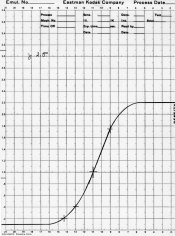
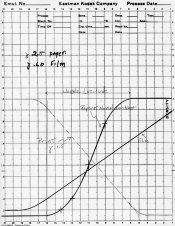
I've incorporated 2 curves here. The one on the left is an average grade 2.0 paper, and on the right, superimposed on that curve are those of a negative film like yours in the right curve and a print curve from the two neg-pos curves.

As you can see, the soft toe of your left negative would impact on the print, lowering contrast and the film curve described in the OP which bows upward would cause a sag in the mid tones of the print.

Neither of these is desirable IMHO. Although in scanning a lot is corrected by the scanning operation via automatic software.

I have displaced the print curve and the paper curve a bit far to the left to get everything on the page. Usually, this entire sequence is plotted on a wide horizontal paper.

PE
 

Attachments

  • Ektacolor 70 aim.jpg
    Ektacolor 70 aim.jpg
    106.5 KB · Views: 147
  • film-paper-print curves.jpg
    film-paper-print curves.jpg
    157.2 KB · Views: 140

sanking

Member
Allowing Ads
Joined
Mar 26, 2003
Messages
5,437
Location
Greenville,
Format
Large Format
Ron,

That is all fine and good, but not relevant to point of my post where the curves were attached. As I noted then, the curves attached were the result of exposure and development methods designed for scanning, not for printing directly.

Sandy


I surely don't like the curve on the left then. Sorry about the misunderstanding though.

I've incorporated 2 curves here. The one on the left is an average grade 2.0 paper, and on the right, superimposed on that curve are those of a negative film like yours in the right curve and a print curve from the two neg-pos curves.

As you can see, the soft toe of your left negative would impact on the print, lowering contrast and the film curve described in the OP which bows upward would cause a sag in the mid tones of the print.

Neither of these is desirable IMHO. Although in scanning a lot is corrected by the scanning operation via automatic software.

I have displaced the print curve and the paper curve a bit far to the left to get everything on the page. Usually, this entire sequence is plotted on a wide horizontal paper.

PE
 
Last edited by a moderator:

joncapozzi

Member
Allowing Ads
Joined
Sep 28, 2008
Messages
9
Format
Medium Format
If you are going to pixel peep like this why don't you guys just shoot digital?
 

Photo Engineer

Subscriber
Allowing Ads
Joined
Apr 19, 2005
Messages
29,018
Location
Rochester, NY
Format
Multi Format
Ron,

That is all fine and good, but not relevant to point of my post where the curves were attached. As I noted then, the curves attached were the result of exposure and development methods designed for scanning, not for printing directly.

Sandy

Sandy;

I fully understand. I was pointing out the case for people who want to do totally analog work and I think that we have both made the point that each method requires a different approach. I agrre with you completely and I think that given that my examples refer only to a fully analog work flow, then you might also agree with me.

Ron
 

sanking

Member
Allowing Ads
Joined
Mar 26, 2003
Messages
5,437
Location
Greenville,
Format
Large Format
Pixel PEEP . . . PEEp . . . PEep . . . . Peep . . . . peep . . . . peep, peep, peep . . . . . . peep....


peep . . . peep . . . peep . . . . peeP . . . . peEP . . . . pEEP . . . . PEEP . . . . Pixel PEEP.


Sandy


If you are going to pixel peep like this why don't you guys just shoot digital?
 
Last edited by a moderator:

Tom Duffy

Member
Allowing Ads
Joined
Nov 13, 2002
Messages
969
Location
New Jersey
Thanks for posting, Tom. Somebody once said that instead of buying more expensive lenses you should switch from Tri-x to TMY, or now, I guess Delta 400, also. Very practical observations, even if you didn't use a tripod! :smile: Delta 400 is the only 400 speed t-grain film I've ever liked, mostly because I think it's a "Tri-x like" film. It works well in combination with Ilford fiber paper (I use the warm tone variable contrast), and not quite so well with RC Ilford.

I do urge you to start printing your negatives as soon as possible. Twenty something years ago, I got back into photography after a hiatus, I developed lots of B&W negatives that looked very good to me, but were, in fact, overdeveloped. I only realized this when I started printing again.

Take care,
Tom
 

df cardwell

Member
Allowing Ads
Joined
Jul 16, 2005
Messages
3,358
Location
KY USA
Format
Multi Format
I love making film curves from film & developer combinations that WORK for me.

Usually when it is snowing or something, and I can't get out for a little while.
My method is to go over the notes of pictures that succeeded over the course of the previous year,
to see how my technique is holding up, and how my film choices is working. I take a day,
and look at the pictures I like, and review how I got them. Then, I look over the pictures that failed.

The premise ? Simply that for every scene there is a perfect curve,
which simplifies shooting so it can remain an intuitive process. To be able to shoot by 'seat by the seat of my pants', I have to check out the process once in a while.

And if the premise is true, that for every scene, there is a perfect curve,
the corollary is that no curve is perfect for everything.
The axiom, I suppose is that technique must serve the vision.

So there is no such thing as a perfect-for-everything film and developer.

One can simplify (for instance) the technique to one film and 3 developers, or 3 films and one developer.

I prefer one film and 3 different curves from 3 developers: it helps my intuitive approach when there is some familiarity as I move from 35mm to 8x10.

The only trick, then, is to choose a film suitable for this approach... and available in all my formats.

And BRAVO Sandy for illustrating what D23 and Diafine really do.

Oh, yeah. The curve is just a snapshot of your technique, seldom pixel peeping.
Using words to describe numbers is as silly as...using numbers to describe words.

-30-

.
 

gainer

Subscriber
Allowing Ads
Joined
Sep 20, 2002
Messages
3,699
I love making film curves from film & developer combinations that WORK for me.


Oh, yeah. The curve is just a snapshot of your technique, seldom pixel peeping.
Using words to describe numbers is as silly as...using numbers to describe words.

-30-

.

I assume you using reductio ad absurdum. Without the word-number relationship, how could we have APUG?
 

Russ - SVP

Member
Allowing Ads
Joined
Mar 26, 2005
Messages
755
Location
Washington
Format
35mm
I may be misinformed, but I was under the impression Neopan 400 was a traditional random grain film. To me it looks much like Tri-X but with finer grain; in prints though, I don't have any testing equipment.

- Thomas

Thomas

You are correct. Neopan 400 is not one of the newer, high tech (Tabular grain) films.

Kiron Kid
 

achi

Member
Allowing Ads
Joined
Nov 1, 2009
Messages
2
Location
Switzerland
Format
Multi Format
d400 in moerschs finol, a staining developper.
speed then is 640...800 in dilution 1+1+80 (nix pushed; this is also, why this film has become my standard).
going 10% longer with the devtime to compensate a diffuse light source on the enlarger.
prints from 35mm neg to 12' x 18' / 31 cm x 46 cm: smoth grain visible from a common viewing distance.
prints from 120 film to 18' x 18' / 46 cm x 46 cm: grain not noticable, unless one brings up his nose to the glass.
this is not a technical comparison, i just share my experience.
for further infos go have a look at the website of wolfgang moersch, magical word: finol.
 

Attachments

  • IMG_1117.JPG
    IMG_1117.JPG
    563.1 KB · Views: 98

Gerald C Koch

Member
Allowing Ads
Joined
Jul 12, 2010
Messages
8,131
Location
Southern USA
Format
Multi Format
The OP admits in post #1 "This is a subjective scale." It's been firmly established that granularity cannot be determined by visual inspection. Kodak measures the diffuse RMS granularity of 400TX as 17 (fine). Unless he can produce data that gives a similar scientific measurement then this is all speculative.
 

John Wiegerink

Subscriber
Allowing Ads
Joined
May 29, 2009
Messages
4,034
Location
Lake Station, MI
Format
Multi Format
The OP admits in post #1 "This is a subjective scale." It's been firmly established that granularity cannot be determined by visual inspection. Kodak measures the diffuse RMS granularity of 400TX as 17 (fine). Unless he can produce data that gives a similar scientific measurement then this is all speculative.
I don't know for sure, but I think post #1 is about "inherent resolution" and not about "granularity". I do know from my own experience that granularity does play a role in perceived sharpness & resolution, but I think the original OP is forming his opinion based on exactly what he sees with his own eyes.
 
Photrio.com contains affiliate links to products. We may receive a commission for purchases made through these links.
To read our full affiliate disclosure statement please click Here.

PHOTRIO PARTNERS EQUALLY FUNDING OUR COMMUNITY:


Ilford ADOX Freestyle Photographic Stearman Press Weldon Color Lab Blue Moon Camera & Machine
Top Bottom