
I developed a roll of 36exp Adox CHS 50 (135) last night, using Adonal APH09 at 1:50 (11 minutes at 20C). I made up the developer with tap water.
I also developed two other rolls of 135 (Tri-X and PolypanF) in the same session, using the same regime as described below, varying only the developer and development times.
My normal routine is as follows, and consistently produces clean, unmarked negatives, perfectly suitable for digitisation or enlarging: Paterson tank+spiral, no prewet, initial 30s agitation + 5s agitation per min; 30 secs tap water stop with 3 changes of water; 4 minute fix in Ilford rapid with initial 30s agitiation + 15s every minute; ilford wash regime of 5,10,20,20, then brief wash with filtered water, then final rinse in deionised water + drop Ilfotol; hang to dry in initially humid bathroom overnight.
The Tri-X and Polypan were (are) fine.
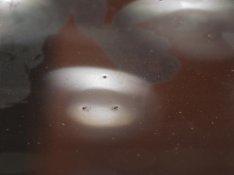
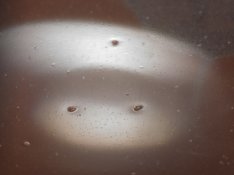
The Adox (Efke) however shows a fine spotty residue all over the non-emulsion side, the entire length of the roll; if it had been sprayed with some sticky substance such as sugar syrup, it would look like it does.
(I don't use any aerosol or other sprays in my house, not indeed sugar-syrup)
Using a 10x loupe, as far as I can ascertain the residue spots are an orangey-purple, perhaps plum-coloured, but they seem only to be on the non-emulsion side. They feel slightly hard to a fingernail and can be scratched off.
What I find most peculiar is that even examined with the 10x loupe, I cannot see any of this same residue on the emulsion side.
Although I have only scanned one strip of negatives, it's clear they are pretty much unusable either for digitisation or enlarging as they stand.
My guess (prompted by the colour of the residue) is that the APH09 (which I have had open and used regularly for about 14 months, and is now "coke coloured" ) has some crystals or other precipitate which has not dissolved when diluted and that this is what has caused the residue. It does not explain how it comes to be only on one side of the roll, however, and I have used it within the last week to develop a different brand of film without incident.
I've soaked a strip of negatives in deionised water for 10 minuties with some agitation, and given it a final rinse including a drop of Ilfotol, and so far as I can see on the wet negative much of the residue has gone. I will examine it properly again when it has had time to dry fully.
I am wondering how much re-washing I can undertake (I was thinking about, say, 30 minutes @ 20C with some agitation, for the remainder of the roll) without too high a risk of damage to the emulsion, which I know from past experience can be delicate.
If rewashing doesn't work, wiping off with "Pec pads" springs to mind, and I have some Isopropanol to hand with which I could moisten a microfibre cloth for wiping (though I believe one has to be careful not to contact the emulsion with it?)
Any other suggestions?
I also developed two other rolls of 135 (Tri-X and PolypanF) in the same session, using the same regime as described below, varying only the developer and development times.
My normal routine is as follows, and consistently produces clean, unmarked negatives, perfectly suitable for digitisation or enlarging: Paterson tank+spiral, no prewet, initial 30s agitation + 5s agitation per min; 30 secs tap water stop with 3 changes of water; 4 minute fix in Ilford rapid with initial 30s agitiation + 15s every minute; ilford wash regime of 5,10,20,20, then brief wash with filtered water, then final rinse in deionised water + drop Ilfotol; hang to dry in initially humid bathroom overnight.
The Tri-X and Polypan were (are) fine.
The Adox (Efke) however shows a fine spotty residue all over the non-emulsion side, the entire length of the roll; if it had been sprayed with some sticky substance such as sugar syrup, it would look like it does.
(I don't use any aerosol or other sprays in my house, not indeed sugar-syrup)
Using a 10x loupe, as far as I can ascertain the residue spots are an orangey-purple, perhaps plum-coloured, but they seem only to be on the non-emulsion side. They feel slightly hard to a fingernail and can be scratched off.
What I find most peculiar is that even examined with the 10x loupe, I cannot see any of this same residue on the emulsion side.
Although I have only scanned one strip of negatives, it's clear they are pretty much unusable either for digitisation or enlarging as they stand.
My guess (prompted by the colour of the residue) is that the APH09 (which I have had open and used regularly for about 14 months, and is now "coke coloured" ) has some crystals or other precipitate which has not dissolved when diluted and that this is what has caused the residue. It does not explain how it comes to be only on one side of the roll, however, and I have used it within the last week to develop a different brand of film without incident.
I've soaked a strip of negatives in deionised water for 10 minuties with some agitation, and given it a final rinse including a drop of Ilfotol, and so far as I can see on the wet negative much of the residue has gone. I will examine it properly again when it has had time to dry fully.
I am wondering how much re-washing I can undertake (I was thinking about, say, 30 minutes @ 20C with some agitation, for the remainder of the roll) without too high a risk of damage to the emulsion, which I know from past experience can be delicate.
If rewashing doesn't work, wiping off with "Pec pads" springs to mind, and I have some Isopropanol to hand with which I could moisten a microfibre cloth for wiping (though I believe one has to be careful not to contact the emulsion with it?)
Any other suggestions?