
• Welcome to Photrio!
    Registration is fast and free. Join today to unlock search, see fewer ads, and access all forum features.
    Click here to sign up

Replacing Ni-Cad batteries in an electronic flash

Fusion Energy

A
Fusion Energy

  • 2
  • 0
  • 44
The Outhouse

A
The Outhouse

  • 2
  • 2
  • 54

Recent Classifieds

Forum statistics

Threads
203,472
Messages
2,855,305
Members
101,858
Latest member
FreeRanger
Recent bookmarks
0

AndyH

Member
Allowing Ads
Joined
Aug 16, 2004
Messages
451
Location
New England
Format
Medium Format
I have a couple of old Bauer E 160 Ultrablitz electronic flashes that I'd like to restore to functionality. I love the compact size and the relatively high output, and they look great with many of my old film cameras. They have both hot shoe and PC to PC adaptability. Back in film days, they were my favorite units, and I always had one along in case of need.

The capacitors charge and the flashes work on AC power, but the batteries appear shot and won't hold a charge. Although I'm fairly handy with repairs and modifications, I've never attempted to replace rechargeable batteries in a flash unit.

I'd appreciate any advice on whether this is a reasonable thing to attempt, and on possible sources for replacement NiCads. It seems like it should be a relatively easy feat with a modicum of soldering skills and the ability to disassemble the case. Both of these units are in otherwise mint condition, and a quick test of exposure under AC power indicated that they were putting out pretty close to full power.

Any advice before I start the process? (I already know that I need to make sure the capacitor is fully discharged before opening it up)

Thanks in advance for any tips or thoughts!

Andy
 
Yes by all means! Replace with NiMH batteries. Electronically I don’t know if they will overheat when you charge them. But if you can take them apart you can replace the batteries and give them a new life.
 
  • mgb74
  • mgb74
  • Deleted
  • Reason: duplicate
Do you know the form factor of the batteries built into the flash? Is the original chemistry Ni-cad? All the different battery chemistries have their own charge and discharge characteristics. If you're not sure about the circuitry, it might be best to stick with the same battery chemistry as the original.

For soldering, you generally want batteries with tabs.
 
The other issue is that apparent C-size batteries (if that is what is inside) come in two versions...tabbed, or tabless. Often companies use tabless batteries and welded the connections...if you tried to get tabless batteries and SOLDER them, your soldering iron is likely to have insufficient heat capacity to achieve a soldered connection!
 
You can use NiMH of the same size. The most difficult part isn't the soldering nor finding the batteries. It's about disassemble the battery pack and reassemble it.
 
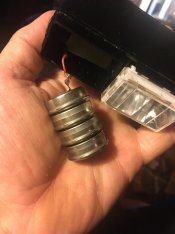
This looks fairly easy. Batteries are coded DEAC. Four cells in series. Now I just have to find them.
Andy
 

Attachments

  • E6EF0D58-6646-433D-B737-CDE310E638C1.jpeg
    E6EF0D58-6646-433D-B737-CDE310E638C1.jpeg
    705 KB · Views: 139
Yes by all means! Replace with NiMH batteries.
Flashes of that generation have built-in batteries. Exchanging them for NiMh ones, if dimensions fit, means needing to exchang the charger too (which typically is also designed as feeder for mains operation).

Some sizes of NiCd batteries are still available, thus the flash can be left in original state.


By the way, that model was my very first electronic flash....
 
Last edited:
By the way, that model was my very first electronic flash....

Mine too. Excellent output for the day. Beautiful finish, quite compact, and a fair number of shots per charge.

I'd love to get mine working for my Nikon F, Pentax Spotmatic, and Rolleiflex SLRs. Now I've just got to find the replacement cells. Soldering and installing them will be a piece of cake.

Andy
 
Too bad it is not 5 cells because I believe those button cells are not available. Stacks of 5 of those button cells can be duplicated with 5 AAA cells. Duplicating a stack of 4 will be difficult.

1106e89e1854ab3a295add.jpg


View attachment 249312

I wonder whether I could simply unsolder one of those and reassemble the stack with four?

Andy
 
I wonder whether I could simply unsolder one of those and reassemble the stack with four?

Andy
That is the one made of 5 AAA cells, but look back at the post #9, I think I found the flat cells you need already welded together and updated the post.
 
both NiCd and NiMH are nominally 1.2 volts per cell, fwiw
 
I have a couple of old Bauer E 160 Ultrablitz electronic flashes that I'd like to restore to functionality. I love the compact size and the relatively high output, and they look great with many of my old film cameras. They have both hot shoe and PC to PC adaptability. Back in film days, they were my favorite units, and I always had one along in case of need.

The capacitors charge and the flashes work on AC power, but the batteries appear shot and won't hold a charge. Although I'm fairly handy with repairs and modifications, I've never attempted to replace rechargeable batteries in a flash unit.

I'd appreciate any advice on whether this is a reasonable thing to attempt, and on possible sources for replacement NiCads. It seems like it should be a relatively easy feat with a modicum of soldering skills and the ability to disassemble the case. Both of these units are in otherwise mint condition, and a quick test of exposure under AC power indicated that they were putting out pretty close to full power.

Any advice before I start the process? (I already know that I need to make sure the capacitor is fully discharged before opening it up)

Thanks in advance for any tips or thoughts!

Andy
replacement batteries are fairly easy to get. To make the soldering and job easier get the ones that have soldering tabs already attached.
 
both NiCd and NiMH are nominally 1.2 volts per cell, fwiw

Yes, but as indicated, the original charger would not work (good) with NiCd cells. As these often are built in. you then got a charger issue.
 
replacement batteries are fairly easy to get.

Not to my understanding. Sales of NiCd cells are restricted in the EU . Over here at first sight I only can get few large cells for special purposes, oll of them 1.2V, which in the best case would fit. However the OP even needs Nicd button-cells to make a stack from.

I did not look internationally yet.
 
Last edited:
As indicated above, the OP needs NiCd cells, not NiMh.
 
  • AgX
  • Deleted
As indicated above, the OP needs NiCd cells, not NiMh.
As I said earlier NiMH works just fine in place of NiCad. NiMH tends to hold more charge and has less memory effect. They do have less current capacity but that would make the flash recycle a bit slower only if any.
 
They work just fine, but need different charging and thus chargers. This is a problem when the cells are built-in as in the OP's case.
Or do you charge your NiMh cells with the old chargers intended for the NiCd cells?
 
Good luck. Consensus is use Nicad . I would keep detailed instructions to disassemble/ reassemble because you will have to do it again
 
AgX said: Or do you charge your NiMh cells with the old chargers intended for the NiCd cells?

I have several chargers for AA cells that can charge both NiCad and NiMH however one must deploy a switch for each variety so I'm thinking that each type needs a dedicated charger.
 
AgX said: Or do you charge your NiMh cells with the old chargers intended for the NiCd cells?

I have several chargers for AA cells that can charge both NiCad and NiMH however one must deploy a switch for each variety so I'm thinking that each type needs a dedicated charger.
The switch on the few I've dismantled just increases the time. NiMH are going to be higher capacity so require a bit longer. As long as the original charger is not some super quick - fast - ultra - mega job then it should be fine. Temperature is a good indicator, when the cells get hot they're full. Unlike Lipo or similar these are much easier to charge (at slow rates anyway) not too much to worry about.
I've done this with a few battery drills RC toys etc. with no problem.
Of course I'm not recommending you do this, just saying that I have. If not confident seek other advice/info!!!
 
Photrio.com contains affiliate links to products. We may receive a commission for purchases made through these links.
To read our full affiliate disclosure statement please click Here.

PHOTRIO PARTNERS EQUALLY FUNDING OUR COMMUNITY:


Ilford ADOX Freestyle Photographic Stearman Press Weldon Color Lab Blue Moon Camera & Machine
Top Bottom