• Welcome to Photrio!
    Registration is fast and free. Join today to unlock search, see fewer ads, and access all forum features.
    Click here to sign up

Red Oxide printing question

Recent Classifieds

Forum statistics

Threads
203,213
Messages
2,851,525
Members
101,729
Latest member
Luis Angel Baca
Recent bookmarks
0

Thwyllo

Member
Allowing Ads
Joined
Apr 27, 2022
Messages
142
Location
SW France
Format
Large Format Digital
This is a bit of a history question. Rowland Ward was a world famous taxidermist operating from the latter part of the 19th century through to the 1980s when the name was sold. As well as being renowned for taxidermy of all kinds, especially big game, the company ventured into all sorts of things and the owner of one of the companies largest stash of old records and documents has asked if I can find out something about red oxide printing.

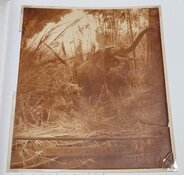
The attached photo that he sent me (not a very good shot I'm afraid, I can get better if it helps) is a specimen of one of his originals. Its his belief that the company pioneered the use of red oxide printing but that the technique ultimately died out, so my questions are:

1) Is there any truth to that assertion, and if not, whats the real story..?

2) Are there any special measures he should take to ensure long term preservation of what are clearly already old prints?

Many thanks in anticipation!
 

Attachments

  • IMG-20260409-WA0029.jpg
    IMG-20260409-WA0029.jpg
    122.2 KB · Views: 40
I'm not familiar with 'red oxide printing'. I know that red iron oxide is a reddish-brown pigment. It can be used in e.g. carbon transfer printing. The fact that the print shown here seems to be mirrored, would be consistent with a single-transfer carbon print. Is this what we're looking at? Or something else entirely?
 
You are probably right...I was parroting the words of the document owner who isn't a photographer :smile:

How does a carbon transfer print work then and what is it made from, an original negative? I'm assuming the image reversal isn't normally an issue except as here, where there was a printed banner of some sort in frame?

And what does it allow compared to a traditional print process? Is it just for colouration of the final print?

The subject of this photo by the way is almost certainly a taxidermy diorama - Ward was well known for its big game taxidermy skills and used by hunters and naturalists from all over the world.
 
The elephant is being attacked by a ??leopard maybe?? while the tiger looks on....

I almost think I can see thick-ish gelatin surface on the lower right... Koraks guess seems possible.
 
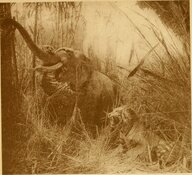
Just for interest, herewith a copy of what I assume is a standard print of the same negative. The photo is, as I said previously, of a diorama created by Rowland Ward for the Colonial & Indian Exhibition of 1886, but I'm still keen to confirm how the reverse print was done and why?
 

Attachments

  • Records_of_big_game_-_with_their_distribution,_characteristics,_dimensions,_weights,_and_horn_...jpg
    Records_of_big_game_-_with_their_distribution,_characteristics,_dimensions,_weights,_and_horn_...jpg
    552.8 KB · Views: 18
Looks sepia on silver gelatin.
Great pictures, do you have any more?

The owner of the documents is apparently certain that it's a "red oxide print", I'll have to ask how he knows that.

Theres a version of the original and many others in a digitised copy of a very old Rowland Ward big game book (which continues to be published in updated form to this day I believe by the current owners of the trademark) in the link below. (I'm assuming the posting of links is allowed, we'll see?) The book takes a while to load - but the Internet Archive Site is a boon for researchers.

 
As you probably gathered I green as grass about any darkroom stuff that isn't traditional BnW with an enlarger!

I've asked the owner of this print if he can clarify his beliefs about red oxide but from what digging I've done, I see that the photogravure process (which fits the time period) uses red oxide but of course produces black and white print....however it is a much cheaper process for the production of handbills and the like, so I have two questions....firstly does photogravure result in a reversed image (which would explain the reverse text) and secondly, was there a commonly used secondary chemical process in the 19th century that would result in a red print such as this one? Or even perhaps something that might degrade from BnW to red over a period of 140 years...
 
(I'm assuming the posting of links is allowed
Sure, no problem!

As said, I'm not familiar with the term 'red oxide print', so I don't really know what it is. If it turns out to be a carbon print, then I can answer your other questions - but keep in mind that this is in the assumption that it's indeed some kind of carbon print, and not an entirely different printing process that is being referred to.
How does a carbon transfer print work then and what is it made from, an original negative?
Yes, a carbon print was historically typically made from a regular B&W negative. It's a contact printing process, so that means the negative needs to be the same size of the negative. The hardening action was typically through the use of dichromate, which hardens a pigmented gelatin matrix under influence of exposure to UV. It's a slow hardening action, which is the reason why it's a contact print process. Once hardened, the image needs to be 'developed' by washing away the unhardened gelatin, leaving the image, consisting of a hardened gelatin layer. In this step, the image must at the same time be transferred to a support; this is where the mirroring happens. The transfer is a mechanical necessity as otherwise the image would wash away together with the unhardened gelatin.

There's a related 'carbro' process that used an interaction between silver, chromium and gelatin to harden the gelatin. In this case, an enlargement could be used to make a print from, so the original negative could be smaller than the final print. This process relied on enlarging papers with no or a very soft supercoat; it doesn't work anymore with modern enlarging papers. Physically, a carbro print is very difficult or even impossible to distinguish from a carbon print, so they can be considered as practically the same from an archival and collectionist viewpoint.

I'm assuming the image reversal isn't normally an issue except as here, where there was a printed banner of some sort in frame?
Yes, indeed. There are variants of the carbon transfer process that add another transfer step so the image is mirrored again, making it end up correctly oriented.

And what does it allow compared to a traditional print process? Is it just for colouration of the final print?
The carbon transfer process was one of the earliest printing processes that could produce any hue, since the colorant is a pigment, and in principle any pigment can be used. It also allows a full tonal scale with very good dmax, the prints are very stable and practically do not deteriorate as long as they're not subject to excessive moisture, and any number of prints can be made from a single negative. Most carbon prints tend to be monochrome, often with some degree of warm toning depending on the carbon pigment used since carbon has historically been the most-used pigment for the process (hence the name, 'carbon' transfer). In the late 19th and early 20th century there was a bit of an industry that made ready-to-go carbon tissue: the pigmented gelatin layer that could then be sensitized with dichromate and used for printing. Interestingly, I recall having read that this could come in different colors, so not just black. I recall e.g. a dark blue/green variant being offered, and quite possibly (but I'm not sure about that) an iron oxide red one as well. Either way, an iron oxide red/brown tissue is easy to make; in fact, Calvin Grier routinely does this as he uses red iron oxide for the skin tones of his full-color carbon prints.

Coming back to your original questions:
1) Is there any truth to that assertion, and if not, whats the real story..?

2) Are there any special measures he should take to ensure long term preservation of what are clearly already old prints?
1: If (again, if) this is indeed a variant of the carbon printing process, then no, this publisher was certainly not the first or only party to do this. The carbon process originates in the mid-19th century and was pretty much 'ripe' and used in full swing by the end of the 19th century. That period was actually the heyday of historical carbon transfer.
2: Again, the same if: carbon prints are robust in themselves, but are subject to deterioration of mostly the paper base and the gelatin. Neither withstand moisture very well, but prolonged storage in excessively dry conditions can likewise crack the gelatin matrix. Storage conditions suitable for silver gelatin prints will also be fine for carbon prints. The gelatin can furthermore yellow; I'm not sure if this process can be halted and how far it'll proceed, but I expect that exposure to (UV) light will likely accelerate it. However, other than that, carbon prints are generally light-fast as long as a light-fast pigment is used, and red iron oxide certainly falls in this category. So the prints should be more stable than e.g. silver gelatins.

the photogravure process (which fits the time period) uses red oxide but of course produces black and white print....however it is a much cheaper process for the production of handbills and the like, so I have two questions....firstly does photogravure result in a reversed image (which would explain the reverse text) and secondly, was there a commonly used secondary chemical process in the 19th century that would result in a red print such as this one? Or even perhaps something that might degrade from BnW to red over a period of 150+ years
Good questions; whatever I can come up with is likely incomplete, but let's give it a shot.

Photogravure is a possibility, but would be easy to tell apart from a carbon print. A carbon print is a gelatin matrix with pigment in it. So you'll see the slick, hard and somewhat glossy surface of the gelatin. If the prints are dead matte and do not lay on top of the paper base, then it cannot be a carbon print. Given the appearance of the image in your first post, which appears to be a glossy print that's also somewhat brittle, this suggests a gelatin layer on top of paper. That's not consistent with photogravure and one of the reasons why I initially suggested a form of carbon transfer.

Photogravure can, like carbon transfer, occur in any color since this really only depends on the pigment used, and pretty much any pigment can be used in a printing ink. Photogravure might be recognizable along the edges of the image where you see signs of the edges of the plate, see signs of inked scratches in the plate surface, etc. More importantly, photogravure is a halftone process, so it's not continuous tone. With a magnifier, you should see little dots of ink. If you see continuous tone, it's not photogravure. Contrary to what you state, photogravure was not just used for low-end printing; it was used for high-end photographic reproduction. A notable example is Stieglitz' Camera Work editions, which used the process to reproduce the original photos. These were (still are) considered as excellent. The same is true for some of the (early) volumes of Curtis' The American Indian (the later volumes were also photogravure printed, but the prints were much poorer in quality than in the early volumes).

As to other processes - the world is a big place! For sure, there are possibilities, but again, the appearance of the first print which to me looks like some kind of gelatin imaging layer, limits the options a bit. There's still the hypothetical possibility that these were some form of metal-based process and the prints were then supercoated with gelatin - but I really doubt anyone would have gone to those lengths. So if the paper has a gelatin layer (or another colloid with similar appearance), it's probably safe to assume that the gelatin is essential in the image-making/printing process. That means the options are reduced to a much shorter list:

* Albumen prints were very common back in the 19th century and early 20th century. They were difficult to process properly and the often fade and yellow. A faded albumen print can very well have a reddish hue. In a collection of albumen prints made over an extended period of time, I would expect to see large variation in the degree of fading and yellowing. Moreover, I would expect to see variations within a single print (e.g. edges faded more than the center). If all prints look similar and they are of even hue across the surface, I think albumen is an unlikely candidate.

* Silver gelatin prints, toned to a red hue in some way. Some kind of metal replacement toning could result in these reddish hues. I'm not aware of any toning process that uses red iron oxide, however, so that would make the name attributed to it a little puzzling. It could still refer to the hue, and not the technical nature of the process.

* Carbon transfer as discussed above.

* Gum bichromate; although typically these would have a more 'painterly' look and the tonal scale is really not consistent with how I'd expect gum prints from that era to look. So I think we can set this one aside.

I might be forgetting a few.

If you want to know for sure what these are, my suggestion would be to get in touch with a photo museum that's accessible to you and ask if one of their archivists or restorers would have a look at one or a few samples. They should be able to narrow down the options considerably by just looking at them (with the aid of a microscope here and there). If I had physical access to these prints, I'd start by having a look at them with a good magnifier and take note of the image structure, as well as study the substrate and surface to narrow down options.

It's an interesting puzzle, for sure. Whatever else the owner can tell you would be of great use as well.

 
I am speechless! Thank you so much for that incredibly informative response!!!

Applying a bit of logic here and ignoring the owners assertion that it was somehow a process that Rowland Ward "invented" (I'm not sure they even had in-house photographers but that's difficult to confirm), I am fast coming round to thinking this may be some kind of hand bill.

The reverse lettering at the bottom, however, makes no sense in that context... So given that he rescued or purchased a large quantity of often random documents after the company closed down, I wonder if he has some kind of interim experimental item?

I'll ask him about the surface finish but it it WAS a photogravure process (which would make sense in the context of a handbill) then I assume as it's an ink process the colouring could be nothing more than just that....a coloured ink. But does photogravure reverse the negative image?

Thanks again for your wonderful response!!!

Paul
 
You're welcome; I hope it helps any, although I must admit that I raise more questions than I answered...

I'll ask him about the surface finish but it it WAS a photogravure process (which would make sense in the context of a handbill) then I assume as it's an ink process the colouring could be nothing more than just that....a coloured ink. But does photogravure reverse the negative image?
Photogravure has also freedom of color as the pigment can be more or less chosen freely. So yes, if this is a regular mechanical printing process (photogravure, or lithography), then the color is probably just the color of the pigment used. However, given the glossy sheen on the image in #1, I really doubt we should be looking in this kind of direction.

Whether an image ends up being mirrored depends on how the process is conducted. Basically, there's no 'inherent' orientation if it's a multil-step process, since steps can either be added that flip the image, or a step can be performed in such a way as to (un)mirror the image (e.g. exposing a negative the 'wrong way').

It's conceivable that the mirrored print you showed was purposefully mirrored: it might have really been a kind of interpositive, intended as an intermediate product for the creation of mass prints, and the mass printing process might be easiest/quickest to perform if they started with a mirrored positive. That's just a wild guess, though, and it'll be very hard to reconstruct this unless we somehow find physical examples of the final (mass-made) prints of the same image. In that case we could try to figure out what process was used, then use that to draft what the process steps likely would/might have been and what requirements it would have put on an interpositive. In short, the possibility is that in #1 we're looking at an intermediate print that was never intended as a final product.

One of the challenges in all this is that the world of printing used to be enormously diverse and the specifics of an imaging chain would have differed from one print shop to another, and often even from one print job to another. The possibilities truly are endless, and most of the time, this was not documented apart from at a very superficial level. So the specifics are almost always lost in time.
 
Thanks for the clarification. I have asked him if he can provide any clarification about the claims made for "the process" and will let you know.

We have to understand Rowland Ward was a colossus in his field and certainly not above a bit of self-promotion, so it will be good to try and see his claims in this regard in black and white! I'll keep you posted.
 
Thanks, I'm very interested to hear about any progress you make on this! I was not aware of Ward or his work in the field of taxidermy; it's interesting to see how it somehow appears to extend into the realm of printing and photography.

One more thing about the carbon prints and the example you showed in #1: the Achilles' heel of carbon transfer prints is the transition from the lightest visible tone to paper white. On many carbon prints that have areas of paper white, you can see (often with magnification) a somewhat jagged, uneven transition from the palest visible tone to paper white. This is because the image-forming gelatin at this point becomes so thin that it doesn't survive the process. Calvin calls this the 'tonal threshold'. Whether it's visible depends on many factors, but the print you showed at the start of the thread is a good candidate for spotting this potential issue, given the bit of blank sky at the top of the image and the edges it makes with the reeds and the trees in the background.
 
Rowland Ward was kind of the PT Barnum of the Victorian taxidermy world and his/their work continued into the 1980s when they finally closed. The name was bought and now attaches to an annual big game publication (not my thing but hey it's a free world!)..

 
It's a whole universe opening up! Fascinating how things evolve over time; thanks for sharing that bit of context. I should look into the person of Ward and see if I can find any hints about his/their involvement in printing. Maybe there's something to be found by means of an explanation of that red oxide printing thing.
 
Well it's interesting you say that....my wife is the fanatic, not me....she has a small hobby website that's about Victorian taxidermy but she is as equally as interested in the cultural aspects and the back stories (some of which have led to surprising and fascinating discoveries!)


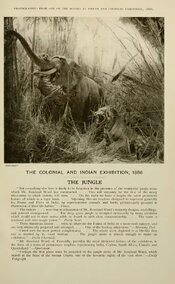
But just for interest, heres an original instance of the photo this print has come from. I have tried to find out if Ward used an in-house photographer...it would make absolute sense to me given the scale of his operation but I haven't been able to find an answer.
 

Attachments

  • Sportsmansbritis00lyde.djvu.jpg
    Sportsmansbritis00lyde.djvu.jpg
    328.5 KB · Views: 8
The owner of the documents is apparently certain that it's a "red oxide print", I'll have to ask how he knows that.

Theres a version of the original and many others in a digitised copy of a very old Rowland Ward big game book (which continues to be published in updated form to this day I believe by the current owners of the trademark) in the link below. (I'm assuming the posting of links is allowed, we'll see?) The book takes a while to load - but the Internet Archive Site is a boon for researchers.


Wonderful, thanks for the link.
 
@Thwyllo I agree with @awty above - wonderful website! (One minor gripe - in case you have any control over how it behaves, would it be possible to have the links open in the same window instead of opening a new window?) It's a treasure trove of information and beautifully presented, too.

Coming back to the elephant photo, and sorry to have not touched upon this aspect before: the reproduction you show in post #6 certainly looks like a halftone printing process to me; photogravure is a possibility, but so is e.g. lithography (the latter seems a little more likely for a mass reproduction). There's a visible raster to the photo. Also, the process lends itself to mass reproduction and as such it would make sense in the context of a published book. The photo in #1 looks more and more like an interpositive or intermediate product, and in that context the mirroring might have been very intentional and not so much a byproduct of the printing process of that generation of the image (the 'double transfer' procedure for carbon prints was already amply known AFAIK in the 1880s).

I've just asked Copilot to generate a report on the 'red oxide' printing technique. It comes up with a lengthy bit of prose which mostly expands on the points I made above (it's likely it pulled in our exchange...) It did not come up with an additional source discussing a 'red oxide printing process' by that name. One somewhat interesting factoid is that it refers to synthetic 'Mars Red' pigment (man-made red iron oxide) which became available around 1800 or so and kind of fits in the broader period of adoption of man-made pigments that accelerated throughout the 19th century, onward (continuing today!) Perhaps the 'first used' reference has something to do with the use of an artificial iron oxide pigment for printed illustrations in books. I'm really guessing here.
 
Photrio.com contains affiliate links to products. We may receive a commission for purchases made through these links.
To read our full affiliate disclosure statement please click Here.

PHOTRIO PARTNERS EQUALLY FUNDING OUR COMMUNITY:


Ilford ADOX Freestyle Photographic Stearman Press Weldon Color Lab Blue Moon Camera & Machine
Top Bottom