• Welcome to Photrio!
    Registration is fast and free. Join today to unlock search, see fewer ads, and access all forum features.
    Click here to sign up

Red Oxide printing question

Recent Classifieds

Forum statistics

Threads
203,199
Messages
2,851,169
Members
101,718
Latest member
ClassyJ
Recent bookmarks
4

Thwyllo

Member
Allowing Ads
Joined
Apr 27, 2022
Messages
136
Location
SW France
Format
Large Format Digital
This is a bit of a history question. Rowland Ward was a world famous taxidermist operating from the latter part of the 19th century through to the 1980s when the name was sold. As well as being renowned for taxidermy of all kinds, especially big game, the company ventured into all sorts of things and the owner of one of the companies largest stash of old records and documents has asked if I can find out something about red oxide printing.

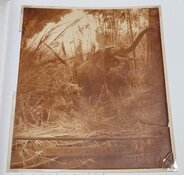
The attached photo that he sent me (not a very good shot I'm afraid, I can get better if it helps) is a specimen of one of his originals. Its his belief that the company pioneered the use of red oxide printing but that the technique ultimately died out, so my questions are:

1) Is there any truth to that assertion, and if not, whats the real story..?

2) Are there any special measures he should take to ensure long term preservation of what are clearly already old prints?

Many thanks in anticipation!
 

Attachments

  • IMG-20260409-WA0029.jpg
    IMG-20260409-WA0029.jpg
    122.2 KB · Views: 15
I'm not familiar with 'red oxide printing'. I know that red iron oxide is a reddish-brown pigment. It can be used in e.g. carbon transfer printing. The fact that the print shown here seems to be mirrored, would be consistent with a single-transfer carbon print. Is this what we're looking at? Or something else entirely?
 
You are probably right...I was parroting the words of the document owner who isn't a photographer :smile:

How does a carbon transfer print work then and what is it made from, an original negative? I'm assuming the image reversal isn't normally an issue except as here, where there was a printed banner of some sort in frame?

And what does it allow compared to a traditional print process? Is it just for colouration of the final print?

The subject of this photo by the way is almost certainly a taxidermy diorama - Ward was well known for its big game taxidermy skills and used by hunters and naturalists from all over the world.
 
The elephant is being attacked by a ??leopard maybe?? while the tiger looks on....

I almost think I can see thick-ish gelatin surface on the lower right... Koraks guess seems possible.
 
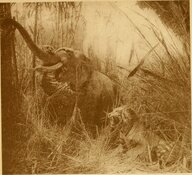
Just for interest, herewith a copy of what I assume is a standard print of the same negative. The photo is, as I said previously, of a diorama created by Rowland Ward for the Colonial & Indian Exhibition of 1886, but I'm still keen to confirm how the reverse print was done and why?
 

Attachments

  • Records_of_big_game_-_with_their_distribution,_characteristics,_dimensions,_weights,_and_horn_...jpg
    Records_of_big_game_-_with_their_distribution,_characteristics,_dimensions,_weights,_and_horn_...jpg
    552.8 KB · Views: 0
Photrio.com contains affiliate links to products. We may receive a commission for purchases made through these links.
To read our full affiliate disclosure statement please click Here.

PHOTRIO PARTNERS EQUALLY FUNDING OUR COMMUNITY:


Ilford ADOX Freestyle Photographic Stearman Press Weldon Color Lab Blue Moon Camera & Machine
Top Bottom