• Welcome to Photrio!
    Registration is fast and free. Join today to unlock search, see fewer ads, and access all forum features.
    Click here to sign up

Reciprocity and long exposure on instax film

Recent Classifieds

Forum statistics

Threads
202,671
Messages
2,843,865
Members
101,453
Latest member
lubowe
Recent bookmarks
0

geirtbr

Member
Allowing Ads
Joined
Feb 21, 2015
Messages
53
Format
35mm
Anybody who has done some experiments with long exposures on instax?
How much should one compensate?
 
I'm wondering the same thing. A search of the web failed to reveal much in the way of pertinent citations, except one anecdotal report that reciprocity was pretty bad. So then I asked Fuji Canada via their support email. The first reply was "what's reciprocity?". The second reply was Instax doesn't have any reciprocity information. So, no help there.

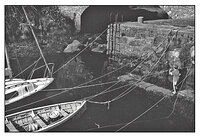
My first attempt to shoot Instax in a Crown Graphic was with continuous lighting and a 0.5s exposure. It looked about 2/3 stop underexposed, which might be the beginning of reciprocity.
 
This [Instax] photo was metered at 1 second @ f45 (off the road) - but is under-exposed.

060221-001-03.jpg
 
Last edited:
Last edited:
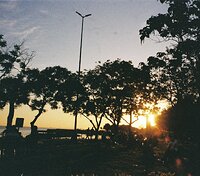
A year or so I was doing some long exposures at dusk. They came out under-exposed. I was not thinking of a poor reciprocity at the time and ascribed the results to error in setting the camera or metering. In retrospect I seems like I the images were suffering from reciprocity failure. The images looked like post #3 above.
 
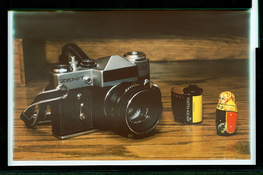
I received a Lomograflok and have been able to do some controlled exposures. I think reciprocity failure begins to kick in very soon with Instax film, even at about 1/8s. For still lifes metered accurately at 1/4s I have to bump up exposure about 1.5 stops! Even then, I detect the image going a bit bluish, as in the first attachment photo of the Vitessa. Since this film is already very contrasty, reciprocity just makes things worse. Using flash, the correct exposure is as metered for ISO 800 and less colour cast, as in the second shot of the Zenit.
 

Attachments

  • vitessa_july29_500_web.jpg
    vitessa_july29_500_web.jpg
    1.5 MB · Views: 248
  • zenit_flash_aug1_501_web.jpg
    zenit_flash_aug1_501_web.jpg
    1.1 MB · Views: 235
I had decent results (aside from the excessive contrast typical of reciprocity excursion) using an Ilford exponent of 1.3 from 1/10 second when shooting pinhole images on Instax. Ilford exponent is the power to which you raise the exposure in multiples of the longest reciprocal value -- so for regular films, with a reciprocity limit of 1 second, a metered exposure of 4 seconds becomes 4 ^ 1.3 = ~6.1 seconds. If you have metered at 4 seconds with Instax, since the reciprocity limit is 1/10, you'd need (40 ^ 1.3) / 10 = ~12.1 seconds.
 
I had decent results (aside from the excessive contrast typical of reciprocity excursion) using an Ilford exponent of 1.3 from 1/10 second when shooting pinhole images on Instax. Ilford exponent is the power to which you raise the exposure in multiples of the longest reciprocal value -- so for regular films, with a reciprocity limit of 1 second, a metered exposure of 4 seconds becomes 4 ^ 1.3 = ~6.1 seconds. If you have metered at 4 seconds with Instax, since the reciprocity limit is 1/10, you'd need (40 ^ 1.3) / 10 = ~12.1 seconds.

Thanks. So if I scale all this to a reciprocity limit of 1/10s, and I meter 1/4s, then that's 2.5 times 1/10s, and the formula gives me 2.5^1.3=3.3. I'm assuming the Ilford formula gives the exposure multiplier, not absolute time, but they were the same in your example because the formula was for a reciprocity limit of 1s. So I should expose 1/4s*3.3~0.75s? That seems to align well with my estimate of being off about 1.5 stops in that range. It's all complicated by the fact that the first shot was with a large format camera with magnification around 1:2, so bellows extension was also starting to figure in. I never bother to calculate that precisely; I just threw in an extra stop. But with Instax one can't fool around with that stuff; it has no latitude.
 
Last edited:
I included the multiplication and division by 10 in the second example, specific to Instax (also applies to a few reproduction films). 1/4 = 2.5x 1/10 which is the same as 10 / 4, so in the form I gave above, that would require ((10/4)^1.3)/10 = ~.33 seconds. That's the actual time to use, not a multiplier.
 
Thanks. Did you see a lot of colour shift to cool tones in your pinhole experiments with multi-second exposures?
 
Last edited:
I own quite some non-automatic Instax cameras and backs. Instax film seems to be 800 ISO only in not so bright and not so dark circumstances. In very bright sunlight it's 1600 ISO, in shady areas it's 400 ISO. Some cameras as the Mint RF70 can compensate this or have learned to do so. I had the first series of this camera and had it kindly replaced by a new version which compensates very well.

I also have an Instax pinhole camera. My photos were all blue, for times beyond 10s up to some minutes. I tried to filter, but no real success up to now. You would also need a steep center filter which I do not own. I only have those for Angulons and Super Angulons which are too soft.
 
Color shifts due to reciprocity departure are common with many color films, but with modern color negative and transparency films one seldom gets into long enough exposures to see a significant change in relative speeds of the color layers. This is not the case with Instax -- and quite reasonably so; this was developed as an economical film for low-end "fun zone" instant cameras, not as a "serious" photographic material intended to cover the whole range of photographic endeavor. For the most part, I'm just happy to get instant prints at a cost comparable to 6x9 on 120 color film. The fact that there are limitations is just part of the package.
 
Photrio.com contains affiliate links to products. We may receive a commission for purchases made through these links.
To read our full affiliate disclosure statement please click Here.

PHOTRIO PARTNERS EQUALLY FUNDING OUR COMMUNITY:



Ilford ADOX Freestyle Photographic Stearman Press Weldon Color Lab Blue Moon Camera & Machine
Top Bottom