

• Welcome to Photrio!
    Registration is fast and free. Join today to unlock search, see fewer ads, and access all forum features.
    Click here to sign up

Questions on Fog in Salt and Albumen Prints

Recent Classifieds

Forum statistics

Threads
202,690
Messages
2,844,303
Members
101,472
Latest member
zzzzzz
Recent bookmarks
0
As in the first post of this topic, I have observed similar fogging issues while using Hahnemühle Platinum Rag. That is not a buffered paper.
That is why I attempted to solve the fogging issue permanently, and I introduced a concentrated salt wash as part of my workflow. In order to dissolve and remove the unexposed silver chloride present in the paper fibers.
And that is also why I said I am not entirely convinced that the primary reason for fogging is the paper buffer.
 
As in the first post of this topic, I have observed similar fogging issues while using Hahnemühle Platinum Rag. That is not a buffered paper.
That is why I attempted to solve the fogging issue permanently, and I introduced a concentrated salt wash as part of my workflow. In order to dissolve and remove the unexposed silver chloride present in the paper fibers.
And that is also why I said I am not entirely convinced that the primary reason for fogging is the paper buffer.

Yes, it does not need to have the buffer for fogging on the paper (the dark reaction kind, not the one that happens due to inadequate fixing which is indeed an another source but that develops long after processing.) Number of things in the paper can reduce silver nitrate to silver - starting from cellulose (cotton fibers themselves) which a good reducing agent. The same reason why skin turns dark if happens to come in contact with it. What the buffer does is provide alkaline environment where the spontaneous precipitation of Ag metal is more favorable. Conversely adding an acid in the mix slows down this dark reaction enough to make an exposure and process the print.

I did a study back when with various papers and found that the only un-buffered paper (COT 320) in the whole bunch had the least (or none) amount of dark stain developed.

:Niranjan.
 
Last edited:
As in the first post of this topic, I have observed similar fogging issues while using Hahnemühle Platinum Rag. That is not a buffered paper.
That is why I attempted to solve the fogging issue permanently, and I introduced a concentrated salt wash as part of my workflow. In order to dissolve and remove the unexposed silver chloride present in the paper fibers.
And that is also why I said I am not entirely convinced that the primary reason for fogging is the paper buffer.

I have seen similar fogging during processing with COT 160, also an unbuffered paper.
 
I have seen similar fogging during processing with COT 160, also an unbuffered paper.

Is this really an unbuffered paper? I did a quick test of Bergger Cot 160 16 x 20 paper that I received earlier this week. Cut two small strips, put one in a tray of Citric Acid and coated the other with FerroBlend sensitiser. I could see bubbles, likely CO2, coming out from the first strip indicating a reaction between Citric Acid and some ingredient of the paper. The second strip showed signs of fogging and darkened substantially as it dried. Usually these symptoms are suggestive of the presence of buffer in the paper.

Next I soaked a 8x10 strip in Citric Acid, washed in water, dried, and subsequently made a FerroBlend print which came out fine. So I'll continue to acid treat Cot 160, this batch of 25 sheets, for making alt prints.
 
I don't think it's buffered. A piece soaked in 10% sulfamic acid looks the same as a piece in alkaline tap water to me.

And I've never had the long scale and high Dmax of COT 160 with a buffered paper.

That being said, I prefer to soak the unbuffered papers in weak sulfamic acid anyway. Particularly HPR benefited from this.this
 
That being said, I prefer to soak the unbuffered papers in weak sulfamic acid anyway. Particularly HPR benefited from this.this

That's a sensible approach also supported by Mike Ware:

"It is possible that this ‘decalcification’ treatment also brings an added hidden benefit: the small anions such as chloride or sulphamate from the acid will tend to neutralise the cationic polyelectrolytes that are present as retention aids, unacknowledged"
 
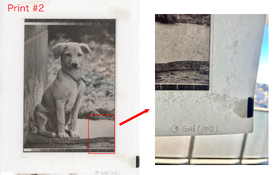
I made another albumen print from the same negative, increasing the citric acid in the sensitizer to see if the fogging would improve. (Paper: HPR)

  • This print: 1 ml of 12% silver nitrate + 4 drops of 50% citric acid
  • Previous print (heavy fog): 1 ml of 12% silver nitrate + 2 drops of 13% citric acid

This time, no fog appeared before UV exposure, but after gold toning (gold-borax) fog showed up in the margins. Under transmitted light, I can see excess silver remaining in the paper.
A print without toning did not fog like this one.


For fixing, I followed FotoD’s advice (Thank you!):


Fixer was Rapid Fixer 1:9, two 2-minute baths, adjusted to pH 7.5 with 28% ammonia. No bleaching occurred.


Since this is albumen printing (not salted paper), the albumen layer should normally protect the paper. However, because it is only a single coat, I suspect that thinner areas may allow silver nitrate to penetrate the paper fibers and react with something inside the paper, producing fog.


Do you think pre-acidifying the paper with an acid solution treatment before coating with albumen would help? If you know of any specific formula for this step, I would appreciate it.

I also plan to try thinner papers, double-coating the albumen, and floating in silver (not a puddle pusher application).
 

Attachments

  • Print #2.jpg
    Print #2.jpg
    1.8 MB · Views: 41
Since this is albumen printing (not salted paper), the albumen layer should normally protect the paper. However, because it is only a single coat, I suspect that thinner areas may allow silver nitrate to penetrate the paper fibers and react with something inside the paper, producing fog.
I think that analysis is correct. The very thin layer of albumen will simply let a significant amount of silver nitrate sensitizer through.
 
Photrio.com contains affiliate links to products. We may receive a commission for purchases made through these links.
To read our full affiliate disclosure statement please click Here.

PHOTRIO PARTNERS EQUALLY FUNDING OUR COMMUNITY:


Ilford ADOX Freestyle Photographic Stearman Press Weldon Color Lab Blue Moon Camera & Machine
Top Bottom
