• Welcome to Photrio!
    Registration is fast and free. Join today to unlock search, see fewer ads, and access all forum features.
    Click here to sign up

problem: grey image

Somewhere...

D
Somewhere...

  • 5
  • 2
  • 106
Iriana

H
Iriana

  • 7
  • 1
  • 171

Recent Classifieds

Forum statistics

Threads
202,751
Messages
2,845,079
Members
101,505
Latest member
PeterFFM
Recent bookmarks
0
PE: if you mean fogged sample of a real paper then yes, it turns black within 3 seconds. If you mean the paper I coated then it took about 60 seconds to get to the state as in the photo. Btw, I am using Ilford Multigrade 1:9.

Hexavalent: I checked the details of the gelatine and it is 'porcine', intended for confectionery and jellies. I wouldn't think that could matter as long as the bloom number is high.
 
Well, turning black when fogged means that the emulsion can get there, but that the contrast is too low. That suggests that something is lowering the contrast.

How to up the contrast? Well, shorten the addition time of the Silver Nitrate as I said before, but then the pig gelatin may be a problem as often additives are put into the gelatin to alter its properties for the intended use. Bovine (cow) gelatin is more common for making. In terms of properties, the swell factor of each gelatin is different. Bovine gelatin swells more in the developer, while porcine gelatin swells more in the acid fixer or wash.

Hope these hints help.

PE
 
So if I understand correctly, the period of time during which I add solution B (silver nitrate) into the solution A needs to be shortened, right? The book 'silver gelatin' mentions it should take time of about ten minutes, but I will try to shorten it.

Regarding the Bovine gelatin: I live in the UK and I can't find any company that sells this particular product. However, I found that SILVERPRINT sells photo quality gelatin so I will order it from there.

Thank you very much to all of you guys for your amazing help. I really appreciate it!
I will post any results one it is done.

martina
 
Martina;

FOTOIMPEX is a good source of photo grade bovine gelatin. They advertize it on their site. Rousselot in France is also a good source.

Addition time of Silver Nitrate controls speed and contrast. As contrast goes up, speed goes down.

I understand that not all of the formulas in the book you are using were tested in the first edition.

PE
 
So, I've been quiet because I've been waiting for the correct gelatin to arrive. Tonight I repeated the process and the results are quite the same. The temperature, filtration and nitrate addition was followed as suggested, but no signs of any black; all I got is dark grey. The only possible fault I can think of is that the stainless steel thermometer affected the reaction, but I am not sure if that actually happened since it is a laboratory thermometer. I am really clueless now.. :sad:
 
Hi Martina,

You really are going to have spell out exactly how you are making your emulsion. The ingredients are only part of it. A useful analysis also needs time and temperature at each step. They all have an effect. The good news is that you don't have "peppering" (black precipitate}. That is usually the bugaboo. We should be able to get you a full max black. If you're around today, I'll try to watch APUG so you can get back to things asap. If you can supply more information, I'm sure other emulsion makers will weigh in also.

One thing: this thread has managed to confuse you about contrast. Contrast is usually meant to mean the number of discernable density steps from black to white, i.e. how many shades of gray. Addition time does influence that. In general, the faster you add the silver nitrate to the salted gelatin, the fewer shades of gray between a solid black on one end and no-to-very low density on the other (with the right exposure and the right developer.) A slow addition will give you a nice, long gradient scale -- usually something that is preferred -- but it still should have the capability to deliver solid blacks. How much time and at what temperature you let the emulsion sit before you coat has a huge influence.

The stainless steel thermometer is not at fault.

d

 
Last edited by a moderator:
Hello everybody,
I have made another batch with notes which I will publish soon. However, I just realized something else; when I was browsing through some books and internet info, I noticed that the Silver Nitrate is described as white crystals. However, the Silver I use is liquid. To be precise, on the bottle it says: Silver Nitrate 2% W/V solution. I have a feeling that this might be behind all my problems and I've been just wasting your time :sad:
 
:smile:No worries about time wasting. Good news: I'd bet you found your problem!
Also, before you cook up another batch with 100% silver nitrate, you might read the last couple of posts on page 3 of the thread "Substituting chrome alum with glyoxal."

(there was a url link here which no longer exists)

I think you'll have a lot of fun from this point forward. One thing you might consider. You can cut your recipe exactly in half (just the ingredients, not the times and temperatures.) That way you'll go through a lot less silver nitrate as you are learning. Looking forward to hearing how things are going. d
 
Thank you Denise, I think I will have to cut the recipe in half considering the price of Silver.
I just saw the other post and I must say I find it very inspirational; I will definitely start 'cooking' properly now :smile:

Thank you all again for all the support and help; I will update any positive progress.

martina
 
Hello everybody,

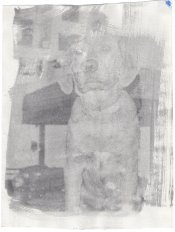
I've made a first real image; it looks very weak and it has low contrast but I am SO happy it worked. The process wasn't that difficult, and as it was mentioned I let it ripe for 30 minutes; I thought I would start at 30min and increase the next ripening time in order to compare the differences. The biggest problem for me is to keep the temperature stable. However, I've had a lot of fun with it. Bear in mind that it is only 1 thin layer of emulsion so I believe I will reach better results with thicker coating.

Thank you all! img007.jpg

m.
 
Congratulations! Can't be sure, of course, but looking at your image, I'd say that a thicker coating might be all you need.

re temperature: If you start out with a couple of nested bowls, with the outer one about 5 degrees C warmer than the inner (waterbath) one you have your emulsion in, the waterbath temp will probably hold for the time you require. Make any adjustments to the outer bowl and your emulsion temperature will hold as steady and reliable as if you had an expensive electric water jacket,

Cute dog!
 
Photrio.com contains affiliate links to products. We may receive a commission for purchases made through these links.
To read our full affiliate disclosure statement please click Here.

PHOTRIO PARTNERS EQUALLY FUNDING OUR COMMUNITY:


Ilford ADOX Freestyle Photographic Stearman Press Weldon Color Lab Blue Moon Camera & Machine
Top Bottom