• Welcome to Photrio!
    Registration is fast and free. Join today to unlock search, see fewer ads, and access all forum features.
    Click here to sign up

Print grade vs quality

Rainy Day Trees

A
Rainy Day Trees

  • 6
  • 1
  • 88
One Way

A
One Way

  • 3
  • 1
  • 87

Forum statistics

Threads
203,156
Messages
2,850,709
Members
101,704
Latest member
yppnq
Recent bookmarks
0
According to you I'm wrong and that's okay.

If it works for you you're doing great. I'm not suggesting that you should change.

The idea this thread is built around simply suggests that there is more than one way to skin a cat. i.e. you could standardize on any grade & make of paper and then refine in a way that gets you what you want.

As Drew and Michael suggest though papers have differences, one makers grade may not match another's exactly, the response to color may differ.

The theory works in general but there are caveats.
 
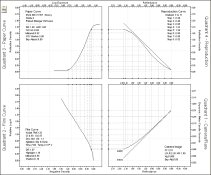
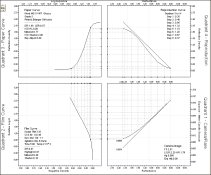
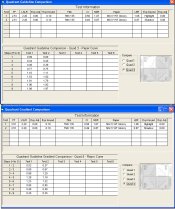
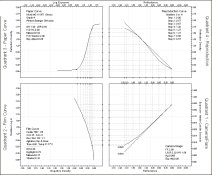
I've done a quick comparison between a negative with a CI of 0.58 matching the paper LER and a negative with a CI of 0.49 and matched to the paper LER. This only illustrates how the values will fall and does not address aesthetics. There are two tone reproduction diagrams showing the tests and two tables showing the resulting print densities in Quad 3 and the resulting gradients in the tone reproduction curve in Quad 4. In the tables, Test 1 is the Normal CI 0.58 test and Test 2 is the reduced CI and higher grade test. Comparing the gradients in the second table as seen in Quadrant 4 will illustrate the changes in local contrast between the two tests. It appears that test two has increased contrast in the midtones at the expense of contrast in the highlights.

Normal CI and LER.jpg

Lower CI, Higher Grade copy.jpg

CI Grade Comparison Numbers.jpg
 
Last edited by a moderator:
Interesting Stephen, thanks!
 
My personal experience bears out what Stephen's tests show. I often designate a negative for less development and printing on a higher grade paper to expand local and mid-tone contrast.

Now that we have more than opinion on the subject (thanks to Stephen taking the time for us all), it seems to me that the argument has been put to rest.

Doremus
 
With roll film it's easier to expose and develop for a particular lighting condition. In the real world this is often difficult, but it's almost impossible to get an easily printable negative from flat, misty conditions and high contrast late afternoon sun on the same film. Some of the most pleasing prints I ever made were on Grade 0 Agfa Portriga paper. The rest of the film would have printed completely flat at that grade, but the best images were of people on a sea wall and the brilliance of the light would have been ruined by any more contrast, and the warm tone filled in the whites perfectly.

As a rule I aim to develop for Grade 2, but Grade 3 is close enough.
 
My personal experience bears out what Stephen's tests show. I often designate a negative for less development and printing on a higher grade paper to expand local and mid-tone contrast.

And Old-N-Feeble's I believe.
 
Interesting approaches to this issue. I learned to develop and print for graded papers, and tried to expose and develop so most images could be printed on G2 in 8"x10" and G3 in 11"x14" or even slightly bigger. That approach gave me the latitude to play with developer, papers and toning for the optimum contrast in the print What changed over the years were my criteria for selecting the paper. Rather than just looking to accomodate most of the negative's scale on the paper, I test to find which paper can make wet rocks look like wet rocks, can make fog look like it should and give the overall mood if the moment. It is getting tougher with a shrinking pallette of papers, but is still an interesting excercise to produce tonally matching prints on different papers, to realize there is usually one that will produce the best copy of a given image.
 
Now that we have more than opinion on the subject (thanks to Stephen taking the time for us all), it seems to me that the argument has been put to rest.

Doremus

Sounds more like a starting point to me.

Say you have two negatives of the exact same scene. Negative 'A' prints precisely one grade harder than negative 'B'. You print negative 'A' at grade 1 and print 'B' at grade 2 to achieve equal contrast on the prints. Will one print be superior or have a better tonal distribution? Are they truly equal prints?

It is obvious, at least for me, that the theory works in general. Overall contrast was matched.

Are they equal?

Both scenarios can produce good work, history and testing have proved that.

It seems obvious for me that they are not going to be exactly the same, perfect duplicates. Do they have to be, to be equally enjoyable?

It could be said that "improvements" can be made in certain areas at the expense of others by choosing one scenario over the other. I'm not suggesting any ranking about which difference constitutes an improvement and which does not because that would depend on the photographer's expectation. That would also be dependent on the film curves and papers that are chosen, we've only seen charts on one combo. The general idea seems well proven, the specifics of say FP4 printed on Adorama's paper are unknown.

Fun stuff to think about.
 
Sounds more like a starting point to me.


It is obvious, at least for me, that the theory works in general. Overall contrast was matched.

Are they equal?

Both scenarios can produce good work, history and testing have proved that.

It seems obvious for me that they are not going to be exactly the same, perfect duplicates. Do they have to be, to be equally enjoyable?

It could be said that "improvements" can be made in certain areas at the expense of others by choosing one scenario over the other. I'm not suggesting any ranking about which difference constitutes an improvement and which does not because that would depend on the photographer's expectation. That would also be dependent on the film curves and papers that are chosen, we've only seen charts on one combo. The general idea seems well proven, the specifics of say FP4 printed on Adorama's paper are unknown.

Fun stuff to think about.

I agree with all you wrote.
 
My personal experience bears out what Stephen's tests show. I often designate a negative for less development and printing on a higher grade paper to expand local and mid-tone contrast.

Doremus

Thanks Doremus for confirming that experience supports sensitometric study.

So a Grade 2 aim produces a more accurate reproduction curve... But...

At first glance it appears that compared to Grade 2, Grade 3 better matches the curve shown in "Preferred Tone Reproduction Curve, Average Pictorial Subject" in Todd-Zakia Fig. I-8

I suppose the trend continues towards improved separation in midtones at the expense of compression in highlights as negative development is further reduced and the paper grade required to match the negative is increased until you reach Grades 4 and 5.

Does Grade 3 make the best aim? Or is a Grade 4 aim even better?
 
Here's an example with the same materials. Film CI 0.35 for a NDR of 0.68, Paper LER 0.69. Looks like increased contrast into the upper part of the shadow area. For a print to look correct the reproduction curve needs to fall below the reference curve. The closer it is to the reference curve, the darker the tones appear compared to the original subject.

CI 35 copy.jpg
 
Thanks Stephen,

I was beginning to think, most of the curve is from Paper because film has more-or-less a straight line (unless you take advantage of the long toe of some films).
 
Sounds more like a starting point to me.

Well, only the question of "are the two scenarios exactly the same" is put to rest. The creative possibilities of using different curve shapes for different renderings within the same overall contrast are still wide open.

Given that the eye separates tonalities better in print highlights and that it is often desirable (from a purely graphic/compositional perspective) to suppress detail in the deepest shadows (I often end up burning shadows down...), expanding the mid-tones at the expense of highlight and shadow by purposely targeting to print on a grade 3 (or higher) paper often results in a more gratifying print.

I'm not very scientific about this when working, however. I normally just decide if I want to increase mid-tone/local contrast or not at the time of shooting and indicate the development accordingly. E.g. I'll give a "normal" scene N-1 development if I want more mid-tone separation or to emphasize texture more. However, if the higher values are the more important, I'll develop normally. That's about as precisely as I can visualize :smile:

Doremus
 
Well, only the question of "are the two scenarios exactly the same" is put to rest. The creative possibilities of using different curve shapes for different renderings within the same overall contrast are still wide open.

Given that the eye separates tonalities better in print highlights and that it is often desirable (from a purely graphic/compositional perspective) to suppress detail in the deepest shadows (I often end up burning shadows down...), expanding the mid-tones at the expense of highlight and shadow by purposely targeting to print on a grade 3 (or higher) paper often results in a more gratifying print.

I'm not very scientific about this when working, however. I normally just decide if I want to increase mid-tone/local contrast or not at the time of shooting and indicate the development accordingly. E.g. I'll give a "normal" scene N-1 development if I want more mid-tone separation or to emphasize texture more. However, if the higher values are the more important, I'll develop normally. That's about as precisely as I can visualize :smile:

Doremus

I do see the possibilities, that interplay is something that looks interesting to experiment with a bit and I do think that this idea can be a refining step in one's work.

I don't see the differences though as game changers, more akin the difference one might see in prints made from negatives developed in Xtol and those done in RolloPyro.
 
My 2 cents.

For my personal work I have never used Zone System or plotted curves to balance out my settings...

Basically I have worked with a simple lighting ratio to determine whether I process normal, or compress or expand, dependent on the original scene.

So my neg's usually printed well on a grade 2 paper or a grade 3. I remember liking the grade 3 paper and using a split development where a portion of the
development was in a softer developer.. I thought that this gave me a bit more flexibilty.

I think that any grade paper can give on excellent prints - I think of Joseph Sudek's work in three middle tones as being an example of breaking the rules
Or David Baileys high contrast prints.
Not sure but I would think that Jock Sturges prints are on a lower grade paper as well.

With the Advent of VC papers and split contrast printing, another set of possibilities are open to us.
 
My biggest problem with this whole line of thinking is that you need to develop the silver to a degree of completion in a given paper grade in order to produce its signature image color (with any specific given developer and toner regimen). Most premium papers had enough silver in them to allow a significant degree of flexibility; and I never found it necessary to keep anything other than Grade 3 on hand. But if I wanted significantly LESS contrast, pulling the print early, or using a softer developer, inevitably tends to give a warmer image color. Sometimes I used this fact creatively, and "snatch" developed certain prints. But if I wanted a cold print with overall softer contrast on the same paper, unsharp masking was called for to get full cold image tone, where that was desired. The published curves don't tell you any of this. They're just a starting point for general comparisons. Maybe this doesn't matter to everyone; but I'm a fanatic about image color and
toning characteristics. It can change the entire personality of a print.
 
I share Drew's concerns regarding print color and tonality though I would never pull a print before full development.

At any rate, I hated the VC contrast papers I tried because print color and selenium toning was affected by contrast grade. I always developed and selenium toned my negatives to print well on grade 3, so the only reason I tried VC was to change local contrast... in the shadows, sky or foliage, for example. Even though local contrast could be improved, the areas exposed at grade 2 filtration had very different color and microcontrast than those exposed through a grade 3 or 4 filter. It just looked weird to me. Those anomalies were exacerbated by selenium toning. I gave up VC and never looked back.
 
Sometimes split toning on VC papers can be a blessing; sometimes it is a curse. The first premium paper that was largely free of splits was Polygrade V, an excellent but now discontinued product. Multigrade IV was also consistent but lacking a tad of punch. Now you've got Ilford Cooltone and Classic, which can either be printed quite consistently or dramatically split if desired. VC papers have come a long way. I'm about as conversant in the Zone System as anyone and know all that "previsualization" dogma. But even with sheet film, where each shot can be developed to a specific level of contrast, it's only when one gets in a printing session that the image really materializes, and sometimes on ends up wanting something quite different than how they initially "previsualized" it. Then you've got the possibility of mistakes in exposure, or an odd shot in a roll of film which doesn't match the rest in terms of contrast, etc etc. Of course, none of us ever
makes a mistake, do we?
 
it's only when one gets in a printing session that the image really materializes, and sometimes on ends up wanting something quite different than how they initially "previsualized" it.

Over the years I've found that if I get bit enough times I start avoiding what bites. You described one of those things that I got tired of being bitten by. That is a distinct part of how and why I came to understand the concept this thread is based in.

Regularly, way back when learning the zone system, I'd use plus development for the film and then have to soften the paper grade, when I'd use minus then I'd normally have to harden up to print. I ended up "balancing" the visualizations I'd made back to "normal" so regularly that it was silly. That said, as long as I balanced one against the other it worked fine.
 
I don't get "bitten" by it. I dance with it. Sometimes I'll deliberately print and tone a negative several very different ways. Each will be good, but in a different manner. If I wanted rote predictability I'd own a xerox machine instead of a darkroom.
 
:smile:
 
If you use a harder grade to get the same overall contrast, all of the textures and structure get more concise. In extreme cases this can lead to metallic like surfaces of non metal things.
Highlights such as the sky need a softer grade. Mostly they burn out. If they are burned, they look harsh.
 
grade 3 :smile:
grade 3 :smile:
grade 3 :smile:
 
There ain't much of Grade Anything left anymore. I popped open a box of Ilfobrom Galeries last week. That's a product I hadn't used for over twenty years; but after a single one-inch wide test strip I bagged an exhibition quality print. Grade 3, "of course". What I didn't like about the paper long ago was the greenish overtones (like in AA's prints, who was addicted to it). But back then I mistakenly blamed the paper instead of the damn Dektol developer. This time I threw it in amidol are got wonderful black blacks. Last of the premium graded papers it seems. I sure hope it stays around.
 
After testing many brands and grades, Gallery grade 3 became the only paper I used. I also hated the olive hue but that paper selenium tones beautifully. You can tone it just a little for neutral hue, or a little more for a very slightly plum hue, or completely for a noticeably plum hue. I toned fully because I loved the ultra-deep blacks while retaining wonderful shadow detail. After testing many developers and dilutions, Ilford phenidone-based developer (Ilfo-something) became my only paper developer. However, the developer seldom made a significant difference in print appearance... at least not the ones I tried.
 
Photrio.com contains affiliate links to products. We may receive a commission for purchases made through these links.
To read our full affiliate disclosure statement please click Here.

PHOTRIO PARTNERS EQUALLY FUNDING OUR COMMUNITY:


Ilford ADOX Freestyle Photographic Stearman Press Weldon Color Lab Blue Moon Camera & Machine
Top Bottom