• Welcome to Photrio!
    Registration is fast and free. Join today to unlock search, see fewer ads, and access all forum features.
    Click here to sign up

Prewash Causing Grain?!

Do Not Come Here

A
Do Not Come Here

  • 5
  • 3
  • 49
Heavy

H
Heavy

  • 11
  • 5
  • 107

Recent Classifieds

Forum statistics

Threads
201,921
Messages
2,832,085
Members
101,018
Latest member
andycapp
Recent bookmarks
0

bvy

Member
Allowing Ads
Joined
Jul 22, 2009
Messages
3,285
Location
Pittsburgh
Format
Multi Format
Under what conditions would a prewash introduce grain? This is an experimental combination, but here's what's up.

I'm working with Arista Ortho Litho 2.0 film and Tetenal Centrabrom S, a soft working paper developer. I ordered this developer after seeing good results with this combination from a member here. My dilution is 1+14 (to compare, the recommended dilution for RC paper is 1+9). After an afternoon of experimenting, I noticed all of my results were coming out with heavy grain. One by one, I started eliminating things from my process -- preflash, safelight, etc., and eventually the camera. I cut a strip of the film in complete darkness and developed it instantly using my normal workflow which includes a prewash. (Why a prewash? I've used this film a lot with other developers and found that a prewash helped with more even development.) I expected it to develop clear, but it developed with the usual grain. I repeated the test, but this time I dipped only half the strip in the tray of prewash water. This time only the half that was prewashed produced the heavy grain. The dry half developed mostly (but not completely) clear -- i.e. the grain was still present but much fainter. Whatever's going on, the prewash seems to be intensifying it.

More info: The film is new, ordered from Freestyle in May. The developer is brand new -- arrived just this week. I mixed the working developer with distilled water. I'm developing in trays at room temperature, ~72F. My development times are in the two to four minute range (closer to two minutes for the strips tests I described above).

Any idea what could be going on here?
 
Last edited by a moderator:

jeffreyg

Subscriber
Allowing Ads
Joined
Jun 12, 2008
Messages
2,769
Location
florida
Format
Medium Format
I haven't used lith film for very many years so these are just a couple of thoughts. Was the prewash also distilled water? If there was a significant temperature difference is it grain or reticulation? Have you tried a film developer that would be recommended for that film?

http://www.jeffreyglasser.com/
 

gone

Member
Allowing Ads
Joined
Jun 14, 2009
Messages
5,504
Location
gone
Format
Medium Format
Simple enough to find out. Just try developing it w/o the pre wash and see what you get.
 
OP
OP
bvy

bvy

Member
Allowing Ads
Joined
Jul 22, 2009
Messages
3,285
Location
Pittsburgh
Format
Multi Format
Thanks for chiming in everyone. Just to follow up...
- All baths are at room temperature.
- The prewash is tap water. I'll try distilled water, but I've not had problems with our water before.
- I've developed this film in Ilford PQ, D-76 and Perceptol at different dilutions. I've only seen grain once before, but it was when I pushed the development time past fifteen minutes.
- The grain pattern is too uniform to be fogging.
- Overdevelopment? Maybe, but a two minute development time is on the short end of the spectrum for lith film in most other developers. Maybe I'll try rating it lower and pulling it after one minute. Still, I'm not sure why a prewash would have an effect on the grain at all.

I should clarify that I do still get some grain without the prewash. I think mentioning it is important only insofar as it might help explain what's going on. I'll try to run some more tests tonight and post some examples...
 

Xmas

Member
Allowing Ads
Joined
Sep 4, 2006
Messages
6,398
Location
UK
Format
35mm RF
Omit prewash unless you get uneven development.
 
OP
OP
bvy

bvy

Member
Allowing Ads
Joined
Jul 22, 2009
Messages
3,285
Location
Pittsburgh
Format
Multi Format
I spent the past two hours playing around with this some more, and feel like I made some progress. Today's lesson learned is, with this developer at this dilution, one minute development time MAX! I added back a short preflash and am now rating the film at 3. And the results (still drying) look very promising. More soon...
 

Photo Engineer

Subscriber
Allowing Ads
Joined
Apr 19, 2005
Messages
29,018
Location
Rochester, NY
Format
Multi Format
That development time is so short for a "sheet film" that uniformity may be a problem. A prewet would almost be mandatory in this case.

PE
 

pdeeh

Member
Allowing Ads
Joined
Jun 8, 2012
Messages
4,770
Location
UK
Format
Multi Format
hmm I've been playing with this film recently, and I can't get grain out of it however badly I shoot or process it :smile:
 

MartinP

Member
Allowing Ads
Joined
Jun 23, 2007
Messages
1,569
Location
Netherlands
Format
Medium Format
Is your tap-water alkaline? What is the pH of your developer compared with the pH of the recommended 'pictorial' developer? Anything at all being visible on unexposed-then-developed lith film is a definite problem (but like you, no one is sure which problem...). Oh, just the obvious one - you are developing in darkness or a very dark red safelight I assume?
 
OP
OP
bvy

bvy

Member
Allowing Ads
Joined
Jul 22, 2009
Messages
3,285
Location
Pittsburgh
Format
Multi Format
I reran my tests and have some results to share. Perhaps I was attributing too much to the prewash, but a similar test done previously showed more profound differences than what appears here. Now the concern (or curiosity) is that grain appears on unexposed then developed film using Centrabrom S.

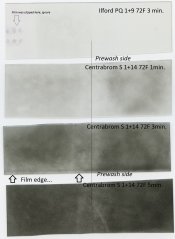
For this test I cut a sheet of 4x5 Ortho Litho film into four strips and presoaked half of each strip in distilled water. Then I developed three strips in Centrabrom S for different times and the fourth strip in Ilford PQ. The strip developed in PQ was clear; the strips developed in Centrabrom showed pronounced grain with increased time in the developer. All of this was done in complete darkness. Film and developer are new. The prewashed side is on the right.

lithocentrabromtest.jpg

So why bother with this developer at all? What I'm finding is that if I preflash and slightly overexpose the film, and pull it at exactly one minute, I do get a workable continuous tone negative -- i.e. better results than I've achieved with the other developers I've tried. As evidence, I present this very unflattering portrait of my wife. This was shot in a Crown Graphic in overcast light. I preflashed the film and rated it around 3. I then made a split grade contact print (no dodging or burning), and that's what appears here.

img666.jpg

I should mention that I looked at the negative under a loupe, and the grain does appear in the deepest shadows and unexposed edges, consistent with what's shown above. But it doesn't seem to show up in my contact print. Enlarging might be a different story.
 
Last edited by a moderator:

cliveh

Subscriber
Allowing Ads
Joined
Oct 9, 2010
Messages
7,804
Format
35mm RF

removed account4

Subscriber
Allowing Ads
Joined
Jun 21, 2003
Messages
29,832
Format
Hybrid
hi bvy

depending on the emulsion ...
extreme temperature variations between the various fluids
have a chance of creating something like grain.
it is being spoken about in a different thread ...

(there was a url link here which no longer exists)
 
OP
OP
bvy

bvy

Member
Allowing Ads
Joined
Jul 22, 2009
Messages
3,285
Location
Pittsburgh
Format
Multi Format
Thanks John. All my baths are at 72F +/- 2F.

I still don't understand why unexposed film would show excessive grain when processed with this developer.
 

Rudeofus

Member
Joined
Aug 13, 2009
Messages
5,119
Location
EU
Format
Medium Format
bvy, I have the strong impression that you are not fighting with grain, but with fog. If you have density in an unexposed area, you should fight the density, not reduce its granularity. As you know, film contains all kinds of compounds that keep the emulsion stable, and one or more of them may provide additional restraining action, which you wash out in your prewash.

My recommendation is you either use a different developer, or add some Potassium Bromide or Benzotriazole to your Centabrom S.
 

NB23

Member
Allowing Ads
Joined
Jul 26, 2009
Messages
4,307
Format
35mm
Grain is not a function of agitation. This is why all the people advocating for stand development or minimal agitation in order to minimize grain are seriously wrong (and funny).

A pre-wash might play a role. But the pre-wash would have to be as long as 30 minutes.

No. The factor that would play the biggest role would be temperature alone. And yes, the more the film is wet, the bigger the grain (this is why stand development actually shows grain more then with normal development).
 

cliveh

Subscriber
Allowing Ads
Joined
Oct 9, 2010
Messages
7,804
Format
35mm RF
Grain is not a function of agitation. This is why all the people advocating for stand development or minimal agitation in order to minimize grain are seriously wrong (and funny).

A pre-wash might play a role. But the pre-wash would have to be as long as 30 minutes.

No. The factor that would play the biggest role would be temperature alone. And yes, the more the film is wet, the bigger the grain (this is why stand development actually shows grain more then with normal development).

I would suggest over agitation during development, thus providing fresh developer at the grain sites could effect grain size. With regards to a pre-wash, temperature will swell the emulsion not the grain.
 

Photo Engineer

Subscriber
Allowing Ads
Joined
Apr 19, 2005
Messages
29,018
Location
Rochester, NY
Format
Multi Format
Grain can be a function of agitation! Uncontrolled temperature can play a role, but only one role of many. And the length of time film is wet has little to do with grain.

PE
 

Photo Engineer

Subscriber
Allowing Ads
Joined
Apr 19, 2005
Messages
29,018
Location
Rochester, NY
Format
Multi Format
As a very simple example, as edge effects increase due to agitation, the grain can "appear" to become greater due to greater sharpness. This is an extreme example but there are many many others that I have run into. Think on this as a logic problem and you might see some of the ramifications.

PE
 

Photo Engineer

Subscriber
Allowing Ads
Joined
Apr 19, 2005
Messages
29,018
Location
Rochester, NY
Format
Multi Format
With changes in agitation, the morphology of the developing silver may change. I believe there are examples in the literature. You might check Haist for this.

PE
 

NB23

Member
Allowing Ads
Joined
Jul 26, 2009
Messages
4,307
Format
35mm
"Appearance of grain" can have something to do with sharpness of grain, which is more a function of developer and dilution, and probably agitation, but we are talking about sharpness of grain, not about its size.
And if we bring it to the most comon denominator, stand development does produce grain, but it's unsharp. Unsharp grain can give the "appearance" of being smaller, but in my focusing loupe that grain is no smaller then from another negative that I have agitated well. It's as big, and mushy. Certainly not smaller.
 
Photrio.com contains affiliate links to products. We may receive a commission for purchases made through these links.
To read our full affiliate disclosure statement please click Here.

PHOTRIO PARTNERS EQUALLY FUNDING OUR COMMUNITY:


Ilford ADOX Freestyle Photographic Stearman Press Weldon Color Lab Blue Moon Camera & Machine
Top Bottom