
-
Welcome to Photrio!Registration is fast and free. Join today to unlock search, see fewer ads, and access all forum features.Click here to sign up
You are using an out of date browser. It may not display this or other websites correctly.
You should upgrade or use an alternative browser.
You should upgrade or use an alternative browser.
Post flashing
-
A
- Thread starter cliveh
- Start date
Recent Classifieds
-
Want to Buy View Camera Shutter
- Started by Beevo
-
For Sale Sam Abell - The Photographic Life
- Started by Rayt
-
For Sale Expired Film: Kodak, Agfa, Ilford and Fuji 4x5/5x7
- Started by Jammoh
-
For Sale Harrison Pub film changing tent, Harrison Dark Cloth Large
- Started by Jammoh
-
For Sale Sinar Copal Shutter
- Started by Jammoh
Forum statistics
mike c
Subscriber
Would not not think there would be much difference either way. With prints post flashing works better for me for the simple reason that the neg has to be removed from the enlarger. I use the enlarger for the flashing light source . Do not think it would make a difference with negs ether.
Mike
Mike

I don't really know if there's a difference in the result, but the idea is to raise the print's exposure threshold so that selected areas register immediately when there is an overall exposure. It just seems logical to me to do that first.

I thought post flashing was face saving vernacular for the unplanned result of accidentally turning on the lights before the print has been fixed, almost always in the presence of students. 
- removed account8
- Deleted
OP
OP

- Joined
- Oct 9, 2010
- Messages
- 7,884
- Format
- 35mm RF
Are you referring to film exposure or when printing?
Printing.
- removed account8
- Deleted

- Joined
- Jul 29, 2009
- Messages
- 93
- Format
- Large Format
Good explanation of advantage of post flashing and technical advise how to do it given in the Ghislain Lootens book " Lootens on Photographic Enlarging and Print Quality"

- Joined
- Feb 9, 2010
- Messages
- 9,555
- Format
- 4x5 Format
Good explanation of advantage of post flashing and technical advise how to do it given in the Ghislain Lootens book " Lootens on Photographic Enlarging and Print Quality"
Where Lootens used the term Flashing, he meant something quite different. He isn't talking about raising the exposure to a threshold to hold a delicate highlight. He wrote about a pictorial effect which he used to darken corners dramatically. He does mention all four times when you can flash paper; before, during or after enlarger exposure and also after print is in the developer - he cautions you about the risk of Solarizing (Sabbatier effect). He recommends flashing after enlarger exposure but doesn't explain.
If I had to guess his reason to recommend flashing after exposing in the enlarger... I imagine you can have a clear short-term memory mental image of "where" the exposure has already happened, so a better chance of flashing the correct corners.
I don't use flashing as a general rule. So, without experience, I can't add knowledge of whether "before, during or after" makes any difference. I am certain there is a sensitometrically-measurable difference. But I am guessing there is little difference visible on the print, and that the distinction exists to explain the way of working.
- removed account8
- Deleted
- Joined
- Feb 9, 2010
- Messages
- 9,555
- Format
- 4x5 Format
I was trying to find that safelight test illustration because, yes, it clearly shows the degradation that an unsafe "safelight" can cause.
So I went to Google... and it led me back to myself on APUG... "The Kodak test was a still-life Siamese cat sculpture with polished silver pots".
Now WHERE did I see those cats?
So I went to Google... and it led me back to myself on APUG... "The Kodak test was a still-life Siamese cat sculpture with polished silver pots".
Now WHERE did I see those cats?
- Joined
- Feb 9, 2010
- Messages
- 9,555
- Format
- 4x5 Format
Found 'em. Kodak Filters for Scientific and Technical Uses, Kodak Publication No. B-3 - Page 51.
Doesn't show whether exposure before or after makes a difference. But the side which had "prolonged" exposure to safelight (the proper safelight filter with the proper bulb at the proper distance... but for too long)... was clearly degraded.
Doesn't show whether exposure before or after makes a difference. But the side which had "prolonged" exposure to safelight (the proper safelight filter with the proper bulb at the proper distance... but for too long)... was clearly degraded.

Funny this topic coming up now. I use pre-flashing for my paper negatives to help control contrast a little and increase speed. I learned about it by reading Joe VanCleave's notes over at f295.org but I know he's posted his method here at APUG as well.
Like here:
(there was a url link here which no longer exists)
I make a test strip for each paper type, and pick the exposure that is 1 second shorter than the faintest visible tone in good light after dry-down. Joe uses graded paper but I use VC paper and only preflash through a green filter, so I'm differentially pre-flashing the low contrast emulsion.
The reason this post was timely is that recently I've made a number of paper negatives using post flashing instead. This was due to being in a hurry or wanting to reload a one-shot camera while a paper was developing and not wanting to turn on my enlarger during that time. Using exactly the same enlarger height/aperture and filters, for exactly the same amount of time that I use for pre-flashing, I am unable to see any difference. So in my context, post-flashing can be more convenient... pull the paper out of the camera, stick it under the enlarger for 17 seconds ( or whatever for the paper type ) start my pre-soak and load the camera with a fresh sheet of paper. I'm almost sure I remember Joe saying that post-flashing was almost the same as pre-flashing, but not exactly the same. But in practical terms, my experience says I can use them interchangeably. Whatever the difference is, it's too small to matter for my mostly pinhole photos. I also use paper in lensed cameras, and have post-flashed a few of those in the past few months too, with equally acceptable results.
I have never used pre or post-flashing during printing, so I can't comment on that at all.
Like here:
(there was a url link here which no longer exists)
I make a test strip for each paper type, and pick the exposure that is 1 second shorter than the faintest visible tone in good light after dry-down. Joe uses graded paper but I use VC paper and only preflash through a green filter, so I'm differentially pre-flashing the low contrast emulsion.
The reason this post was timely is that recently I've made a number of paper negatives using post flashing instead. This was due to being in a hurry or wanting to reload a one-shot camera while a paper was developing and not wanting to turn on my enlarger during that time. Using exactly the same enlarger height/aperture and filters, for exactly the same amount of time that I use for pre-flashing, I am unable to see any difference. So in my context, post-flashing can be more convenient... pull the paper out of the camera, stick it under the enlarger for 17 seconds ( or whatever for the paper type ) start my pre-soak and load the camera with a fresh sheet of paper. I'm almost sure I remember Joe saying that post-flashing was almost the same as pre-flashing, but not exactly the same. But in practical terms, my experience says I can use them interchangeably. Whatever the difference is, it's too small to matter for my mostly pinhole photos. I also use paper in lensed cameras, and have post-flashed a few of those in the past few months too, with equally acceptable results.
I have never used pre or post-flashing during printing, so I can't comment on that at all.
- removed account8
- Deleted
- Joined
- Feb 9, 2010
- Messages
- 9,555
- Format
- 4x5 Format
Ah, you mean this Article?
(there was a url link here which no longer exists)
You are right, it illustrates the difference between pre- and post- flashing. In the diagrams shown, Pre-flashing appears to affect the entire scale, while Post-flashing appears to affect the toe (highlights). The diagram is not an actual photograph, as it is in Publication B-3, but the kitties and kitchenware photo doesn't show pre-flashing.
(there was a url link here which no longer exists)
You are right, it illustrates the difference between pre- and post- flashing. In the diagrams shown, Pre-flashing appears to affect the entire scale, while Post-flashing appears to affect the toe (highlights). The diagram is not an actual photograph, as it is in Publication B-3, but the kitties and kitchenware photo doesn't show pre-flashing.
pentaxuser
Member
Les McLean, formerly of this parish, describes both pre and post flashing with illustrations in articles on his website and in his book Creative Black and White Photography - worth purchasing if you don't have a copy.
pentaxuser
pentaxuser
OP
OP
- Joined
- Oct 9, 2010
- Messages
- 7,884
- Format
- 35mm RF
I may have got this wrong, but surely pre-flashing softens the paper contrast and raises the inertia of exposure level. However, is not post flashing a form of uniform fog of the paper already exposed to the negative? As at this point the exposure has gone beyond threshold.
I may have got this wrong, but surely pre-flashing softens the paper contrast and raises the inertia of exposure level. However, is not post flashing a form of uniform fog of the paper already exposed to the negative? As at this point the exposure has gone beyond threshold.
Clive, with my paper negatives, I'm exposing them as if they had been pre-flashed. So the total exposure to all light is the same either way. I don't think this is analogous to post-flashing while making an enlarged print, unless the print is intentionally underexposed before flashing...
I'm curious about this too... I'll check out Les McLean's site.

I haven't tried post-flashing, but pre-flashing makes a HUGE difference when pushing the crap out of films.
My example is with colour film, Superia 800 exposed at 12800.
FTR, my pre-flash method was double exposure, I held a tissue over the lens and metered through that with camera meter, and determined the pre-flash amount. It was with a Canon AE-1, I used that 'trick' of winding tight the left hand spool and holding it, while pressing the rewind button then gently advancing the frame advance lever.
C-41 @ 6 minutes.
12800 no pre-flash
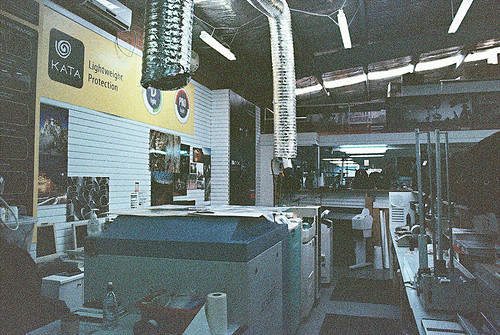
Superia 800 @ 12800 no preflash by athiril, on Flickr
12800 with 'zone 3' pre-flash (Zones 1 and 2 did nothing essentially, all of a sudden at this point density suddenly jumped up, contrast improved, shadow detail increased).
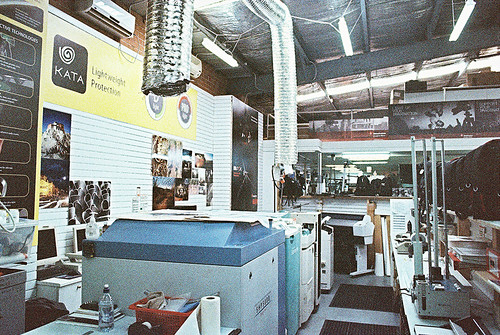
Superia 800 @ 12800 Zone 3 preflash by athiril, on Flickr
My example is with colour film, Superia 800 exposed at 12800.
FTR, my pre-flash method was double exposure, I held a tissue over the lens and metered through that with camera meter, and determined the pre-flash amount. It was with a Canon AE-1, I used that 'trick' of winding tight the left hand spool and holding it, while pressing the rewind button then gently advancing the frame advance lever.
C-41 @ 6 minutes.
12800 no pre-flash
Superia 800 @ 12800 no preflash by athiril, on Flickr
12800 with 'zone 3' pre-flash (Zones 1 and 2 did nothing essentially, all of a sudden at this point density suddenly jumped up, contrast improved, shadow detail increased).
Superia 800 @ 12800 Zone 3 preflash by athiril, on Flickr
Last edited by a moderator:
- removed account8
- Deleted
- Joined
- Aug 22, 2006
- Messages
- 1,532
- Format
- Multi Format
Since the end result is the same as a pre-flash, and the pre-flash procedure is easier/more intuitive, I can't really envision a situation wherein one would post-flash...
Hi, I'm just the opposite - I think post-flash is more intuitive. The way I do it is to first make a print (actually, test strips). When I get to where I'm happy, except for lacking a bit of highlight detail, I'll often try flashing. Typically I'll make another test strip, doing several flash exposure on it. I use a piece of cardboard over the print, same as I would for a print-exposure test, moving it in steps. So one test print might also get flashing tests of 1, 2, and 4 seconds. If the highlights are doing what I want, I can select a flash exposure or test further.
- removed account8
- Deleted

Actually I'm working on an article to show completely (including data) what flashing does (using MGIV), the differences between pre/post, and the effects of flashing at different grades. If there is interest on APUG I will post the article.
It'd be great to see this article here.
- Joined
- Feb 9, 2010
- Messages
- 9,555
- Format
- 4x5 Format
It'd be great to see the article.
I hope you answer my burning questions: Is pre- vs post- just a way to distinguish the sub-threshold exposure from deliberate graying exposure? Does it matter if the total flash exposure occurs at any combination of before, during or after enlarger exposure? My gut tells me it doesn't matter and conventionally we do this because it is easier to figure out what amount of flash is desired by keeping the purposes separated in our heads.
I hope you answer my burning questions: Is pre- vs post- just a way to distinguish the sub-threshold exposure from deliberate graying exposure? Does it matter if the total flash exposure occurs at any combination of before, during or after enlarger exposure? My gut tells me it doesn't matter and conventionally we do this because it is easier to figure out what amount of flash is desired by keeping the purposes separated in our heads.
- removed account8
- Deleted
OP
OP
- Joined
- Oct 9, 2010
- Messages
- 7,884
- Format
- 35mm RF
I have similar questions, Bill. Still working on these tests and it will be a few weeks yet. Lots of data to go through. I've used localized and/or masked pre-flashing fairly often with extremely high contrast subjects, and always did it the way I was taught and the way it made most sense to me, but I've always wanted to do a rigorous "study" on it to hopefully answer some of the nagging questions I've had. Pre vs post is one of them, but the one I've had the most trouble getting my head around abstractly is what effect there might be (if any) if the flash exposure on VC paper is done with different filters. The conventional approach is to simply flash with white light, but I wanted to investigate this further. Another one of those rat holes I guess. The procedure works fine for me as-is, but who knows, maybe there are additional controls, or maybe a myth or two can be busted. There is little written about it, and no real evidence for any assertions. The exception is Henry's book - but that was with graded papers. So I kind of see this experiment as a continuation of his work but with VC papers.
Michael, with all due respect the tests you are trying to do including filter values, exploit so many variables that they become almost meaningless. From a physics point of view I find it difficult to believe that a pre-flash has the same effect as post flash. After exposure the latent image is at a variation of energy states across the entire shadow to highlight range. How can a post flash possibly give the same values as a pre-flash where the exposure value is zero and even before exposure to the variance of the image in question?

The way I see it, Clive, is that if the amount of exposure thru the negative is x and the amount of flash is y, then x+y and y+x should yield the same amount of exposure. I do not think the silver cares when it is actually exposed first -- thru the neg or flashed without the neg.
The idea of flashing is that the paper has a threshhold of z: the amount of exposure needed to get any tonal change beyond pure white. Flashing is used when x<z in the highlights where one wants some tone. In those areas you want x+y, or y+x, to be greater or equal to z.
In the shadows, the exposure is on the order of 200x or greater (compared to x in the highlights). So 200x+y is not significantly different than 200x.
Fun with x,y, and z!
The idea of flashing is that the paper has a threshhold of z: the amount of exposure needed to get any tonal change beyond pure white. Flashing is used when x<z in the highlights where one wants some tone. In those areas you want x+y, or y+x, to be greater or equal to z.
In the shadows, the exposure is on the order of 200x or greater (compared to x in the highlights). So 200x+y is not significantly different than 200x.
Fun with x,y, and z!
Last edited by a moderator:
OP
OP
- Joined
- Oct 9, 2010
- Messages
- 7,884
- Format
- 35mm RF
If I have one house brick next to another house brick and next to another house brick and I add 10 house bricks to each, they are all the same height (pre-flashing). However, if I put three house bricks one on top of one and 10 house bricks on top of the next and 30 house bricks one on top of the next and I then add 10 house bricks to each I have a variance of height (post flashing). Do you get my drift?
- removed account8
- Deleted
If I have one house brick next to another house brick and next to another house brick and I add 10 house bricks to each, they are all the same height (pre-flashing). However, if I put three house bricks one on top of one and 10 house bricks on top of the next and 30 house bricks one on top of the next and I then add 10 house bricks to each I have a variance of height (post flashing). Do you get my drift?
Isn't pre-flashing sort of like pre-visualisation?

In a flood zone, I'd rather put them on the bottom. If I wanted a rooftop viewing deck I'd put them on top.
Your second example sounds more like first burning, then flashing.

I have never heard of post flashing. Can someone tell me when this technique should be used and the advantages it gives?
Well, I can vouch for a definite disadvantage of post flashing, especially at 4pm on a friday afternoon, it can lead to getting arrested...
OP
OP
- Joined
- Oct 9, 2010
- Messages
- 7,884
- Format
- 35mm RF
Well the point of controlled tests by contacting calibrated wedges is to eliminate the variables, which enables one to answer questions like this.
Clive, in your analogy see the bricks as units of light. In your "pre-flash" example you are adding 10 units of light to all the tones in your final print before the image exposure. In your "post flash" example you are adding 10 units of light to all tones in your final print after the image exposure. The variance of height is due to the image exposure.
I understand this, but surely the energy response (if I may call it that) would be uniform from threshold onwards, but after exposure to the variance of densities within the negative, a subsequent exposure would not have such a uniform effect (related to reciprocity/intermittancy effect). If I start a car and start driving, I can accelerate faster when reaching higher speeds than when starting off.
- removed account8
- Deleted
- Joined
- Feb 9, 2010
- Messages
- 9,555
- Format
- 4x5 Format
It should have a uniform effect, at least in theory.
With minor deviations for intermittency effects and latent image keeping properties, possibly reciprocity law failure depending on intensity/duration of flash. All things that would need to be studied to determine their impact. But I think (I would estimate or predict) these effects are minor.
Consider "preflashing" to overcome "inertia", and "postflashing" the overall gray that you decide you want, whether to establish mood or serve some other pictorial purpose. "Preflashing" is invisible and "postflashing" is gray over the entire image.
In your example, cliveh, the story would be: Consider one brick "preflashing", and 10 bricks the "postflashing". The other bricks are the image.
I believe the result (with the exception of certain effects which we might find are not important to us) is the same whether:
You set out one house brick next to another, next to another, add two to one stack, ten to the next and 30 on the next... Then add 10 more bricks to each stack.
Compared to
Make three stacks of 11 house bricks then add two to one stack, ten on the next and 30 on the next.
Though the result is (or may be) the same, I would suggest teaching a working method that keeps pre- and post- flash exposures separated so you can explain their purposes and know how to adjust them independently.
- removed account8
- Deleted
| Photrio.com contains affiliate links to products. We may receive a commission for purchases made through these links. To read our full affiliate disclosure statement please click Here. |
PHOTRIO PARTNERS EQUALLY FUNDING OUR COMMUNITY:  |