


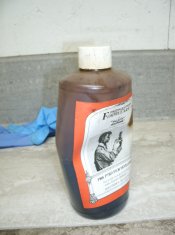
I've read many times how long PMK keeps in a bottle. This bottle is about 5 years old, it is quite dark, is it worth risking a film or should I toss it? Also, Part B seems to have a crystallised blob inside it which I suppose I could crush.

-
Welcome to Photrio!Registration is fast and free. Join today to unlock search, see fewer ads, and access all forum features.Click here to sign up
You are using an out of date browser. It may not display this or other websites correctly.
You should upgrade or use an alternative browser.
You should upgrade or use an alternative browser.
PMK exhaustion
-
A
- Thread starter markbau
- Start date
Recent Classifieds
-
For Sale FS: 35mm Rodenstock APO-Grandagon, Linhof select
- Started by dirkfletcher
-
For Sale Kodak Ektra 35mm Rangefinder Body - Working, Film Tested
- Started by Hunter_Compton
-
For Sale FS: 18mm Zeiss Finder
- Started by dirkfletcher
-
For Sale Nikon F4 and AF-D lenses
- Started by Oldwino
-
For Sale Jobo 3005 Expert Drum up to 8x10 Like new, boxed
- Started by MLG
Forum statistics

Rick A
Subscriber
Yeah, I have some that old that looks just as bad, but it still works the same as it used to. Just shake the whoopies outta part B before you use it.
Doremus Scudder
Member
In contrast to Rick A's advice, I'd toss the developer. Too bad it's so full, though.
However, the pyrogallol component of the developer is likely oxidized to the point of inactivity (hence the dark brown color). Even if the Metol in the developer is still active, it will not have the characteristics of PMK when fresh.
Best,
Doremus
However, the pyrogallol component of the developer is likely oxidized to the point of inactivity (hence the dark brown color). Even if the Metol in the developer is still active, it will not have the characteristics of PMK when fresh.
Best,
Doremus

Raghu Kuvempunagar
Member
I just developed a sheet of HP5 in it as a test. The neg seems fine but I wonder, as Doremus wonders, if it is the Metol doing all the work?
Very easy to figure out. Metol doesn't stain whereas Pyrogallol does. Do you see an imagewise greenish-brown stain in the sheet you developed?
It definitely had the usual PMK stain but probably not as strong as I've had. I used normal Ilford rapid fix which may account for the reduced stain. I had TF4 but couldn't be bothered mixing up a fresh batch for one test, anyhow, Hutchins says normal rapid fixers are fine as long as they don't have hardener. I may do a pictorial shot and use the TF4.Very easy to figure out. Metol doesn't stain whereas Pyrogallol does. Do you see an imagewise greenish-brown stain in the sheet you developed?
Rick A
Subscriber
Doremus, the proof is in the processing, my negatives are still coming out just the way they should using my very ugly PMK. I'll dump it when it stops working.In contrast to Rick A's advice, I'd toss the developer. Too bad it's so full, though.
However, the pyrogallol component of the developer is likely oxidized to the point of inactivity (hence the dark brown color). Even if the Metol in the developer is still active, it will not have the characteristics of PMK when fresh.
Best,
Doremus

Sirius Glass
Subscriber
It is faster to test it than wait for answers on the internet.
Doremus Scudder
Member
It definitely had the usual PMK stain but probably not as strong as I've had. I used normal Ilford rapid fix which may account for the reduced stain. ...
Using Rapid Fixer won't affect the PMK stain. If you're stain is "reduced," it's because the pyrogallol is less active.
@Rick A, I'll try a test with dark brown PMK vs freshly-mixed next time I have some go dark on me (may be a while). Still, I suspect that what turns the developer dark brown is oxidized pyrogallol and I can't see how that can be as good as fresh.
Best,
Doremus
I have to agree with Doremus. I printed the neg tonight. At grade 2, this combo, HP5 plus at EI 200 should have given me a snappy print, it gave me a dull lifeless print. I could monkey around by increasing contrast but the point is, it is under-developed which I can only put down to the pyro being oxidised. I'll mix up a fresh batch and replicate the scene and report back.
Sirius Glass
Subscriber
I have to agree with Doremus. I printed the neg tonight. At grade 2, this combo, HP5 plus at EI 200 should have given me a snappy print, it gave me a dull lifeless print. I could monkey around by increasing contrast but the point is, it is under-developed which I can only put down to the pyro being oxidised. I'll mix up a fresh batch and replicate the scene and report back.
I always mix pyro just before I use it.
Rick A
Subscriber
Are you mixing from powder chems or liquid?I always mix pyro just before I use it.
Sirius Glass
Subscriber
Are you mixing from powder chems or liquid?
Liquid
Doremus Scudder
Member
Liquid
The deal is, the PMK stock solution A will oxidize and turn brown after a time (for me, that's usually a year or longer). When that happens, I just toss the bit that's remaining. The OP had a pretty full bottle of the A solution that turned brown, too bad. Storing in full well-sealed glass bottles may help the longevity.
PMK needs to be mixed from the two stock solutions and used within 20 minutes or so.
Best,
Doremus
Rick A
Subscriber
well, we all mix the liquid just before use. If you mix them well in advance you will not get any development. I have the raw chems to make PMK, but I was waiting for my liquid version to go bad first. I also am experimenting with Jay DeFehr's Obsidion Aqua, I like it a lot.Liquid
Just to clear up my procedure. I had been using a bottle of PMK from the Formulary, working solution was mixed up just prior to development. I’ve never heard of anyone mixing up working strength and then storing it. I now have the raw ingredients to make PMK. The Formulary bottle has now been dumped.

Klaus_H
Subscriber
The deal is, the PMK stock solution A will oxidize and turn brown after a time (for me, that's usually a year or longer).
My chemicals are stored in laboratory glas bottles. 10 years ago I mixed up 5 liter PMK A (filled in 0.5 liter bottle) and 10 Liter PMK B (filled in 1 Liter Bottle). The Bottles had been protected by inert gas. Today I am using the last bottles of A and B. PMK A turned its color to intensive yellow. The developer still works like on its first day.
john_s
Subscriber
My chemicals are stored in laboratory glas bottles. 10 years ago I mixed up 5 liter PMK A (filled in 0.5 liter bottle) and 10 Liter PMK B (filled in 1 Liter Bottle). The Bottles had been protected by inert gas. Today I am using the last bottles of A and B. PMK A turned its color to intensive yellow. The developer still works like on its first day.
The colour is the built-in "indicator." Yellow=good, very dark brown=bad. It's all about storage.
Incidentally, Ian Grant wrote on the subject of long storage for Pyrocat-HD that some extra sodium (meta)bisulphite could be used to be on the safe side. That's what I do, but it's too early to day if it will make a difference.
Doremus Scudder
Member
My chemicals are stored in laboratory glas bottles. 10 years ago I mixed up 5 liter PMK A (filled in 0.5 liter bottle) and 10 Liter PMK B (filled in 1 Liter Bottle). The Bottles had been protected by inert gas. Today I am using the last bottles of A and B. PMK A turned its color to intensive yellow. The developer still works like on its first day.
Klaus,
I'll try glass bottles next time I mix a batch and see if I get more shelf life from my PMK A.
Thanks,
Doremus
Klaus,
I'll try glass bottles next time I mix a batch and see if I get more shelf life from my PMK A.
Thanks,
Doremus
FWIW, I had stock PMK from the Formulary--nearly full bottles, stored in the original plastic bottles as supplied by PF, both A and B bottles in double zip-lock bags, stored in the dark--that was just about 2 years old that didn't look right when I mixed a working solution yesterday morning. I tossed everything and mixed up a working solution of 510-Pyro to develop my film. The PMK might have been okay, but I just didn't trust it. Others seem to get way more storage life out of these pyro formulas than I do.
I'm with you. I'm sceptical, to say the least, about any claim that any developer can discolour and still be as good as it was when made up. Some chemical reaction must be taking place to change the colour. That said, I reuse Ansco 130 for several print sessions, it gets exposed to air for hours in the tray but never seems to change colour and seems to be as strong after 3 or more print sessions.FWIW, I had stock PMK from the Formulary--nearly full bottles, stored in the original plastic bottles as supplied by PF, both A and B bottles in double zip-lock bags, stored in the dark--that was just about 2 years old that didn't look right when I mixed a working solution yesterday morning. I tossed everything and mixed up a working solution of 510-Pyro to develop my film. The PMK might have been okay, but I just didn't trust it. Others seem to get way more storage life out of these pyro formulas than I do.
Rick A
Subscriber
Looking back at my records, this bottle is just over 6 years old. I'm going to test it tomorrow and see if it still works as it should. I think that the stain may be diminished or non existent, but it should develop an image. Last used about three months ago and it still worked decently, but upon reviewing the negatives the stain isn't quite as prominent as previous rolls.
Rick A
Subscriber
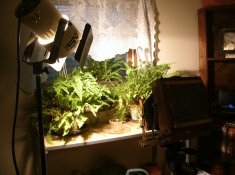
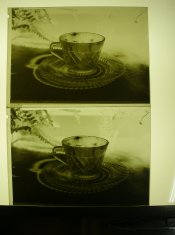
Here are the results of my test, 6 year old PMK vs fresh. Negative on top was processed with the 6 year old PMK, bottom negative with fresh. The only difference between them is one extra stop of exposure for the bottom negative. Both were processed using rotary 10 minutes at 70f, shot with identical setup, using EDU Ultra 200 film exposed at iso 100 with my 5x7 camera with a Kodak Aastigmat f 4.5/6 1/2" lens first shot was one second at f22, second shot two seconds at f 22. Minimal difference in stain, no difference in image development that my old eyes can detect.
Sirius Glass
Subscriber
Here are the results of my test, 6 year old PMK vs fresh. Negative on top was processed with the 6 year old PMK, bottom negative with fresh. The only difference between them is one extra stop of exposure for the bottom negative. Both were processed using rotary 10 minutes at 70f, shot with identical setup, using EDU Ultra 200 film exposed at iso 100 with my 5x7 camera with a Kodak Aastigmat f 4.5/6 1/2" lens first shot was one second at f22, second shot two seconds at f 22. Minimal difference in stain, no difference in image development that my old eyes can detect.
View attachment 299024 View attachment 299025
Which goes to show what Per Volquartz taught me: Pyro lasts damned near forever. Ignore the color it turns.
| Photrio.com contains affiliate links to products. We may receive a commission for purchases made through these links. To read our full affiliate disclosure statement please click Here. |
PHOTRIO PARTNERS EQUALLY FUNDING OUR COMMUNITY:  |