

• Welcome to Photrio!
    Registration is fast and free. Join today to unlock search, see fewer ads, and access all forum features.
    Click here to sign up

physically modified negative, how? why?

Grill

H
Grill

  • 4
  • 0
  • 94

Recent Classifieds

Forum statistics

Threads
202,793
Messages
2,845,643
Members
101,538
Latest member
Hazoret
Recent bookmarks
1
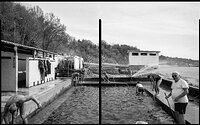
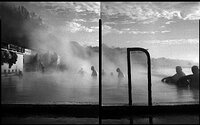
This was done on purpose. I have seen it before, but forget the details. The edge crimps are intended to hold the negative in place for work on the image itself. Note the 3rd photo. I'll bet the image is almost a relief image. I wish I could remember the details.

PE

Could it have been something to do with dealing with warped base materials, or a process that put the negative at risk of bending? Crimping patterns look like they could have been done as a mechanical stiffening. - Anything that deforms the centre would have to overcome the stress patterns on the edge.
 
it's a single negative. Any chance it was put into a slide (either cardboard or plastic) and then removed? It looks like two sides of a slide frame with the negative in the middle, then crimped together to hold the pieces together. Afterwards maybe it was pulled out of the slide?

that's possible I suppose, but it would seem like a lot of effort for a big negative. and I had also thought it might have been some weird mount for an obscure process/copy camera, but then such a process would run the risk of making the negative less flat wouldn't it? so would be a little counter-intuitive.

i mean can you believe some of these goofballs suggesting people process their film in coffee ?! what will they think of next ??

fair enough :D
 
I have seen a lot of press negs from the late 50's and 60's that exhibit this exact look,, me thinks bad processing washing methods.
 
it's a single negative. Any chance it was put into a slide (either cardboard or plastic) and then removed? It looks like two sides of a slide frame with the negative in the middle, then crimped together to hold the pieces together. Afterwards maybe it was pulled out of the slide?

I agree that it was probably in a card board or plastic slide mount.
 
it's not my film to cut up, but I'll ask the owner to see if he's willing.
having said that the south wales electricity board (who's shop is in the photo) didn't exist before 1948, so I doubt the photo is older than the 50s at it's youngest.

and for anyone interested, the notch code is: ----u-o--
I haven't been able to find it yet, but I don't have a resource other than the 'net

Just to spare your negative the snip, it's Ilford HP4, so definitely not Nitrate Cellulose. No need to set it on fire! The notch code matches old cut sheet film I have here. The enclosed data sheet is dated 1966 and the other box has 1970 on its data sheet.

As to the ripple effect, I found a piece of film left in an old 4x5 holder, unexposed, which exhibited that look, but I don't have it on hand to see if it is as extreme or uniform as your example. I'll try to find it tonight to compare.
 
I have seen a lot of press negs from the late 50's and 60's that exhibit this exact look,, me thinks bad processing washing methods.
yeah !! that too, wreck your negatives so they look like you were a press photographer !!
 
Way back in my college days, someone wanted to develop some film in our college magazine's darkroom, and I asked if she knew how to develop the film. She asserted that she did, so I allowed her to use the equipment.

Well, she didn't know what she was doing, and used the 28% acetic acid undiluted as the stop bath, and her negatives were similarly crinkled. She planned to iron them flat. True to life story, I couldn't make this up! It took weeks for the smell of acetic acid to go away in the darkroom. I never allowed her access again.

Maybe this was one of her negatives?
 
This is regular buckling or crimping. All of the things mentioned above lead to irregular crimping AFAIK. So, this entered into my comments. No, this was crimped in a device that gave regular crimps, again AFAIK. Then it was embossed lightly in a way to give it a sort of relief image.

PE
 
Just to spare your negative the snip, it's Ilford HP4, so definitely not Nitrate Cellulose. No need to set it on fire! The notch code matches old cut sheet film I have here. The enclosed data sheet is dated 1966 and the other box has 1970 on its data sheet.

great thanks!
and it would be interesting to see the negative that has a similar shape if you can find it
 
thanks everyone for your suggestions so far, but it would seem that we've come to 2 completely different conclusions.
so I guess it comes down to whether accidental damage, poor technique could cause such uniform damage, or discovering for what purpose embossing a negative in such a way would be needed.

I've asked the owner if he can get some more information about the photographer, but it's a bit of a long shot.
 
I saw a negative with this effect as a kid at my grandfather´s place. I am not sure if I remember correctly, but I think he told me that the neg was glued in a cardboard slide frame and that this is what happend when you remove the slide frame.

But that was more than 30 years back, and I have not seen one like this in a looooooooong while.
 
Typically transparencuies are not glued into a cardboard or glass frame, but just sandwiched inbetween with the edges of the mount seald. Nevertheless such mounting could have led to autocatalytic decay. BUT the edges of the sample of the OP are seemingly fine except for that warping.
 
To get such regular spacing and form, this edge deformation must have been purposeful. I doubt if it is a random effect.

PE
 
I think someone on Etsy used it to make a lamp or a table centrepiece:whistling:
 
As a young man, I was a projectionist. This looks like it has been in a high-intensity projector for some time. The "embossing" looks like what happens as the higher densities of silver get hotter and distort the base. Can't say that I'm familiar with a holder that has scalloped edges like that, but I'll bet a penny that this has baked in an enlarger or some kind of projector for too long.

-Martin
 
To get such regular spacing and form, this edge deformation must have been purposeful. I doubt if it is a random effect.

But still no one has offered a convincing theory for the reason of doing so.

So long I keep assuming a non intended effect. But admit I lack a conclusive theory for such too.
 
Look at post 40.
If this slide baked in an enlarger, why then would the effect be limited only to the edges? If it distorts the base, it would distort the entire base, wouldn't it? wouldn't there be noticeable sag/droop in the center of the negative? Would't the crimping radiate to the edge, rather than be localized only TO the edge? I don't have the experience of being a projectionist, but I'm not sure I'm convinced yet. To me, it looks like this negative was physically stamped with a tool- and the corrugated pattern would be ideal to physically lock it into some kind of frame? Quite the mystery. I don't have the answer whatsoever, but I'd love for this mystery to be solved.
 
It's a negative, so I couldn't see it being projected in a cinema. From my knowledge the cinema ads just used regular mounted positive slides and slide projectors.
 
It could be a registration system of some sort, but that's rather draconian if it is!

That hole punched up in the corner ... interesting.
 
If this slide baked in an enlarger, why then would the effect be limited only to the edges? If it distorts the base, it would distort the entire base, wouldn't it? wouldn't there be noticeable sag/droop in the center of the negative? Would't the crimping radiate to the edge, rather than be localized only TO the edge? I don't have the experience of being a projectionist, but I'm not sure I'm convinced yet. To me, it looks like this negative was physically stamped with a tool- and the corrugated pattern would be ideal to physically lock it into some kind of frame? Quite the mystery. I don't have the answer whatsoever, but I'd love for this mystery to be solved.

Read the posts please. There is nothing said about an enlarger.

This is a plausible thought only at this point, but look at the original post carefully. It appears to have some "modeling" in the sliver image itself. As if the image or support changed somehow in the sprockets and image areas.

PE
 
I think martinola and PE are onto something... This was probably held in a "negaflat" type carrier that holds the negative firmly... placed in a powerful enlarger... and accidentally left overnight with the enlarger on.
 
To me, it looks like this negative was physically stamped with a tool- and the corrugated pattern would be ideal to physically lock it into some kind of frame?

Why would one need edge warping to hold a piece if film?
I hinted at a feature of holding the film at distance, but what for, and such could be achieved more simple by a respective holder.
 
Photrio.com contains affiliate links to products. We may receive a commission for purchases made through these links.
To read our full affiliate disclosure statement please click Here.

PHOTRIO PARTNERS EQUALLY FUNDING OUR COMMUNITY:


Ilford ADOX Freestyle Photographic Stearman Press Weldon Color Lab Blue Moon Camera & Machine
Top Bottom
