
• Welcome to Photrio!
    Registration is fast and free. Join today to unlock search, see fewer ads, and access all forum features.
    Click here to sign up

PGK pyro

Coburg Street

A
Coburg Street

  • 0
  • 0
  • 12
Jesus

A
Jesus

  • 0
  • 0
  • 20

Recent Classifieds

Forum statistics

Threads
201,729
Messages
2,829,232
Members
100,916
Latest member
mikenickmann99
Recent bookmarks
1

gainer

Subscriber
Allowing Ads
Joined
Sep 20, 2002
Messages
3,699
In that one test I used 1:1:50. I have been using the metaborate B bath with Pyrocat MC, but I don't remember the ratios. I'm about to try again. It was far from the standard Pyrocat HD, more like the PC, but using Tylenol, C and TEA as in MC. Does that pH requirement of 10.9 apply to the working solution? I'll go back and do it with Pyrocat MC. This time I'll mix 1:100 and add 15 g/l of dry metaborate, just so I'll know for sure what I have in my tank.
 

sanking

Member
Allowing Ads
Joined
Mar 26, 2003
Messages
5,437
Location
Greenville,
Format
Large Format
In that one test I used 1:1:50. I have been using the metaborate B bath with Pyrocat MC, but I don't remember the ratios. I'm about to try again. It was far from the standard Pyrocat HD, more like the PC, but using Tylenol, C and TEA as in MC. Does that pH requirement of 10.9 apply to the working solution? I'll go back and do it with Pyrocat MC. This time I'll mix 1:100 and add 15 g/l of dry metaborate, just so I'll know for sure what I have in my tank.

The working pH of a 1:1:100 Pyrocat-HD is about 10.9. And at that pH it is pretty well buffered so that you can go from 1:1:25 to 1:1:400 without much of a change in pH.

With the metaborate as Stock B you will get a pH of around 9.2 with a 1:2:100 dilution. This is how I tested Pyrocat-HD with the metol and phenidone versions.

Sandy
 

gainer

Subscriber
Allowing Ads
Joined
Sep 20, 2002
Messages
3,699
.

In your tests where you mixed borate and hydroxide, I am wondering if was not the hydroxide doing all of the heavy lifting? I mean by that, pyrocatechin requires a pH of about 10.9 to be fully activated. Perhaps it does not matter what you use an an accelerator in terms of mix so long as you get the necessary pH. Perhaps it is possible to use more metaborate in the solution and get to a pH of 10.9, but would that have any advantage over the carbonate solution?

Sandy

It does for me as it means I don't need distilled water for the Pyrocat series. My well water is such good drinking water I don't want a softener. We use hard water detergent and bath soap. Any time I can use borates I do.

I think besides pH there is a matter of buffer capacity. I calculate from the CRC tables that 9.53 g of borax make 1 liter of "a" and 5.6 g KOH make 1 liter of "b", and 50 ml "a" + 23.3 ml "b" make 73.3 ml of a solution with pH close to 11 that we might be able to use as B for Pyrocat. This will be a pretty good buffer with agitation, but may not be so good locally. This may be what we want in many cases because it tends to make the developer weaker in areas of heavy exposure, where development products are more acidic.

The calculated weight ratio of sodium hydroxide to borax for pH 10.8 buffer is considerably greater than in sodium metaborate alone, 1.98 compared to 0.22 for metaborate. I had KOH on hand. so the weight ratio is even greater. I would say that for a given weight of borax, one should use 2 times the weight of sodium hydroxide or 2.8 times the weight of potassium hydroxide. I will try 10 g borax + 28 g of KOH per liter and let you know how that works.
 

Kirk Keyes

Member
Allowing Ads
Joined
Jun 17, 2004
Messages
3,234
Location
Portland, OR
Format
4x5 Format
In your tests where you mixed borate and hydroxide, I am wondering if was not the hydroxide doing all of the heavy lifting?

Well, technically, since pH is the driving force, only hydroxide can do anything.

Remember that pH related to the product of the concentration of hydrogen ions (hydronium actually) multiplied with the concentration of the hydroxide ion. The product of this multiplication of concentrations always equals 1 X 10E-14.

This reduces down to pH equalling the negative log of the concentration of the hydrogen ion. As we all probably know, this scale goes from 0 to 14.

However, the scale for pH can also be solved for the concentration of the hydroxide ion, and that scale is called the pOH scale. And it also ranges from 0 to 14, however, it is backwards from the pH scale, so that pOH = 14 - pH. If you know the concentration of the hydroxide ions in a solution, you can also know the pH of that solution.

So you can see, there is nothing here other than hydrogen ions or hydroxide ions to do the heavy lifting.
 

gainer

Subscriber
Allowing Ads
Joined
Sep 20, 2002
Messages
3,699
In your tests where you mixed borate and hydroxide, I am wondering if was not the hydroxide doing all of the heavy lifting? I mean by that, pyrocatechin requires a pH of about 10.9 to be fully activated. Perhaps it does not matter what you use an an accelerator in terms of mix so long as you get the necessary pH. Perhaps it is possible to use more metaborate in the solution and get to a pH of 10.9, but would that have any advantage over the carbonate solution?

Sandy

I'm sure you know that the balance of H and OH ions is responsible for pH. That's about all I know aout it. Maybe its good not to know too much. If I knew a little more I'd think I knew it all and wouldn't learn anything new. Every time I read a book or one of these APUG posts, I learn something about something, or am stimulated to go out and learn something.

So far, I know that an activator solution I concocted some time ago that contains no carbonate works quite well. I also know I forgot how I made it. I know it's concocted from sodium borate decahydrate (borax) and sodium or potassium hydroxide and, of course, water. I think I shall retreat to my dungeon until I find an answer. Actually, I am in my dungeon.
 

sanking

Member
Allowing Ads
Joined
Mar 26, 2003
Messages
5,437
Location
Greenville,
Format
Large Format
I'm sure you know that the balance of H and OH ions is responsible for pH. That's about all I know aout it. Maybe its good not to know too much. If I knew a little more I'd think I knew it all and wouldn't learn anything new. Every time I read a book or one of these APUG posts, I learn something about something, or am stimulated to go out and learn something.

So far, I know that an activator solution I concocted some time ago that contains no carbonate works quite well. I also know I forgot how I made it. I know it's concocted from sodium borate decahydrate (borax) and sodium or potassium hydroxide and, of course, water. I think I shall retreat to my dungeon until I find an answer. Actually, I am in my dungeon.

Yes, I understand that you mix the H and OH ions and get some kind of balance in pH between the two. I have done this with Red Devil Lye and Mule Team Borax to get the equivalent of sodium metaborate.

But with pyrocatechin + metol or/phenidone I think it still boils down to the basic working pH of the developer. At pH 9.2 it is very slow, at pH 10.9 it is fully active. Maybe at some intermediate pH it will be just as active. What impact ascorbic acid would have on this, I can not say.

Sandy
 

sanking

Member
Allowing Ads
Joined
Mar 26, 2003
Messages
5,437
Location
Greenville,
Format
Large Format
But with pyrocatechin + metol or/phenidone I think it still boils down to the basic working pH of the developer. At pH 9.2 it is very slow, at pH 10.9 it is fully active. Maybe at some intermediate pH it will be just as active. What impact ascorbic acid would have on this, I can not say.

Sandy

Actually, I know that at pH of 10.9 the addition of a small amount of ascorbic will increase the energy of a pyrocatechin + phenidone developer. Too much will kill the stain. However, this increase in synergism appears to be primarily between phenidone and ascorbic because there is no increase in synergism between pyrocatechin and ascorbic in the absence of metol or phenidone. In fact, it functions somewhat like a restrainer.

Sandy
 

gainer

Subscriber
Allowing Ads
Joined
Sep 20, 2002
Messages
3,699
Actually, I know that at pH of 10.9 the addition of a small amount of ascorbic will increase the energy of a pyrocatechin + phenidone developer. Too much will kill the stain. However, this increase in synergism appears to be primarily between phenidone and ascorbic because there is no increase in synergism between pyrocatechin and ascorbic in the absence of metol or phenidone. In fact, it functions somewhat like a restrainer.

Sandy

The actions of sulfite and ascorbate with Metol appear to be very similar in effect, according to The Theory of the Photographic Process. I think I posted that chart once. As we found, it takes very little to energise the Metol-catechol synergy. Catechol is like hydroquinone in many ways, as might be expected. Ascorbate is much like sulfite in many ways. I would not expect it to do any more than sulfite in a developer with either hydroquinone or catechol as sole agent. It is not much as a sole agent either.

I'm not sure the replacement of hydroquinone and sulfite by ascorbate demonstrates the synergism between Metol or Phenidone and ascorbate, or the superiority of regenerating by ascorbate over scavenging by sulfite.
 

gainer

Subscriber
Allowing Ads
Joined
Sep 20, 2002
Messages
3,699
Quick test on TEA as a B solution.
As the Haist theory predicts,using Pyrocat HD part A and metaborate part B 1:2:100 30 min 70 F produced an exceedingly faint image on APX 100.
But using Pyrocat HD part A 1 part, TEA 10 parts, water to 100 parts 30 min 70F agitate 10s/min produced good negatives.The 10% TEA solution has a pH slightly less than metaborate by my pH paper. Effects of TEA on grain and acutance are untested.

It occurs to me that DEA might be better for this use. The pH of a 1% DEA solution is higher than that of a 40% TEA solution. If you have not seen the charts, look in www.dow.com for ethanolamines. You can get a raft of charts that will be handy to have around.
 

gainer

Subscriber
Allowing Ads
Joined
Sep 20, 2002
Messages
3,699
I think I have found how I did it before. If I use the buffer proportions listed in the CRC handbook for pH 10.8 to make the Pyrocat B solution, the dilution is such (1:50 for the B, usually) that the working pH is below the desired 10.9. That B contains 10 grams of borax and 28 grams of KOH (or 40 grams of NaOH) in a liter. When I double those amounts, equivalent to using twice as much B, the activity of Pyrocat MC at 1:2:100 is just about right for HP5+ at 68 F for 10 minutes. The pH of the working solution measured at 11 with my newly acquired pH meter as well as my test strips.

So if you have been buying distilled or demineralized water because your well or city water has too much calcium hardness, you can use the nocarb B.
 

Alan Johnson

Subscriber
Allowing Ads
Joined
Nov 16, 2004
Messages
3,374
For PGK Pyro I have found,using 35mm APX 100, that it looks like both the problem of long developing time and the spot problem can be solved by using the TEA based A solution and the metaborate B solution 1:2:100.
I will make more tests with a different film to see if this still appears to be true.
 

gainer

Subscriber
Allowing Ads
Joined
Sep 20, 2002
Messages
3,699
For PGK Pyro I have found,using 35mm APX 100, that it looks like both the problem of long developing time and the spot problem can be solved by using the TEA based A solution and the metaborate B solution 1:2:100.
I will make more tests with a different film to see if this still appears to be true.

That's good because I just read up on DEA and remembered why I didn't make PC-DEA instead of PC-TEA. HC-110's use wasn't the only reason. Even if only small quantities are used at a time, having in in bulk in a DARK room might be dangrous. MEA is stronger yet, and quite dangerous in some circumstances.
 

Alan Johnson

Subscriber
Allowing Ads
Joined
Nov 16, 2004
Messages
3,374
I have tried this version with 35mm APX 100 and FP4+, of course two small films is just an early stage test,but the prints I made are OK.
PGK Pyro version 6
Part A
TEA 80ml
Glycin 2.5g
Pyrogallol 10g
Dissolves on heating to 150F with stirring.
TEA to 100ml
Part B
Distilled water 120 ml
Sodium metaborate 60g
Distilled water to 200 ml
Take 1 part A to 2 parts B to 100 parts water. pH just over 10.
Develop 20% longer than PMK:
http://www.unblinkingeye.com/Articles/Developers/Times_PMK/times_pmk.html
For Pyro hazard refer to The Film Developing Cookbook by Anchell & Troop.
Not possible IMO to make heating of TEA solutions entirely risk-free.

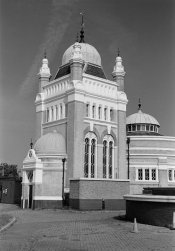
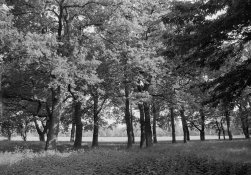
Here are two pics on FP4+, one with a red filter and one illustrating tonal range.
 

Attachments

  • PGK red filter 1 copy.jpg
    PGK red filter 1 copy.jpg
    267.7 KB · Views: 110
  • PGK tones 1 copy.jpg
    PGK tones 1 copy.jpg
    290.3 KB · Views: 129
Photrio.com contains affiliate links to products. We may receive a commission for purchases made through these links.
To read our full affiliate disclosure statement please click Here.

PHOTRIO PARTNERS EQUALLY FUNDING OUR COMMUNITY:


Ilford ADOX Freestyle Photographic Stearman Press Weldon Color Lab Blue Moon Camera & Machine
Top Bottom
