I used to be a sales engineer specialising in chemical laboratory equipment with a sub-speciality in thermometry.
There are several ways where a perfectly good liquid in glass thermometers can read wrong:
1. Using the wrong stem immersion depth. 75mm is a common value.
2. Reading a thermometer horizontal when it calibrated for vertical and vice versa.
3. Not allowing for emergent stem error where the thermometer bulb is at a different temperature to the stem.
4.The temperature indicated by a rising thread of liquid, mercury is the worst, is different from the same temperature indicated by a falling thread. Mercury in a capillary moves in little jumps. Precision mercury thermometers are fitted with a vibrator unit to defeat this characteristic.
5.The shape of the liquid meniscus in a thermometer capillary is different for rising and falling. A precision loupe sliding on the thermometer stem can reveal this and indicate if correction is needed.
6.Thermometers exposed to wide temperature swings, particularly high temperatures like 200c or even 300c, exhibit "glass aging" or annealing so regular re-calibration is needed.
Liquid in glass thermometers can be very precise. A Beckman Differential thermometer used for molecular weight determinations can read to 0.01 degrees and can be estimated to 0.001 degrees.
A good platinum resistance thermometer will get you to a millionth of a degree.





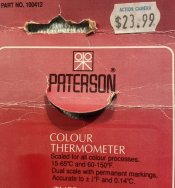
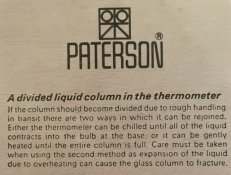


 ) one for non-photographic purposes, and I use that as a reference for the cheaper thermometers I actually use for photo stuff (several Patersons). They are all +/- a few 10ths of a degree C and that is plenty good for black and white photography. Color processing is more sensitive but I don’t know what level of accuracy is needed.